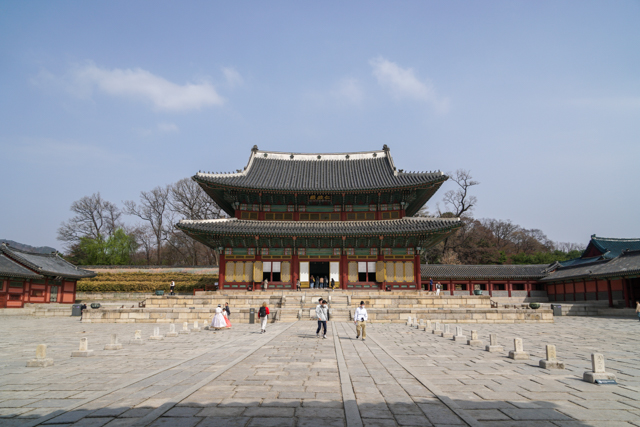
Our fourth day in South Korea saw us visiting Jongno-gu to see the Changdeok Palace, Bukchon Hanok Village, National Folk Museum and Gyeongbok Palace.
Jung-gu
Euljiro
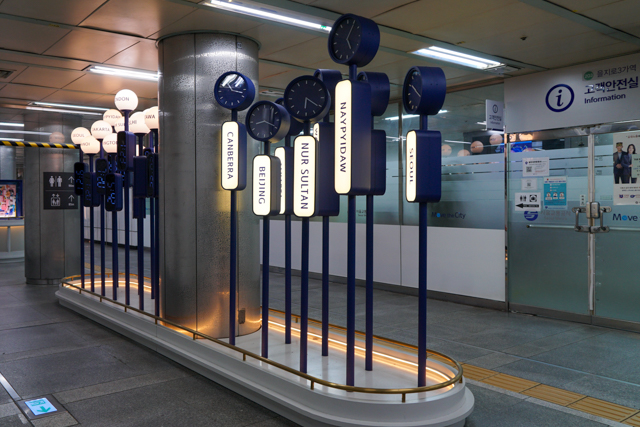
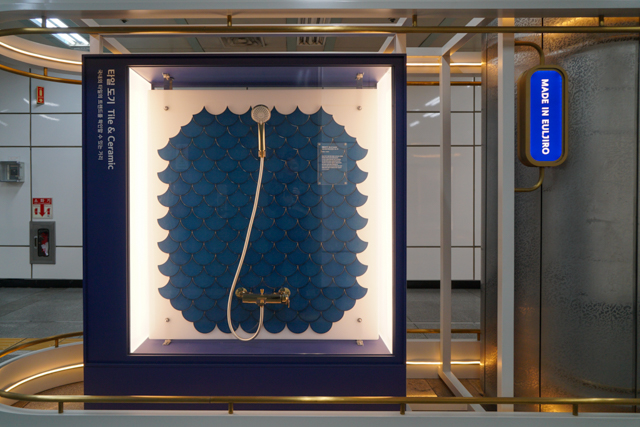
The subway station was deserted on a Saturday morning just before 10 AM, with the usual haunts for coffee and breakfast yet to open.
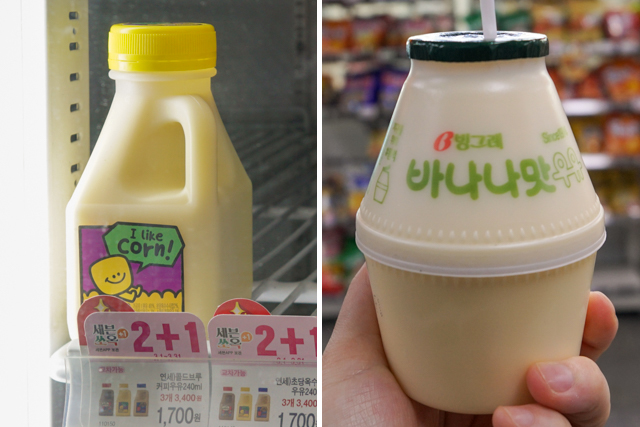
We took the opportunity to stop by a 7-11 to try the much-famed Binggrae Banana Milk. It was surprisingly enjoyable, tasting like a creamy banana milkshake or a banana-flavoured paddle pop.
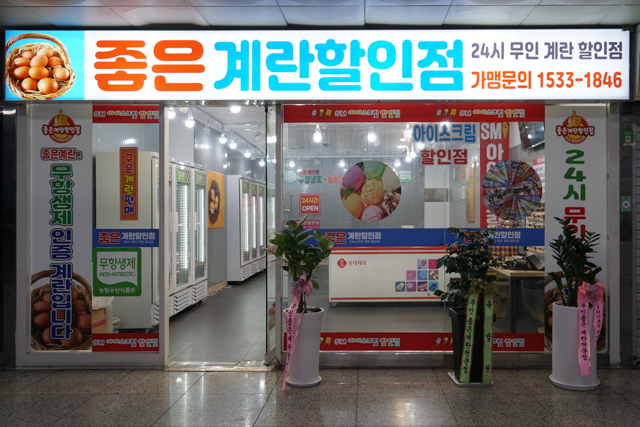
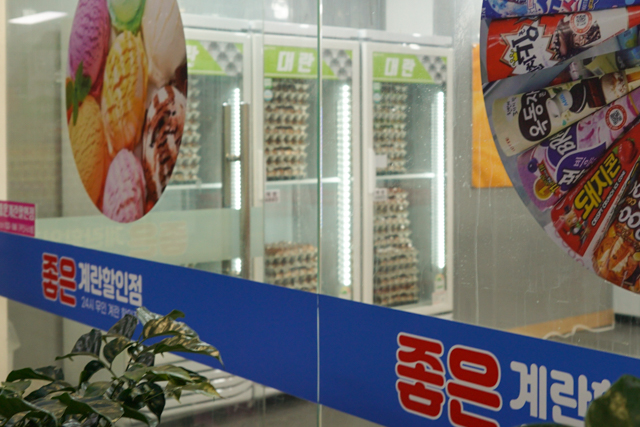
This 24/7 shop selling an endless supply of eggs and ice cream was the only other store that was open. It looked like it had its grand opening just recently.
Jongno-gu
Anguk Station
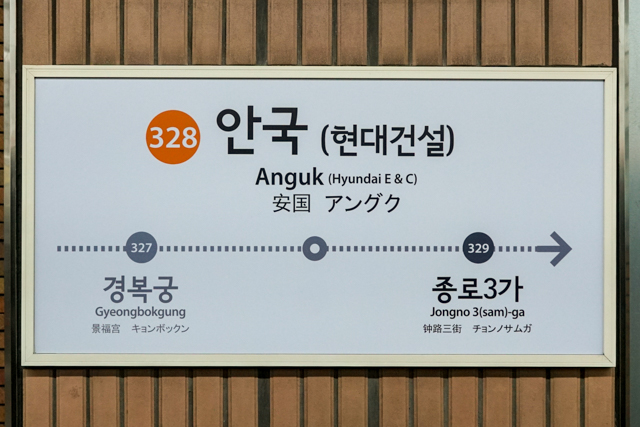
Anguk Station was a 10-minute walk to Changdeok Palace (Exit 3).
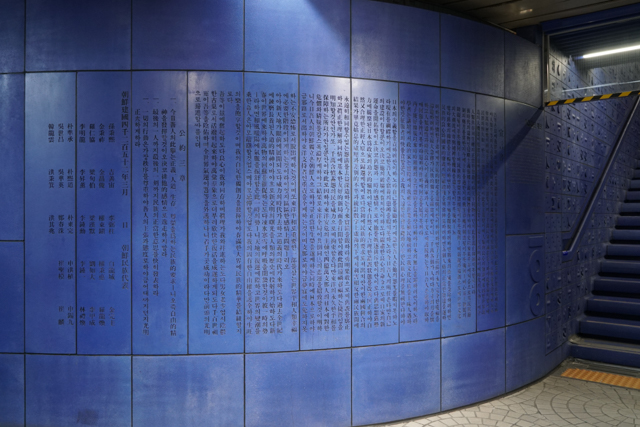
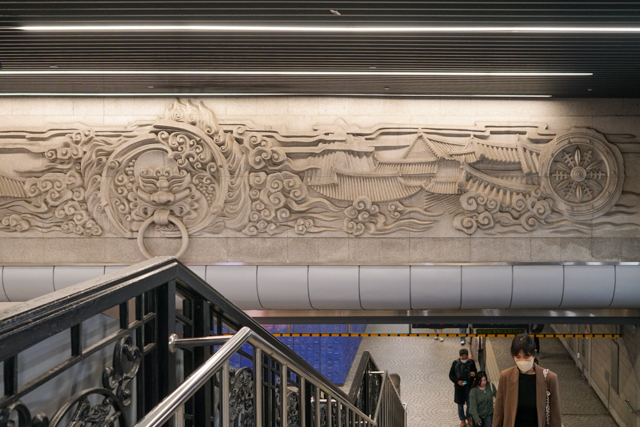
In March 2018, Anguk Station was transformed to showcase the history of the March 1 Independence Movement in Korea. The walls of the platforms at the station show the achievements and quotations of 80 independence activists including Kim Gu, Ahn Jung-geun, Yoon Bong-gil, Yoo Gwan-sun and Lee Bong-chang.
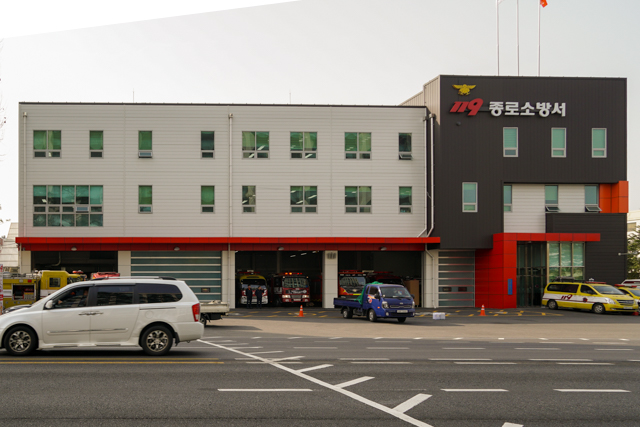
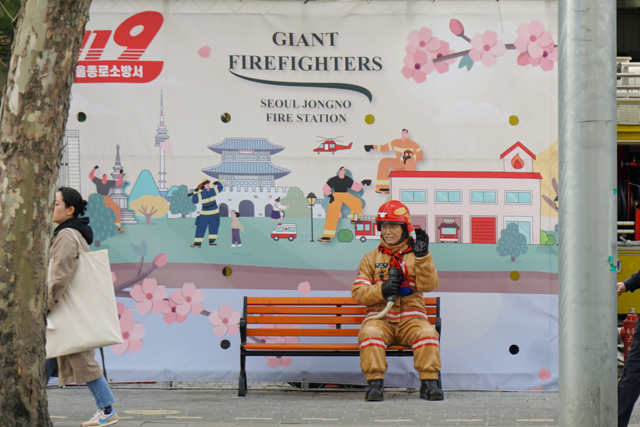
Outside the Jongno Fire Station, a (mannequin) firefighter was ready to take photos.
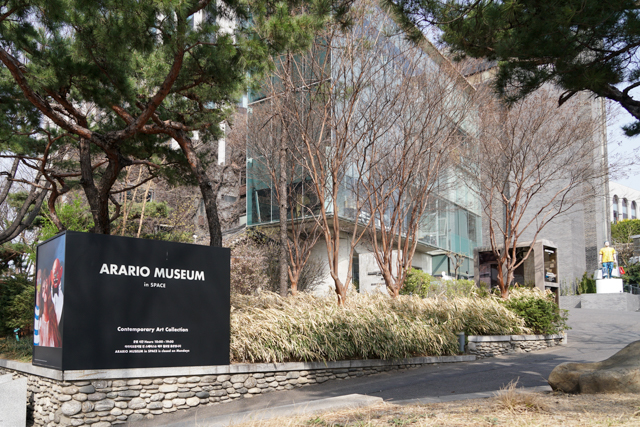
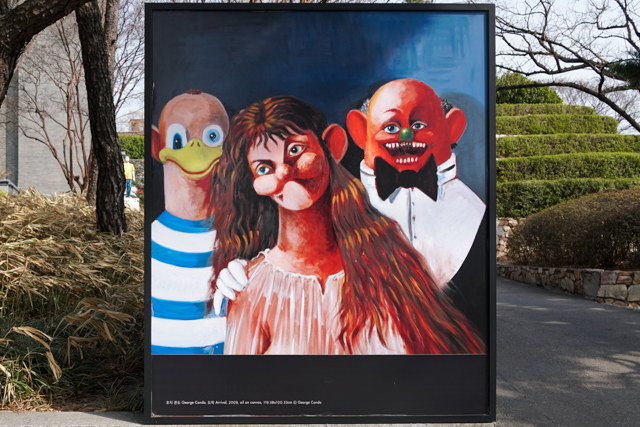
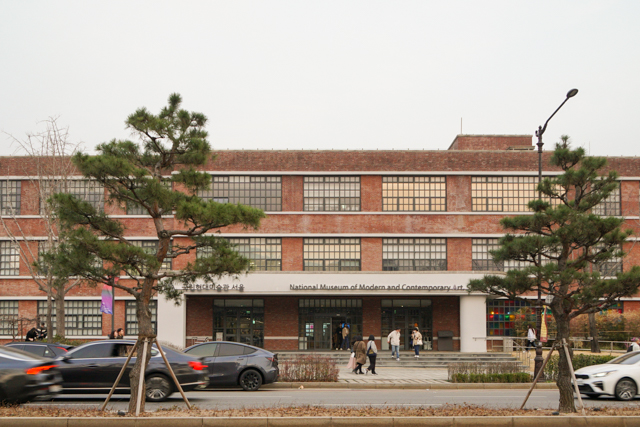
We walked past Arario Museum on the way to Changdeok Palace.
Changdeok Palace
창덕궁, Gwonnong-dong, Jongno-gu, Seoul, South Korea
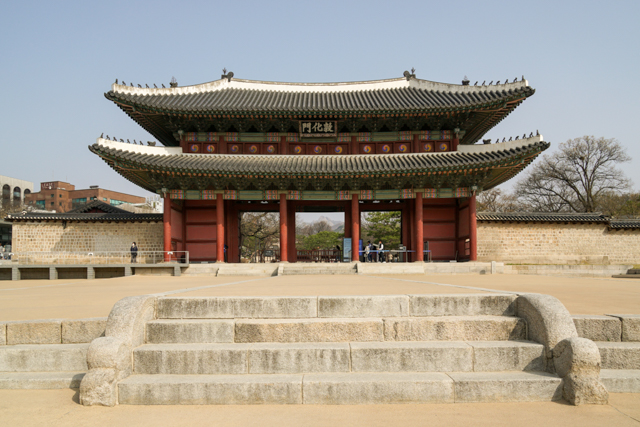
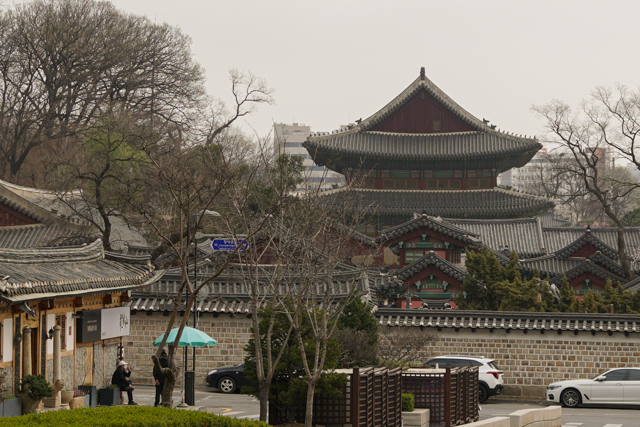
Changdeok Palace was constructed in 1405, the fifth year of the 3rd King Taejong’s reign. Secondary to Gyeongbokgung, the main palace, its completion gave balance to the capital city as Gyeongbok Palace was to the west and Changdeok Palace to the east. All of the palace buildings were destroyed by fire during the Japanese invasion of 1592. Changdeokgung was restored in 1610 and served as the main palace for 270 years including the dynasty’s last king, Sunjong. Since the palace was to the east of Gyeongbokgung, it was referred to as the “East Palace” together with Changgyeonggung Palace. In contrast to Gyeongbokgung, where major buildings are arranged in accordance with the main axis of the meridian, Changdeokgung is laid out in harmony with the area’s topography; the palace architecture has a dissymmetric beauty that is unique to Korea. The layout of Changdeokgung is making perfect harmony with natural background by locating buildings alongside of mountain. It influenced the layout of other major palaces. The buildings of Changdeok Palace including Daejojeon, the queen’s residence, were destroyed in 1917 by fire. To replace them, buildings at Gyeongbok Palace were dismantled and moved here. In the process, many structures were modified or damaged.
Full restoration work began in 1991 and is still under way. Despite all of the damage done to the palace in years past, Changdeokgung is relatively well preserved and is representative of Korean palace architecture. The garden of Changdeokgung is one of the most enchanting spaces in Korea. The Changdeok Palace complex was inscribed on the UNESCO World Cultural Heritage List in 1997 for its outstanding architecture and a design that is in harmony with the landscape.
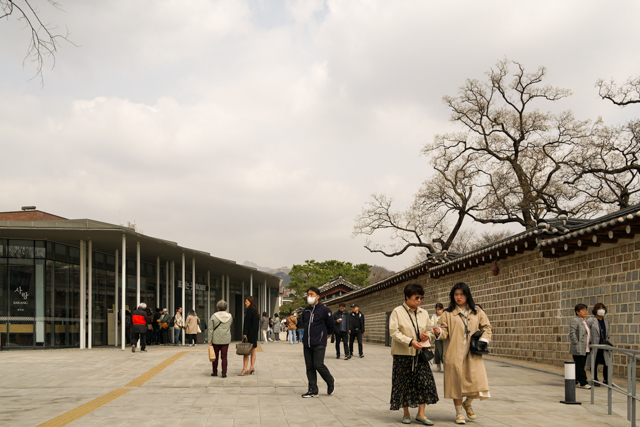
The ticket office was located outside, to the left of the main entrance.
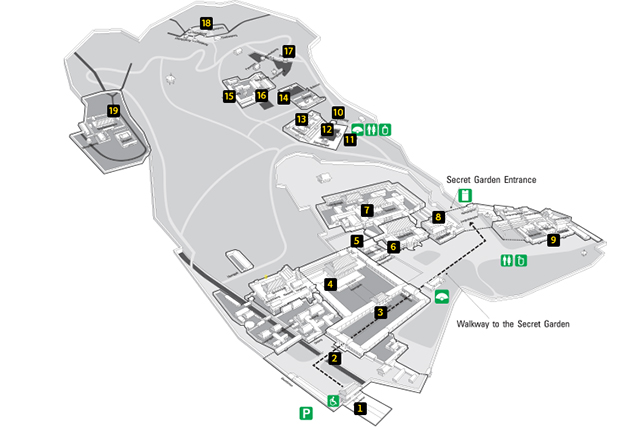
1. Donhwamun
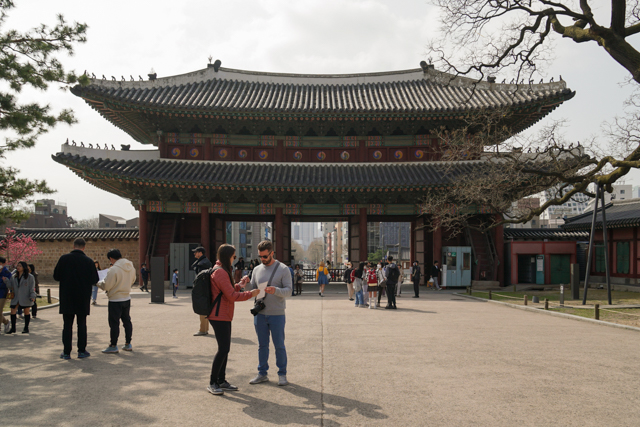
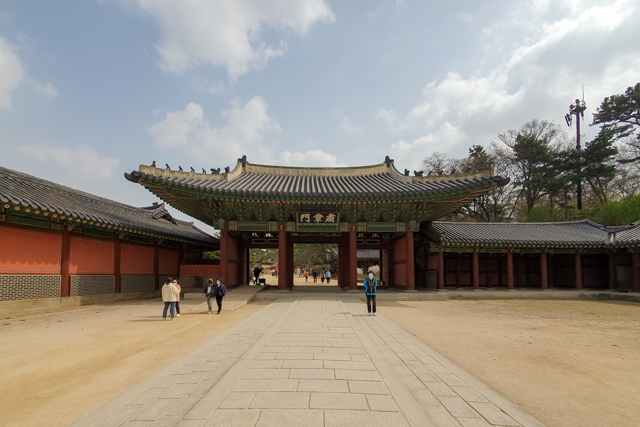
Built in 1412, Donhwamun is the main palace gate. It has a two-story pavilion-type wooden structure and is the largest of all palace gates. Donhwamun was burned down during the Japanese invasion of 1592 and was restored in 1608.
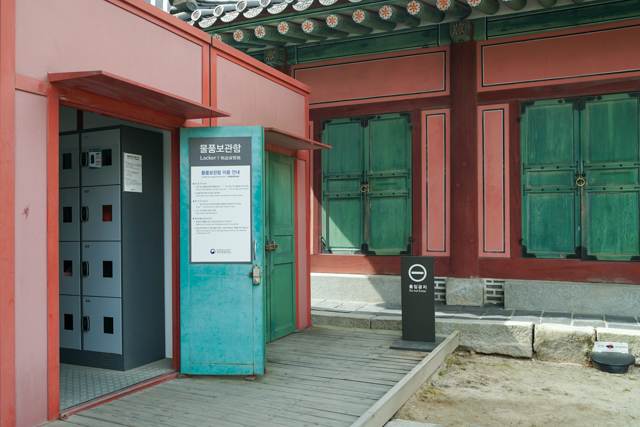
Immediately to the left of the main gate was a free locker for visitors.
2. Geumcheongyo
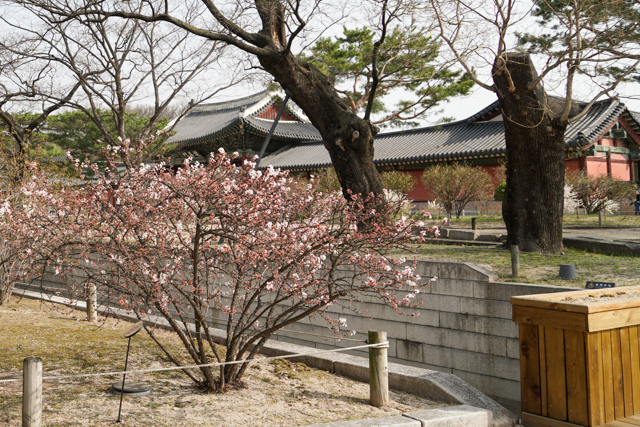
Geumcheongyo is the name of the bridge over a brook named Myeongdangsu which flows between Donhwamun and Jinseonmun, two gates of Changdeok Palace in Seoul. Also known as Geumcheon, or ‘Forbidden Stream’, the brook runs from north to south and flows out of the palace after arriving at Donhwamun Gate, where it is confined between embankments built by piling up hewn granite and crossed over by the stone bridge.
Geumcheongyo was originally built outside Jinseonmun Gate in 1411, six years after the completion of Changdeokgung, and has maintained its original condition although the palace sustained serious damages as a result of fires and wars. It is the oldest extant bridge in the royal palaces of Joseon.
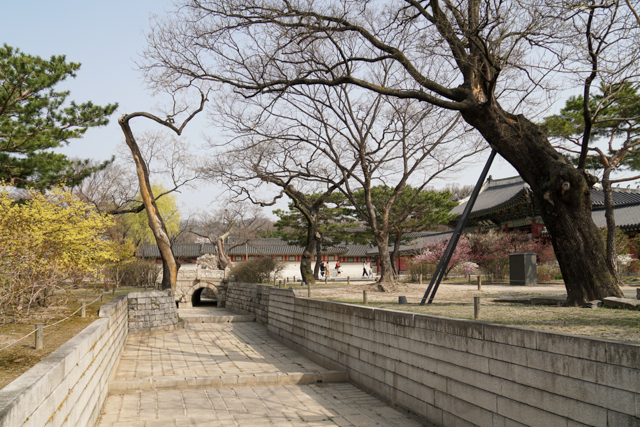
The bridge is marked by a pair of arches with three abutments, one built in the middle of the channel, the other two on the buttress walls at each end. The road deck consists of three sections, all of which are floored with rectangular stones, and has stone statues of imaginary animals at its four corners. The bridge also has stone railings made with posts decorated with lotus caps and panels between them. Each stone panel is divided into two parts by a lotus post carved in relief, and each part in turn contains an “elephant’s eye” window.
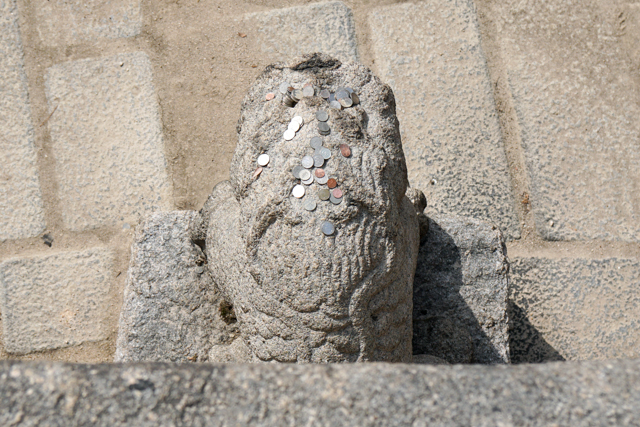
The bridge also features railing posts carved with animal heads, demonic faces carved in relief on both walls between the two arches, and animal carvings on the foundation stone of the central abutment, such as a mythical animal like a lion with horns in the south and a turtle in the north. As one of the oldest stone bridges remaining in Seoul, Geumcheongyo Bridge is widely admired for the historical, artistic and architectural value embodied by its elaborately carved sculptures full of symbolic meanings, its wealth of ornamental motifs, and its excellent construction techniques, respectively.
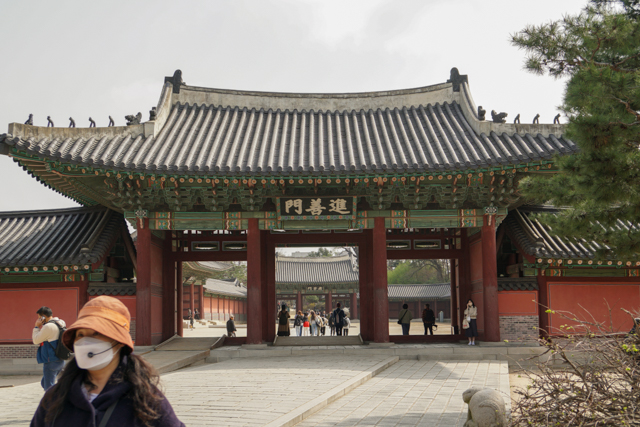
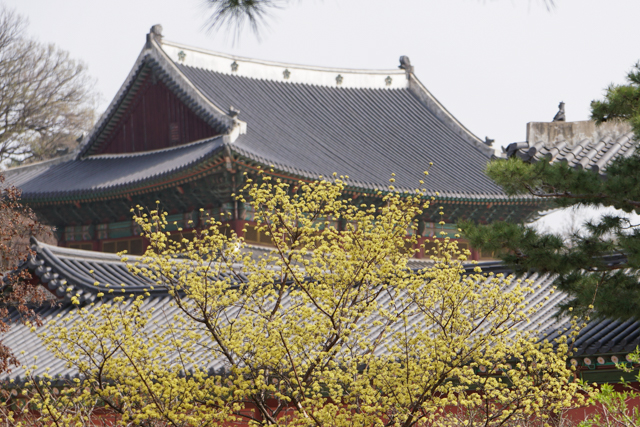
Jinseonmun
3. Injeongmun
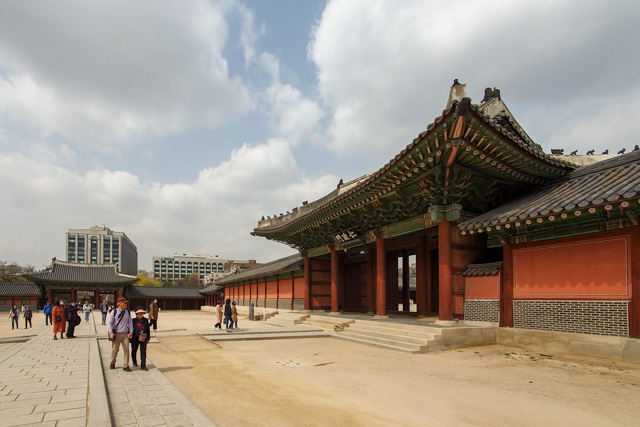
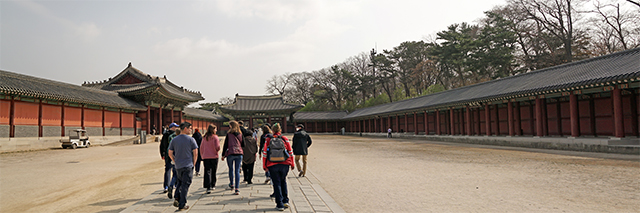
This is an open entrance to the existing wing which surrounds the Injeongjeon where the king and his officials gathered together to hold a conference. This gate is located in the centre of the south of the Injeongjeon.
The Injeongmun was first built in 1418 during King Taejong’s reign, but subsequently it was destroyed and reconstructed; it was destroyed during the Japanese invasion, King Injo’s Reform, and King Yeongjo’s reign. The existing gate is assumed to have been built in 1745 when the Injeongjeon was reconstructed.
4. Injeongjeon
Every palace has its own main hall, which was equipped with various decorations that symbolize the power and authority of the king. The Injeongjeon, the main hall of the Changdeok Palace, is stationed in the centre of the outer buildings of the palace. In fact, it is usual that the outer buildings should be located in the south of the inner buildings, and the most important buildings and pavilions arranged in accordance with the line of the main axis of the meridian.
The Changdeokgung differs from the Gyeongbok Palace in this respect. All the buildings of the Changdeokgung are arranged according to its topography. This is the reason why the palace was built as a detached palace. This is also characteristic of the Changdeok Palace.
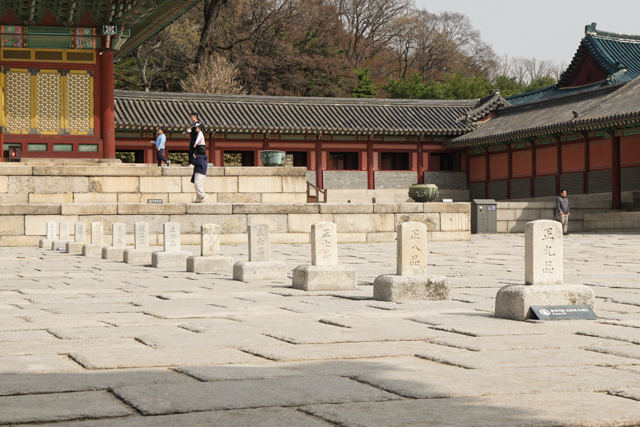
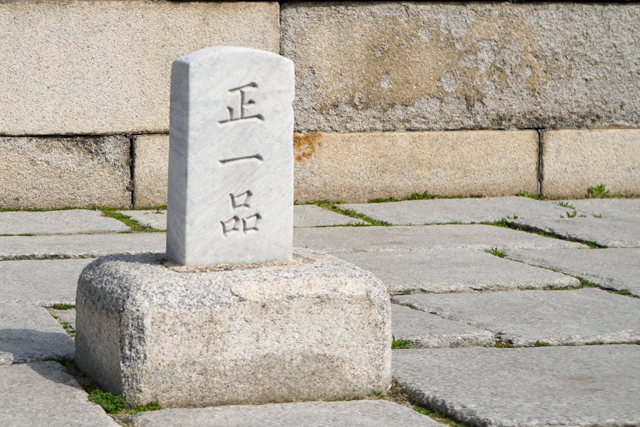
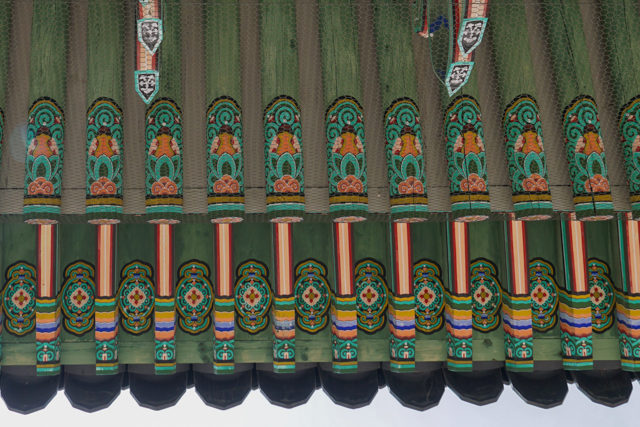
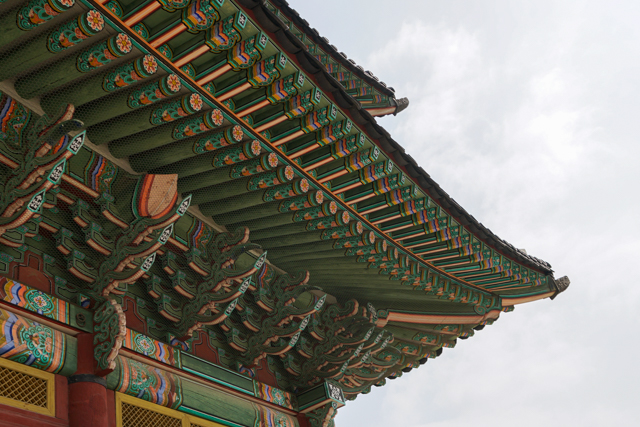
Built on the double bases called “Woldae”, the Injeongjeon is a two-story building, the inside of which has no partition between both stories. It occupies 20 kan and has an eave with a complex bracket structure which represents the late style of the Joseon Dynasty.
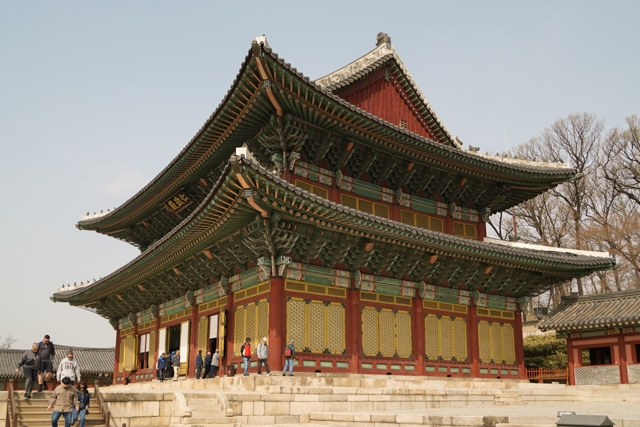
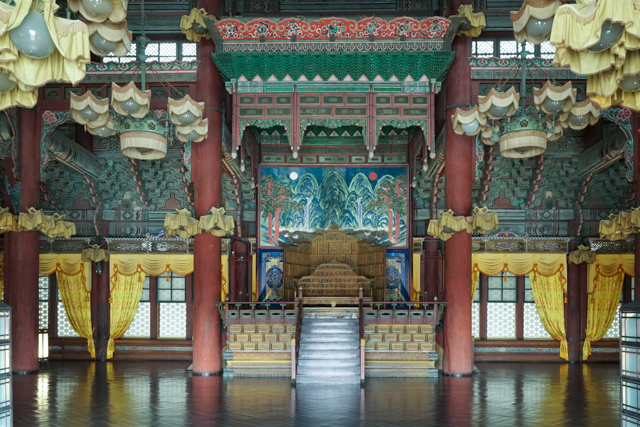
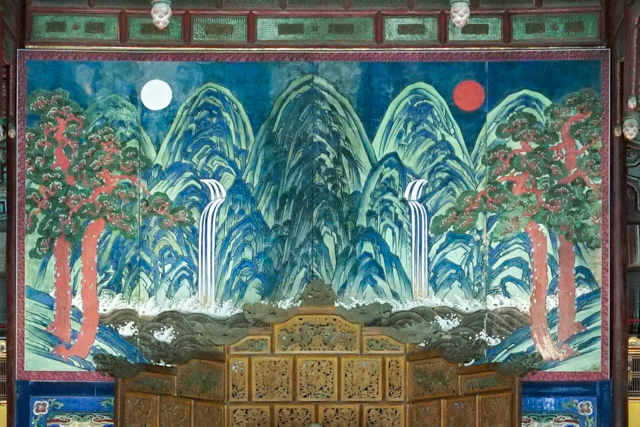
The painting on the back wall of the hall is the Irworobongdo (일월오봉도, lit. The painting of the sun, moon, and five peaks). It is a famous painting that has always been found behind the royal throne, and it is believed that the sun and moon symbolize the king and queen respectively, and the five peaks a mystical landscape. The same painting features on the front side of the 10,000 won note.
5. Seonjeongjeon
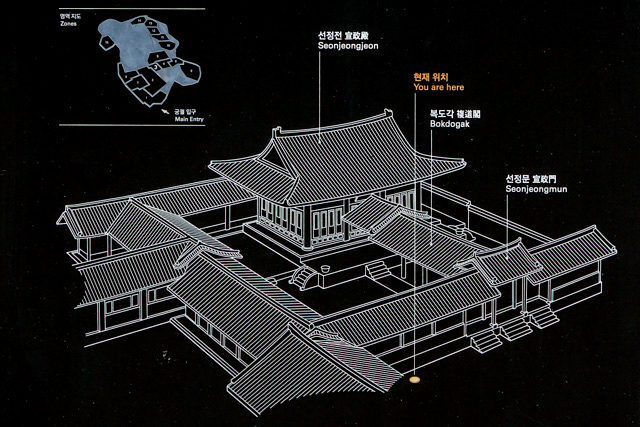
Here the king worked at his convenience to discuss state affairs with high-ranking officials. It was built to the east of the Throne Hall. Various assemblies including daily morning meetings, reports on national affairs and state seminars were held here. A narrow colonnaded area surrounding the hall was used as offices for secretaries and for storage. This is the only existing palace building with a blue-tiled roof. A covered corridor leads from Seonjeongjeon Hall out to Seonjeongmun Gate. Seonjeongjeon Hall once served as a royal shrine during royal funerals, and the corridor provides the only remaining evidence of its funerary function.
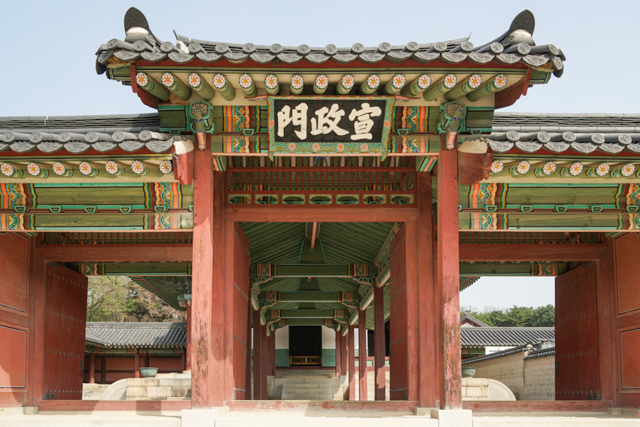
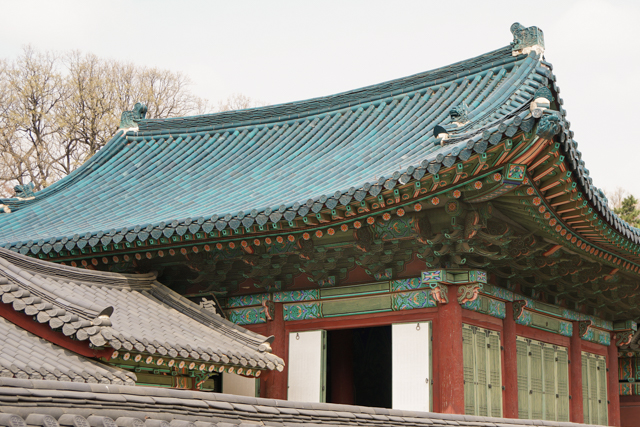
Usually, the Pyeonjeon, where the king worked at his convenience, belonged to the outer buildings of the palace, but it neighbored the king’s sleeping quarters. The Seonjeongjeon is the Pyeonjeon with 9 kan, which is a one-story building. One can feel a sense of comfort and stability here. In particular, the high footstones for gutter, and the blue glazed roof tiles are the attractions here. The four-leaf doors with paper replaced by pane made the inside brighter.
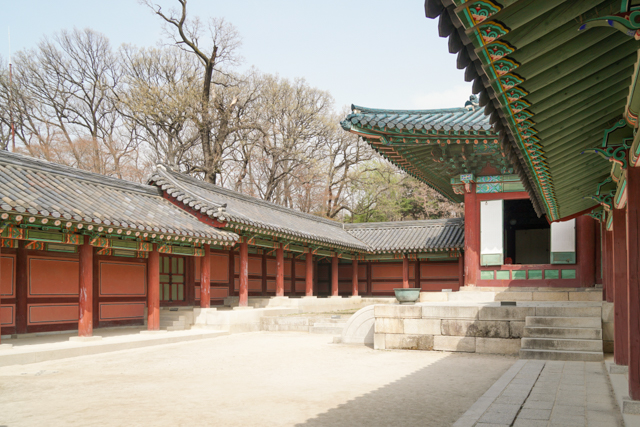
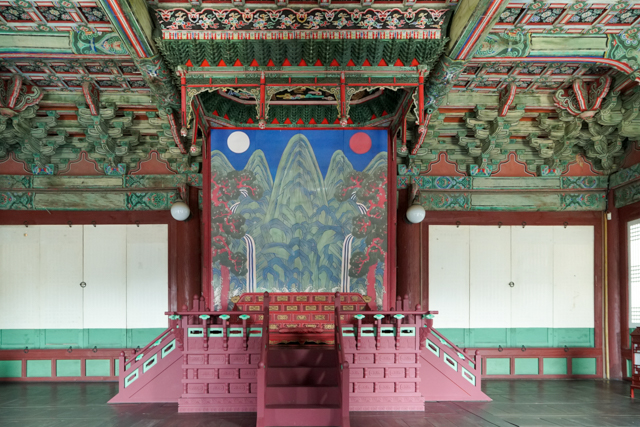
In the centre of the building, the king sat on his throne in from of the screen with the sun, the moon, and five mountains in, and then his subjects were permitted to take their seats on both sides. A scribe also sat in a corner, recording what they were discussing.
The decorative ceiling over the throne is symbolic of the king’s authority. It looks like a canopy, and is truly representative of woodcraft and art of the Joseon Dynasty.
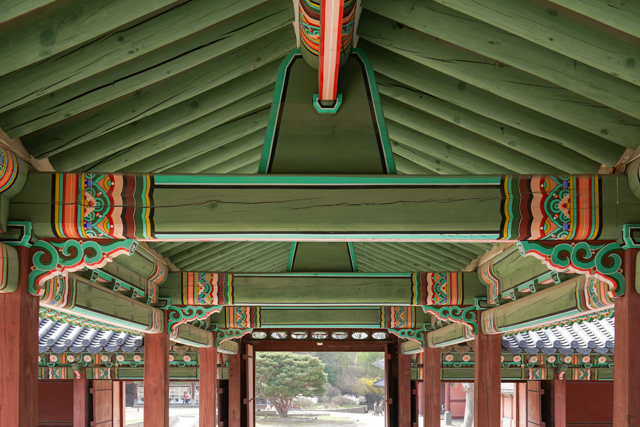
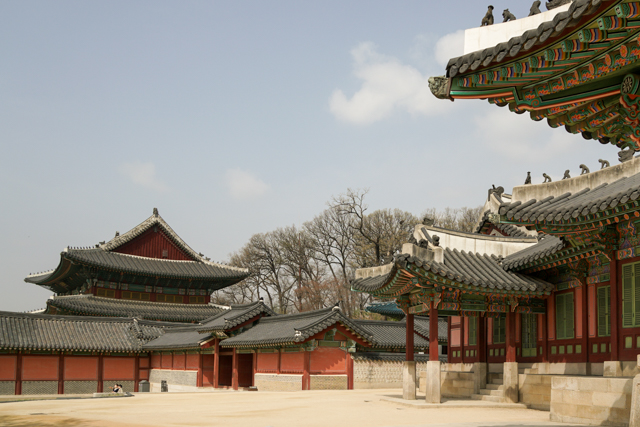
6. Huijeongdang, 7. Daejojeon, and 8. Seongjeonggak
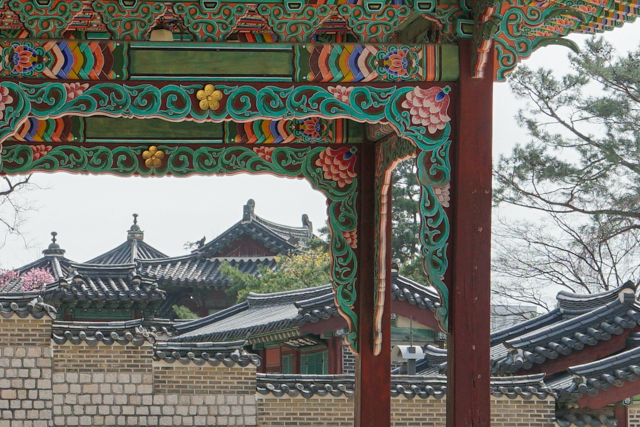
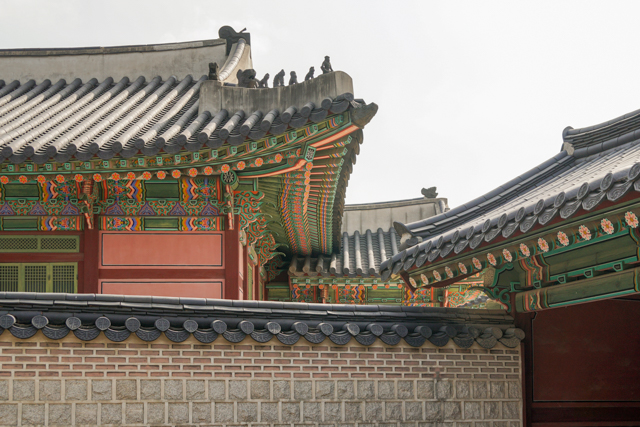
During our visit, the private quarters were undergoing renovation so we were limited to appreciating the Huijeongdang (King’s Residence) and Daejojeon(Queen’s Residence), Seongjeonggak (pharmacy) from the outside.
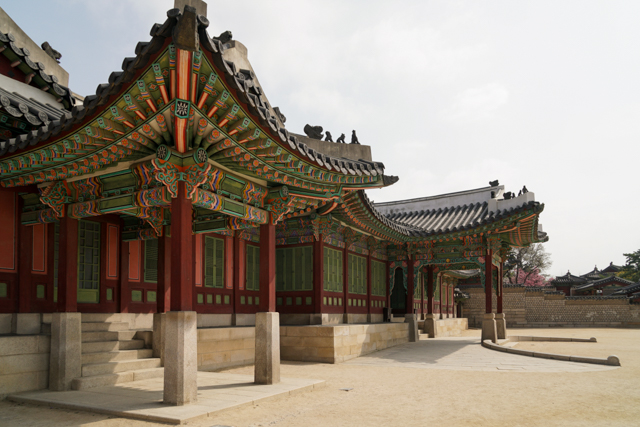
9. Nakeseonjae
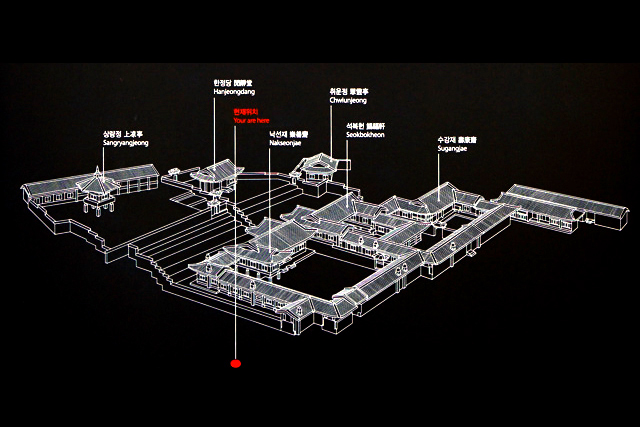
In 1847, King Heonjong constructed Nakseonjae as his personal library and living quarters. The following year, the king constructed two more buildings to the east of Nakseonjae: Seokbokheon, a residence for his concubine Gyeongbin, and Sugangjae, a residence for grand queen dowager Sunwon, who had served as regent until King Heonjong assumed direct rule in 1840. The king ordered these residences to be built in a modest style without the vibrant traditional paintwork (called danchcong*) conventionally applied to royal buildings.
The Nakseonjae Complex served as the last royal residence. The final Empress of Korea, Sunjeonghyo, resided here until 1966. Yi Bangja, the wife of the last crown prince, lived here with the last princess of the Korean royal family. Princess Dcokhyc, until they both passed away in 1989.
*Danchcong: ornamental paintwork applied to walls, pillars, and ceilings of designated types of buildings.
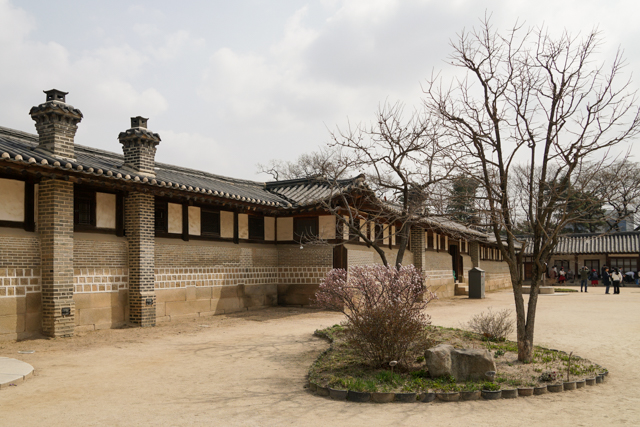
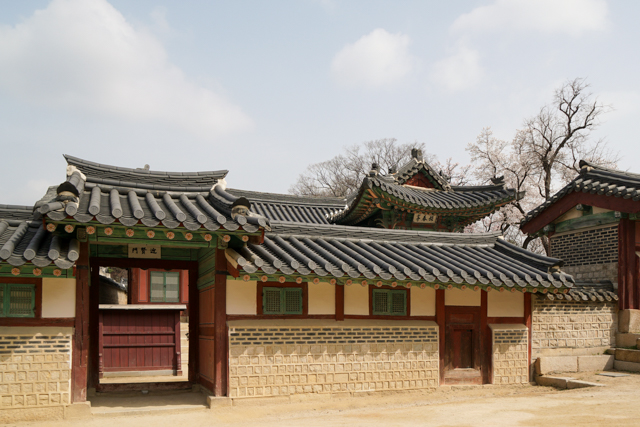
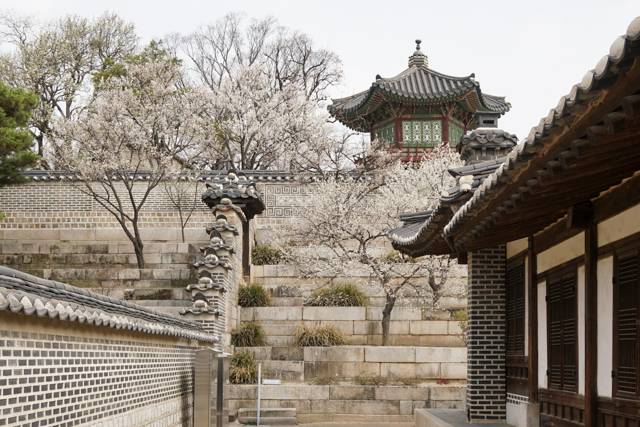
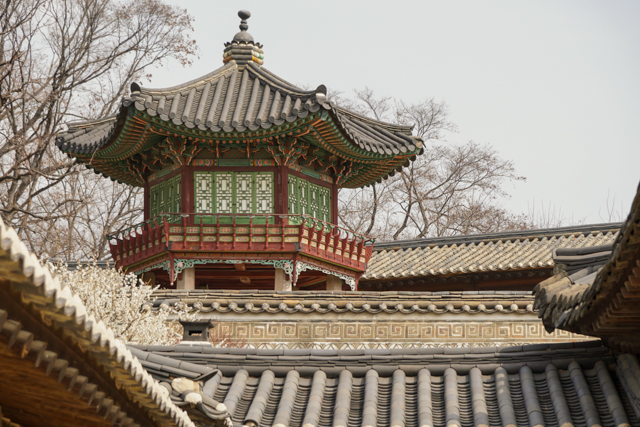
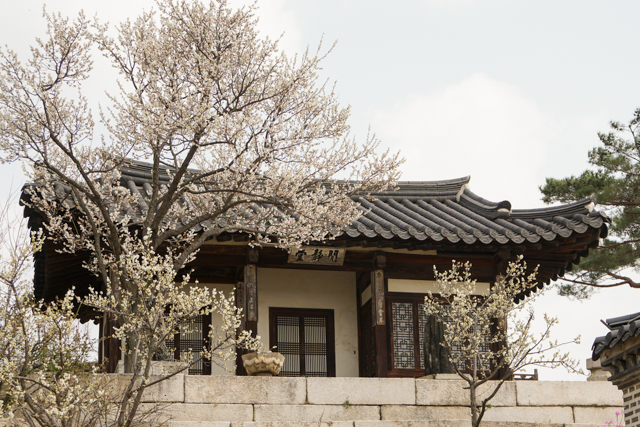
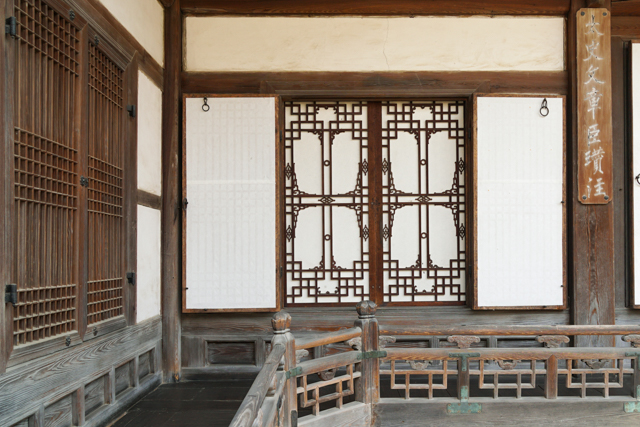
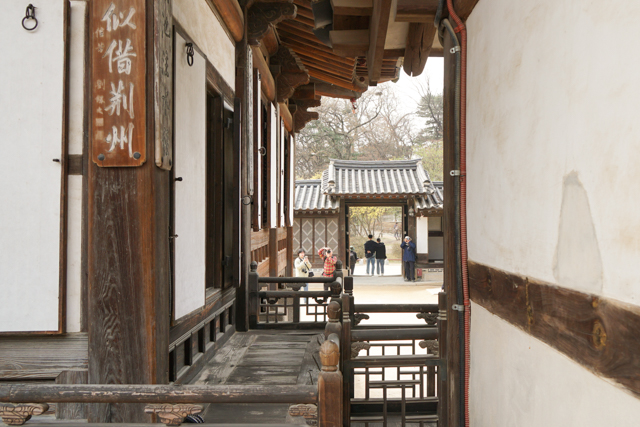
This was the exterior of the complex
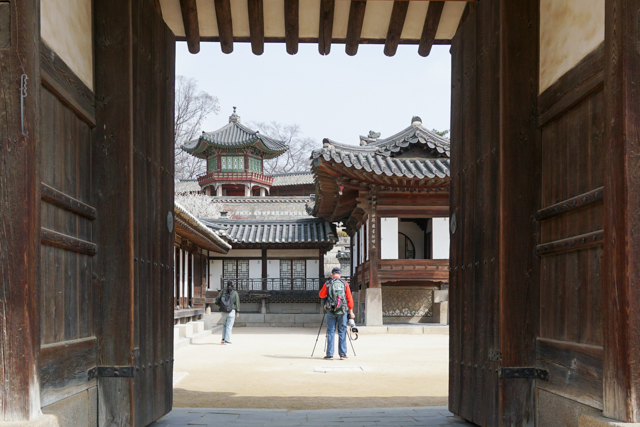
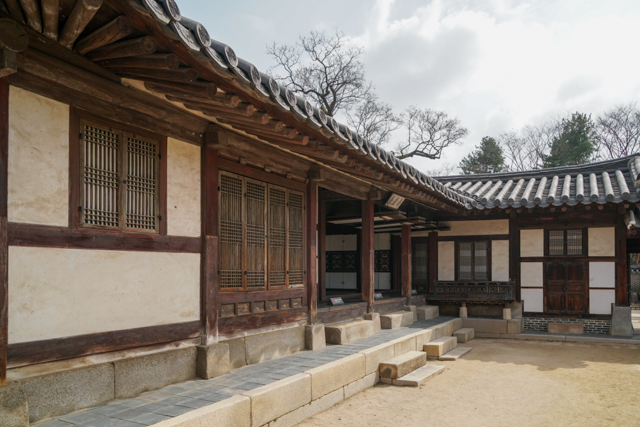
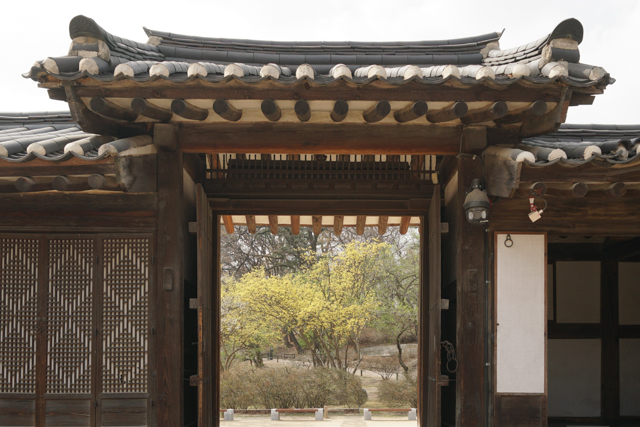
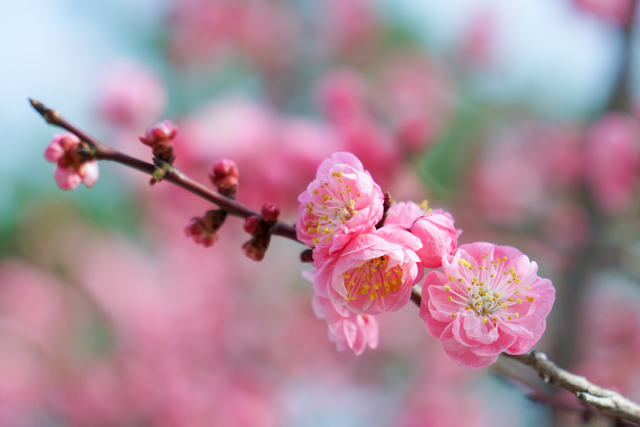
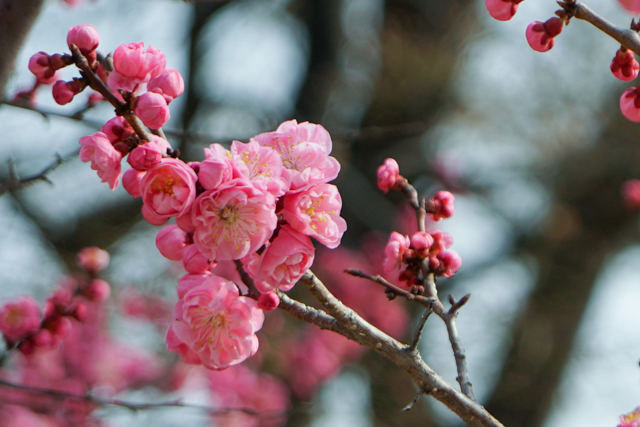
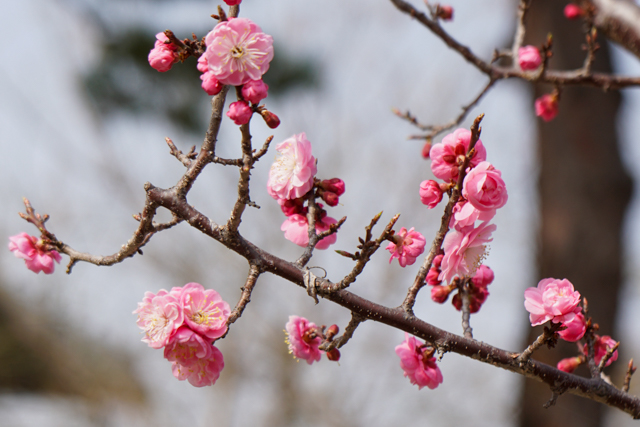
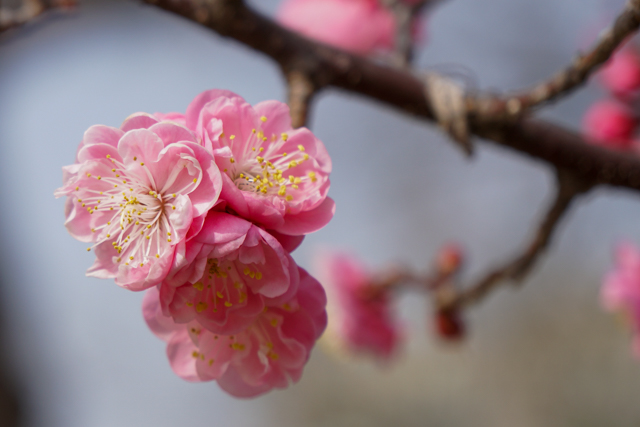
Blossoms
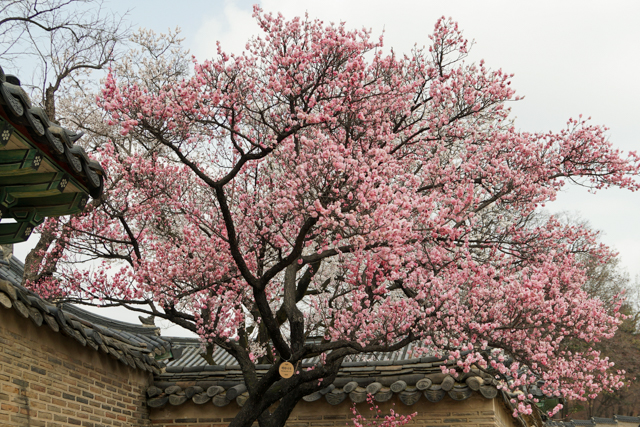
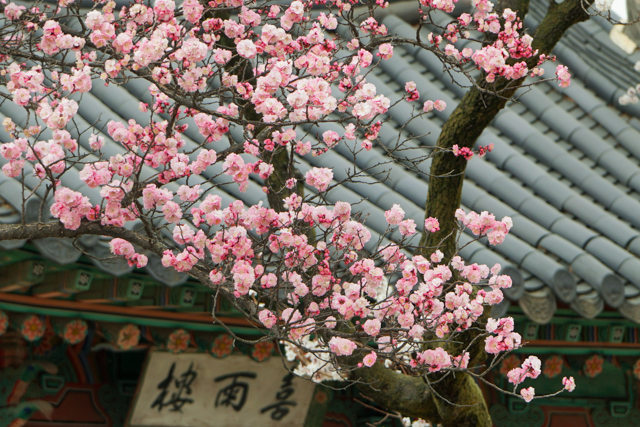
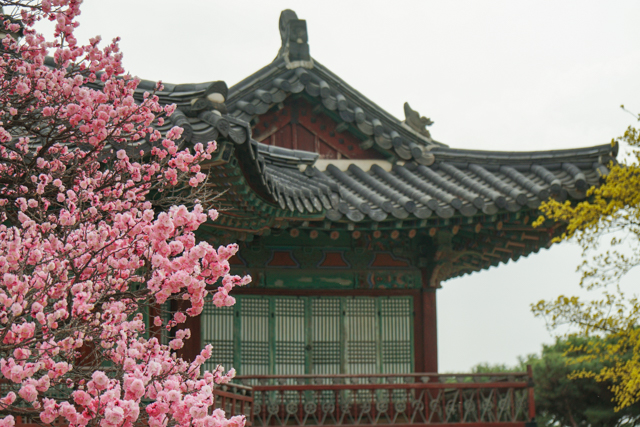
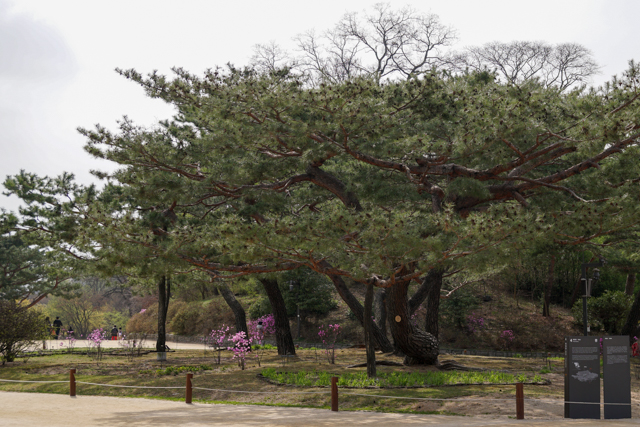
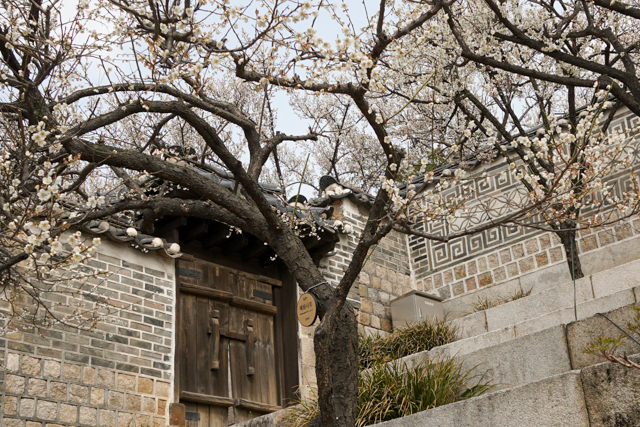
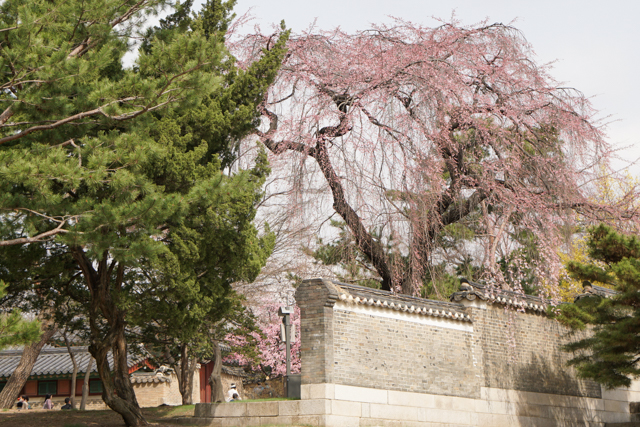
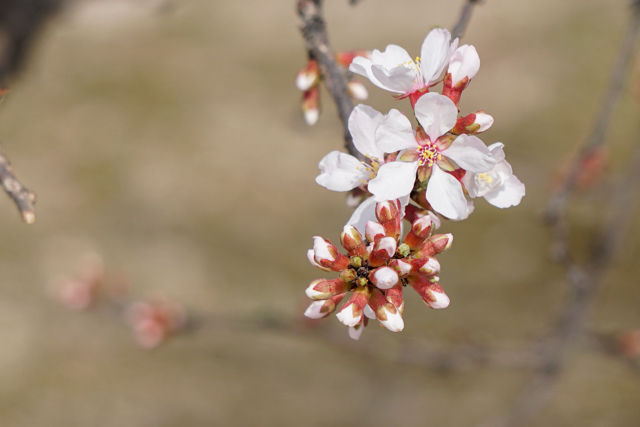
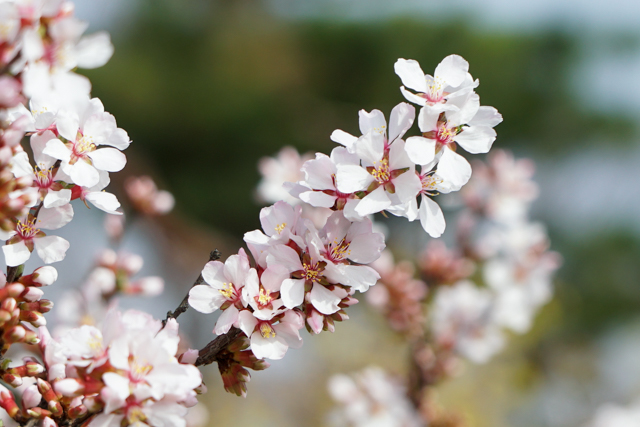
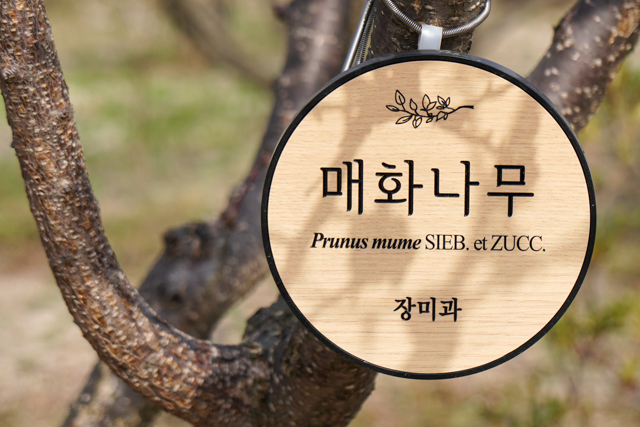
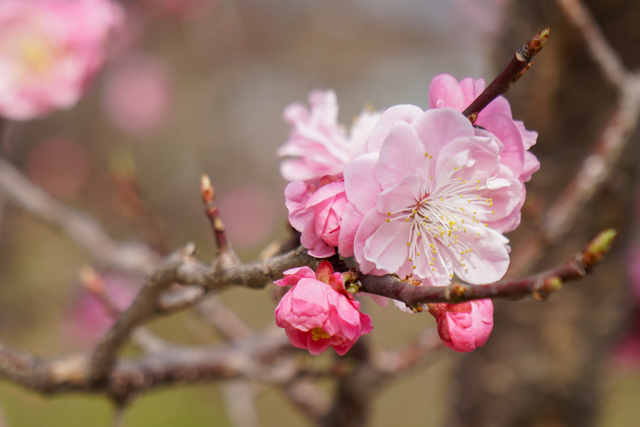
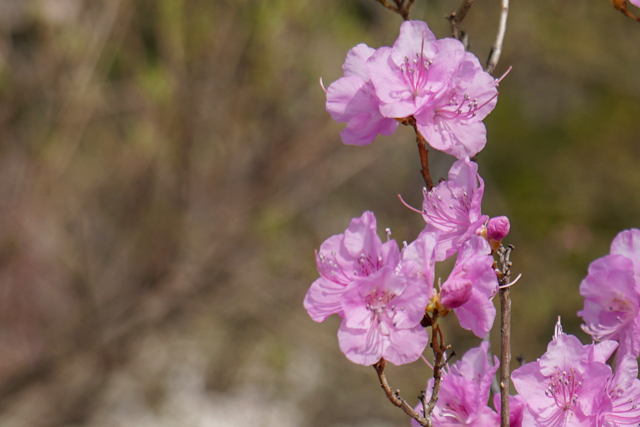
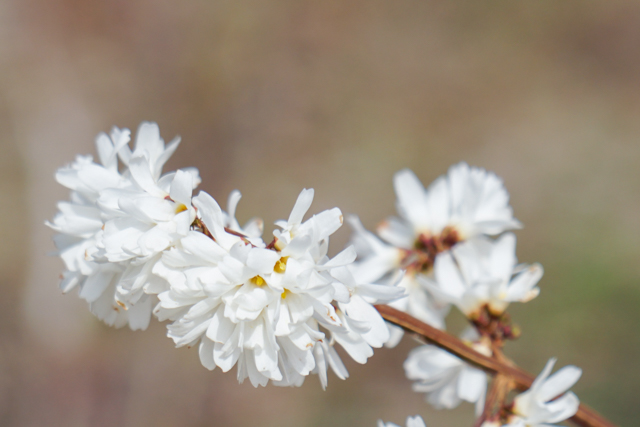
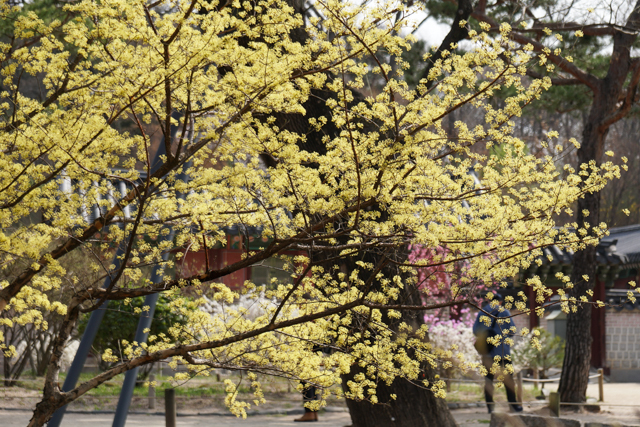
This was a plum tree by the entrance to the Secret Garden (which contained buildings numbered 10-19). In hindsight, we would’ve enjoyed also enjoyed a tour of the Secret Garden (by tour only for an additional 5,000 won).
Artisan Croissant
140-16 Gye-dong, Jongno-gu, Seoul, South Korea
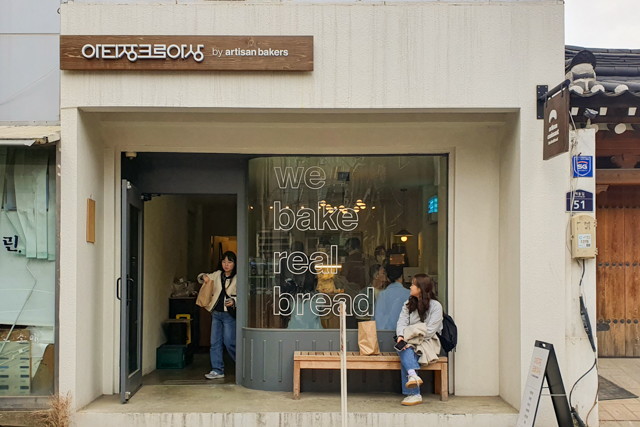
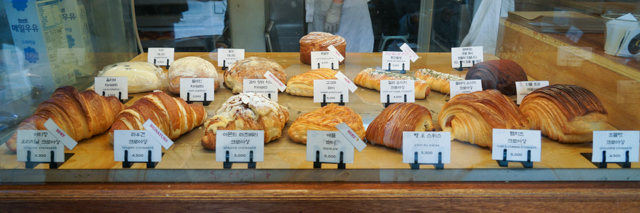
We were delighted that stumbled across Artisan Croissant by chance. The friendly owner was trained in France and spoke great English. But more than that, the baked goods were absolutely delicious.
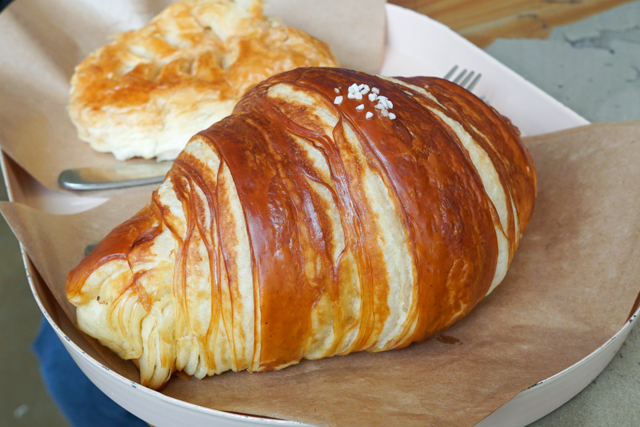
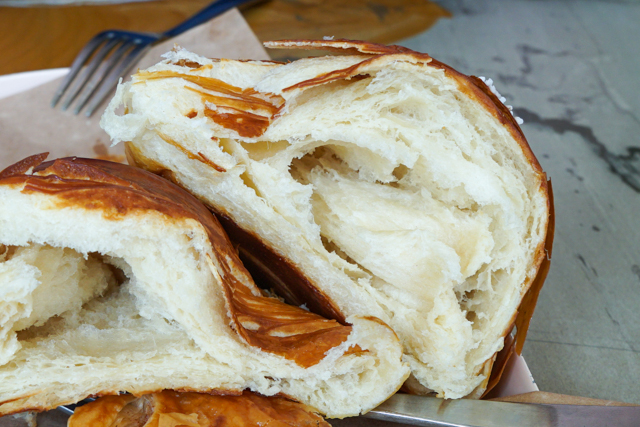
Their Signature Laugen Croissant (4,500 won) was flaky on the outside and tender on the inside, tasting like a buttery pretzel. If Buttercrumbs Croissant in Sydney didn’t have a similar version, this would be something we’d dream about.
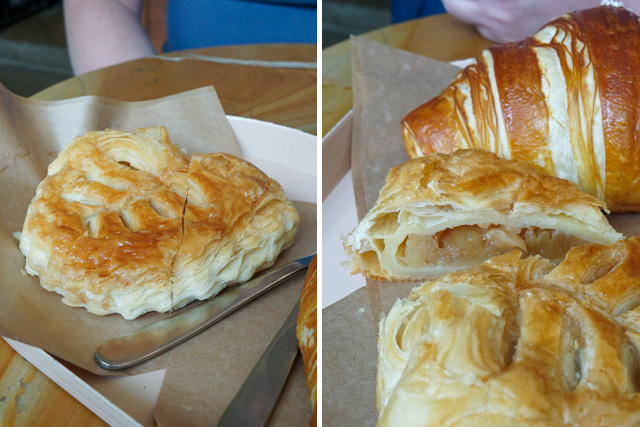
The apple pie (3,500 won) was similarly enjoyable with a light and flaky crust, with a great bite in the apple filling.
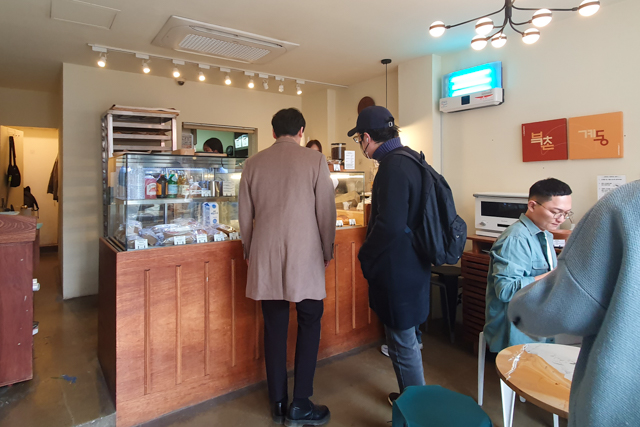
Gyedong-gil
계동길, Jongno-gu, Seoul, South Korea
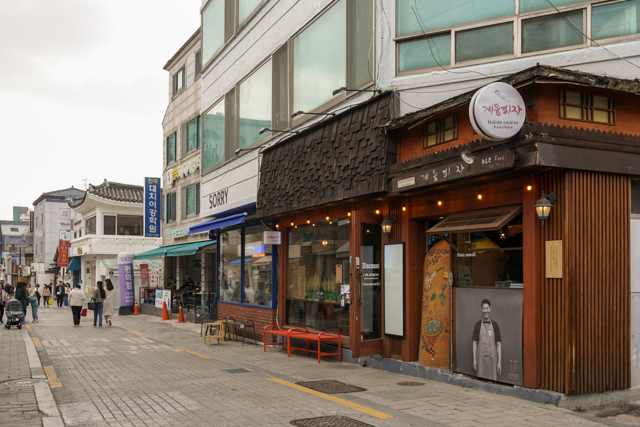
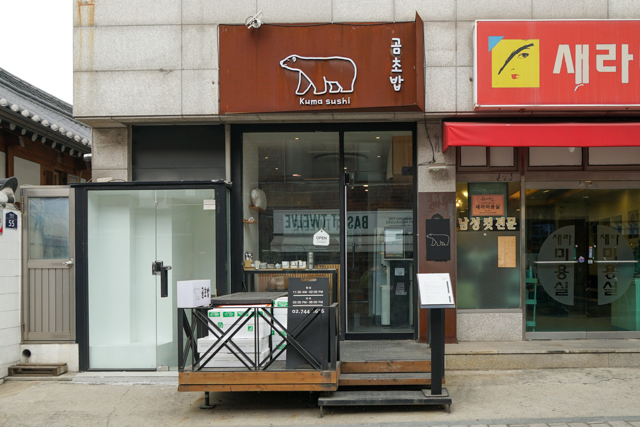
There was a cute cafe called Kuma Sushi serving savoury Japanese-inspired food.
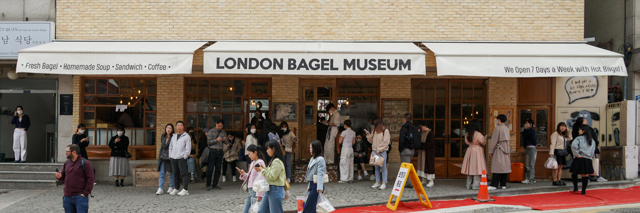
We’d intended to stop at London Bagel Museum for lunch, but the wait time to be served was 3 hours long.
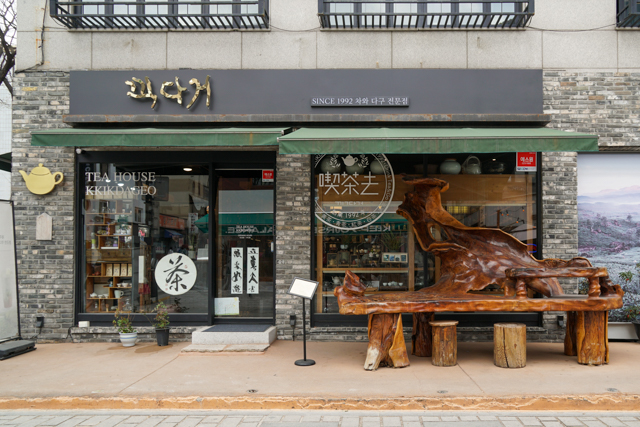
Tea House Kkidaego had an amazing wooden table outside its store.
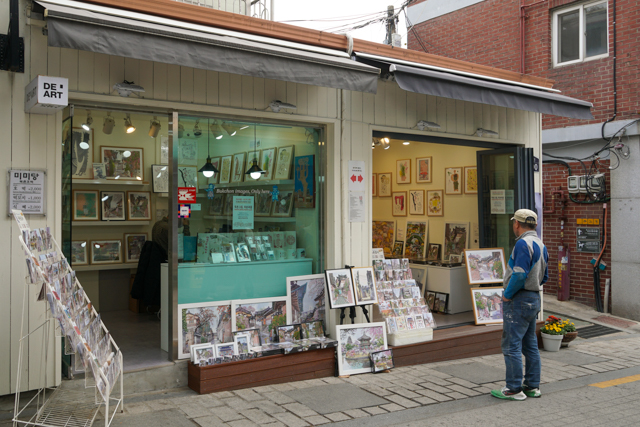
On the way up the hill to the Bukchon Hanok Village, we picked up some postcards from De-Art.
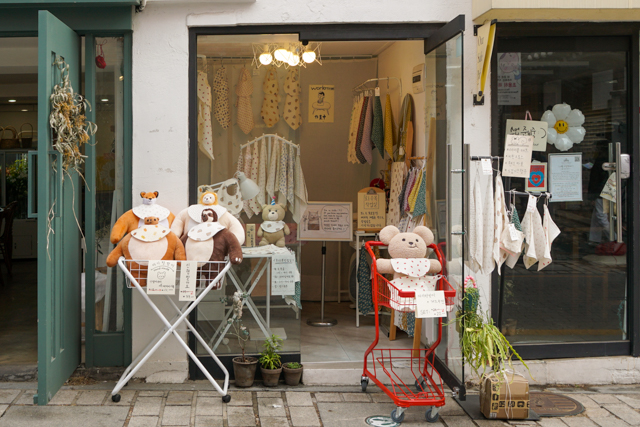
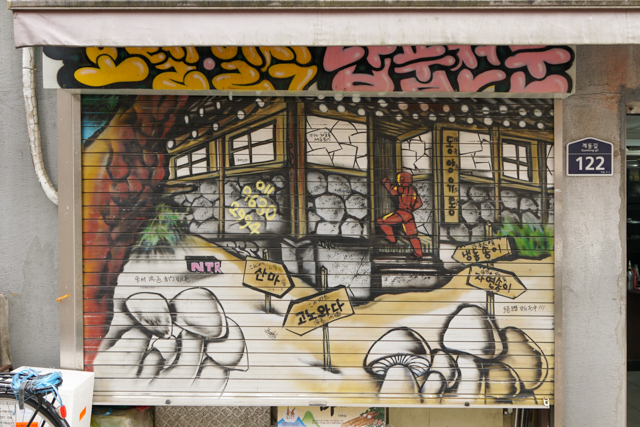
This closed shopfront had a shutter with some cool street art.
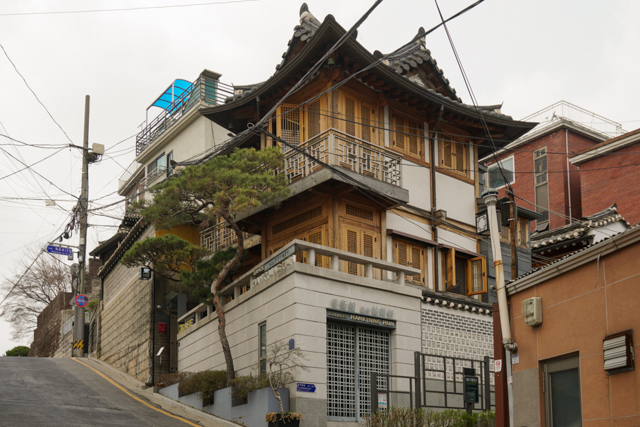
Bukchon Hanok Village
북촌 한옥마을, Gyedong-gil, Jongno-gu, Seoul, South Korea
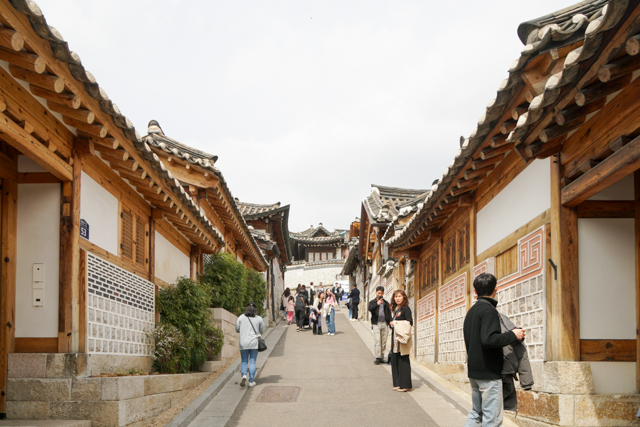
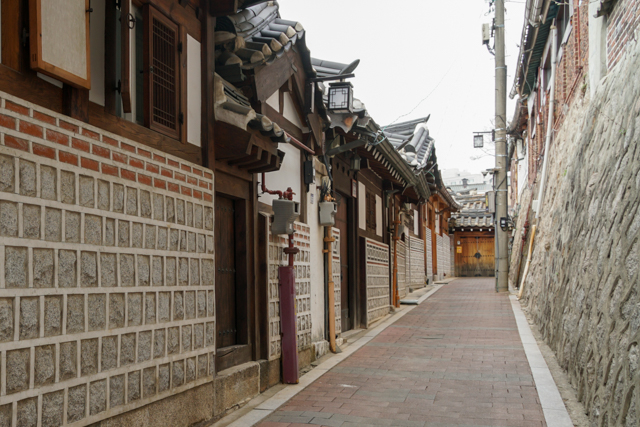
Bukchon Hanok Village is a Korean traditional village in Seoul with a long history located on the top of the hill between Gyeongbok Palace, Changdeok Palace and Jongmyo Royal Shrine. The traditional village was composed of many alleys, hanok and is preserved to show a 600-year-old urban environment. The area of Bukchon, was traditionally the residential quarter of high-ranking government officials and nobility during the Joseon Dynasty. It is located north of Cheonggye Stream and Jongno, hence named Bukchon, which means north village.
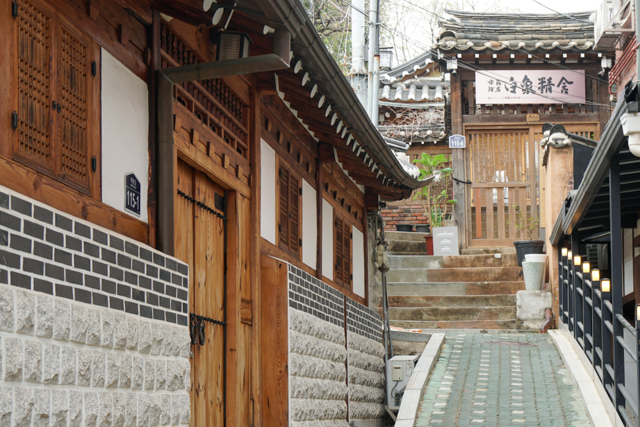
Bukchon Hanok Hall
29-1, 12-gil, Bukchon-ro, Jongno-gu, Seoul, South Korea.
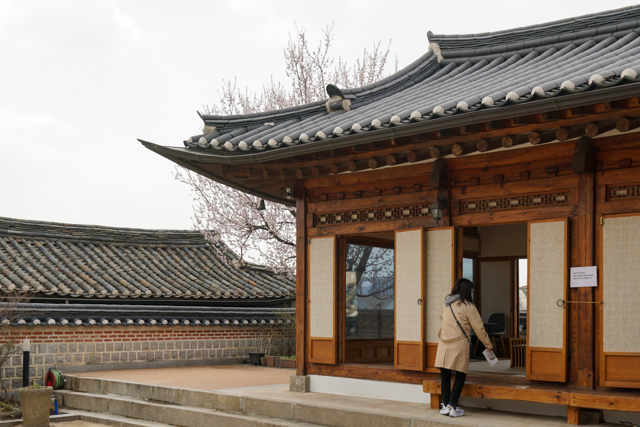
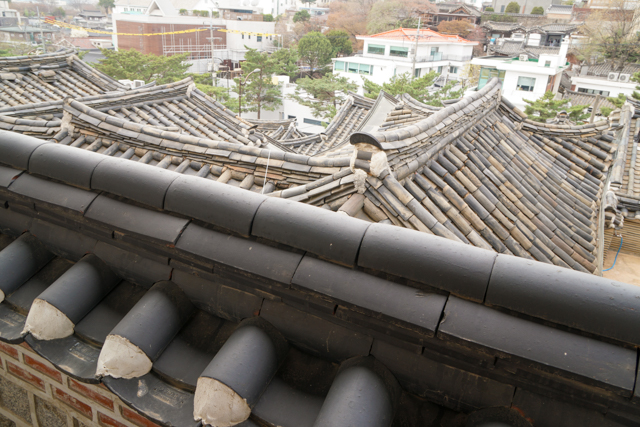
Bukchon Hanok Hall is one of the public hanoks that Seoul City have and uses as an open hanok for citizens to preserve the landscape of hanok and hanok area as part of the ‘Bukchon Regeration Project’ that began in the early 2000s.
The city purchased it in 2003 and used it as a workshop until 2017 for the late Han Sang Soo, the embroidery master who was designated as Important Intangible Cultural Property No 80. It has been renoated since then and is currently operatd as Hanok Hall, a shared hanok house for all fitizens for the education, culture and promotion of hanok, including exhibitions, lectures and forums suitable for the cultural contents and hanok of Bukchon.
The Bukchon area was formed as a small- and medium-sized hanok resident in the late 1920s, with large-sized lots divided into small-sized lots. One of them is Bukchon Hanok Hall, which was divided from 10 Gahoe-dong around 1935. It is where you can appreciate the view of Gahoe-dong, where the roofs stacked in layers over the Hanok Hall yard fence are spread out like a paranoma.
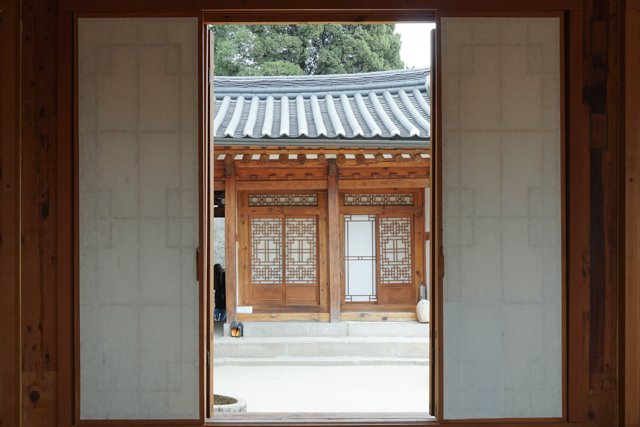
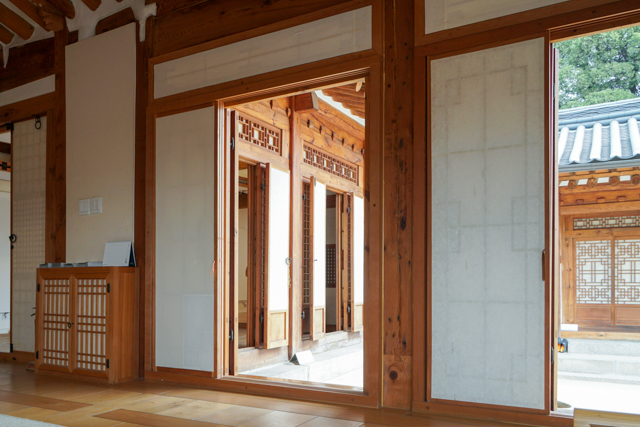
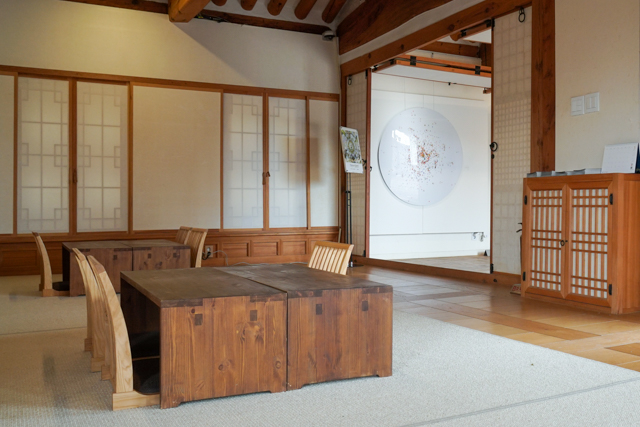
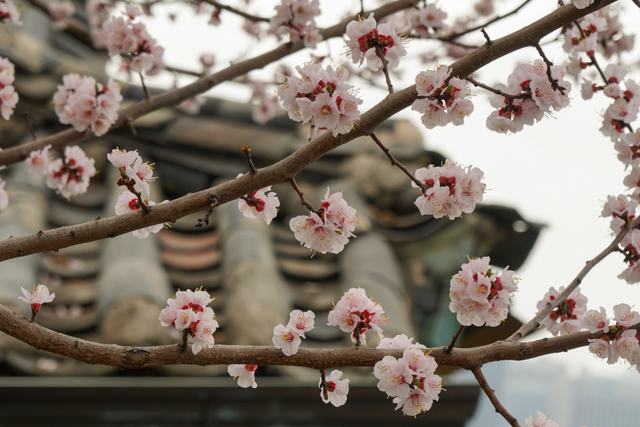
We briefly rested in the hanok while enjoying the breeze and blossoms outside.
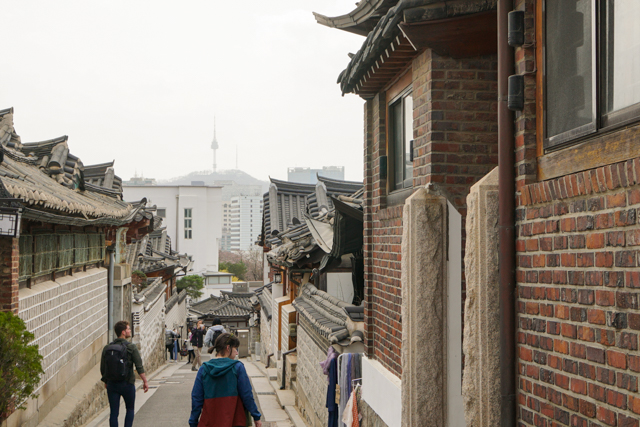
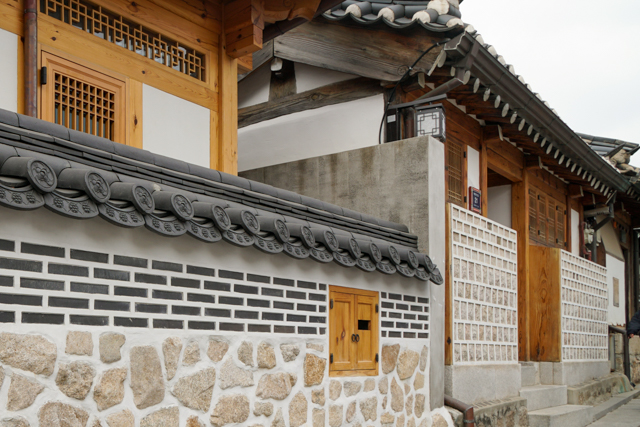
Saeksil-moonyang-nubi Workshop
17, Bukchon-ro 12-gil, Jongno-gu, Seoul, South Korea.
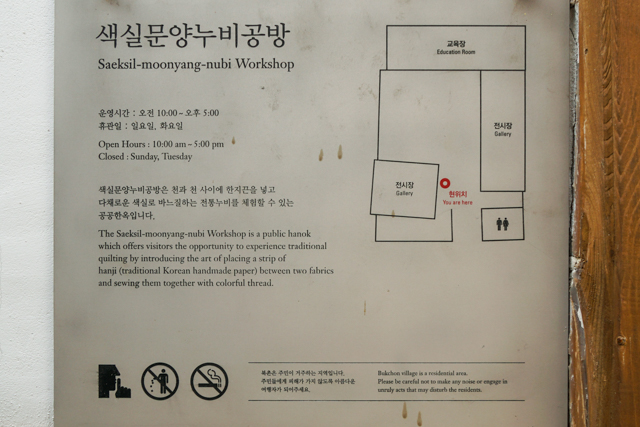
This workshop displays traditional quilting works made by placing a strip of hanji (traditional Korean paper handmade from mulberry tree) between two fabrics and sewing them together, and runs an experience program for visitors.
The owner of the workshop, Kim Yun-seon, first started quilting with colored thread after being inspired by a quilted pouch hand-made by her great grandmother that she found among her grandfather’s relics. Quilting with colored thread, a beautiful and sophisticated traditional handicraft, consists in placing hanji between fabrics, rather than cotton wool, to create colorful but moderate patterns with diverse colored threads.
Quilting with colored thread requires intense concentration, as well as a lot of time and effort, as it generally takes one to two months to complete even a small object. Such dedicated quilting work was performed by women with love and care for their family
It was closed on a Saturday despite its stated opening hours.
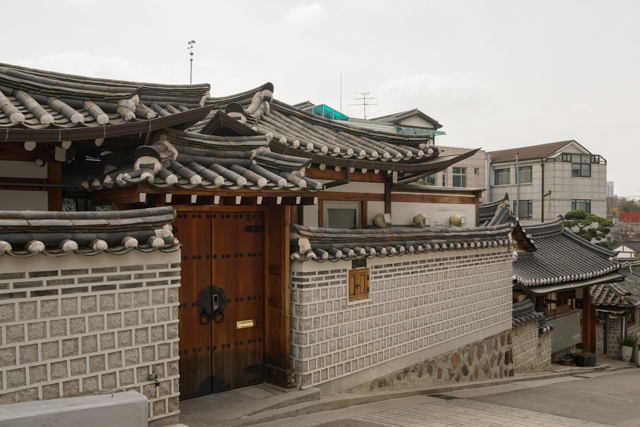
Donglim Knot Workshop
10, Bukchon-ro 12-gil, Jongno-gu, Seoul, South Korea.
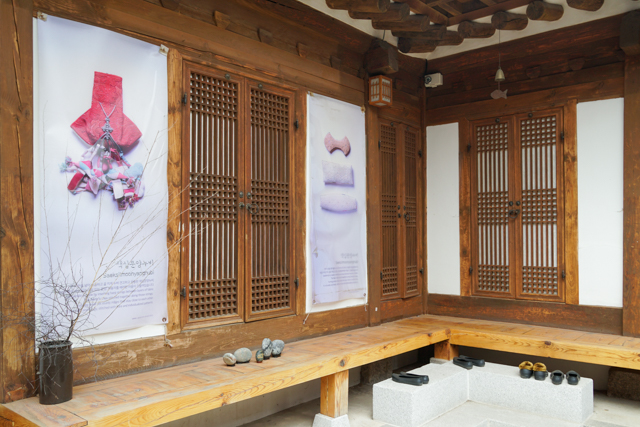
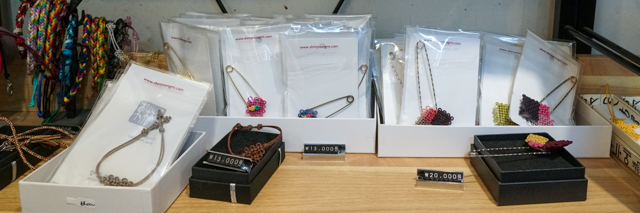
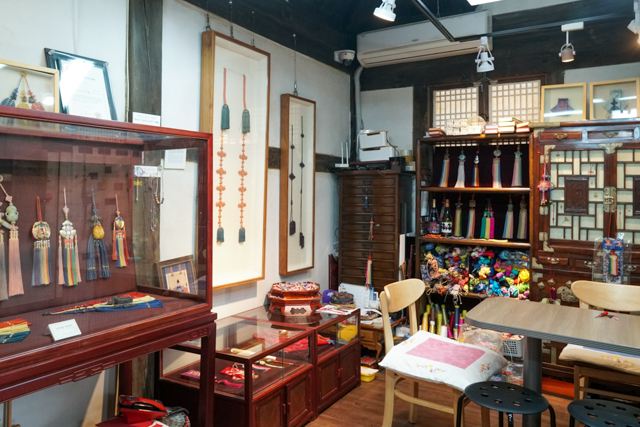
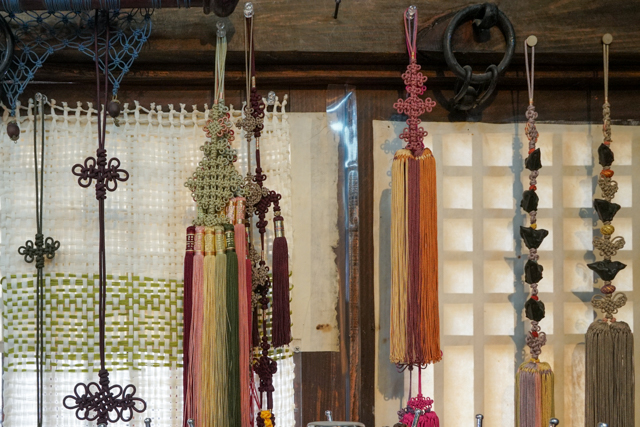
The Donglim Knot Workshop displays the beauty of knots in harmony with diverse ancient relics, reproductions, and creative works with a contemporary sensibility in an exhibition hall situated in a Korean traditional house or ‘hanok’.
It exhibits a wide range of items including various ornamental knots that are traditionally handed down in Korea, waist bands, pockets, and tassels for traditional clothing, fans and flags, and knotting materials such as thread, string, and so on. The workshop is committed to developing and promoting the art of knot-making, and runs various educational programs for beginners and professionals about knot crafts and other craftworks.
Sulwhasoo Bukchon Flagship Store
47 Bukchon-ro, Jongno-gu, Seoul, South Korea
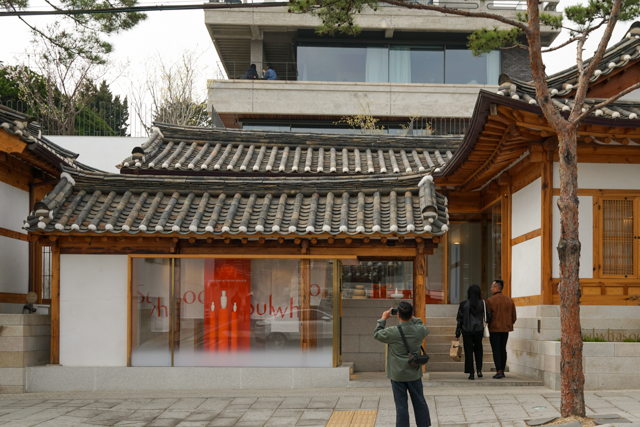
The Sulwhasoo Bukchon Flagship Store is situated centrally in the Bukchon Hanok Village. More interesting to us, though, was the Ossuloc Tea House (brutalist concrete building in the background, accessible via a flight of nondescript stairs to the left of Sulwhasoo) that we missed.
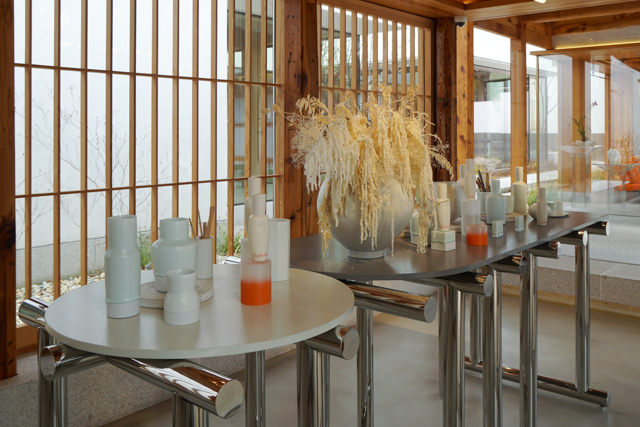
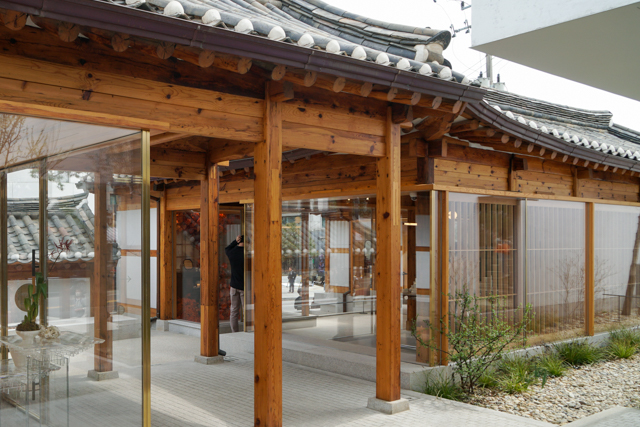
Bukchon-ro 11-gil
Bukchon-ro, Jongno-gu, Seoul, South Korea
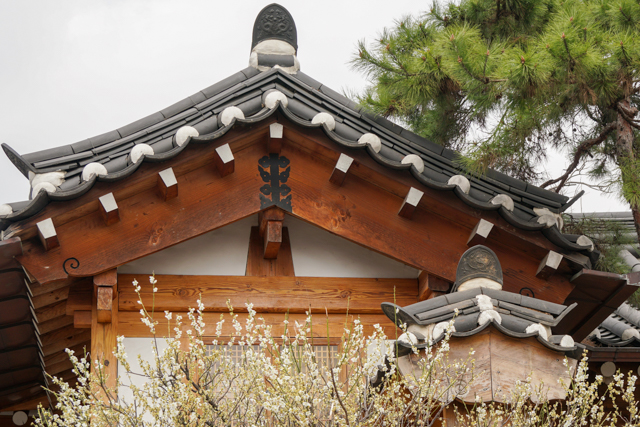
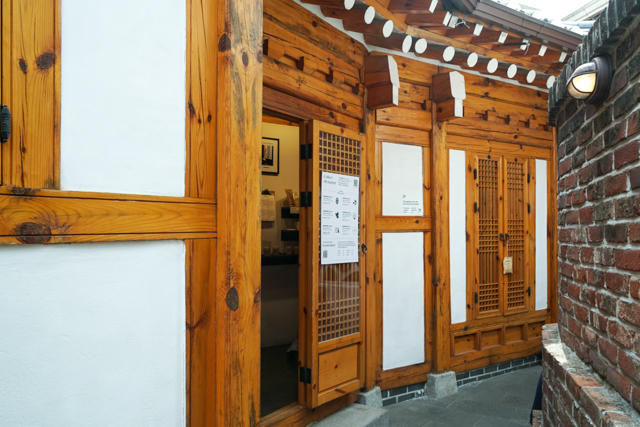
Around the corner, there was a fragrance store. Even from the entrance, the smell of all the scents was enough to overwhelm the senses.
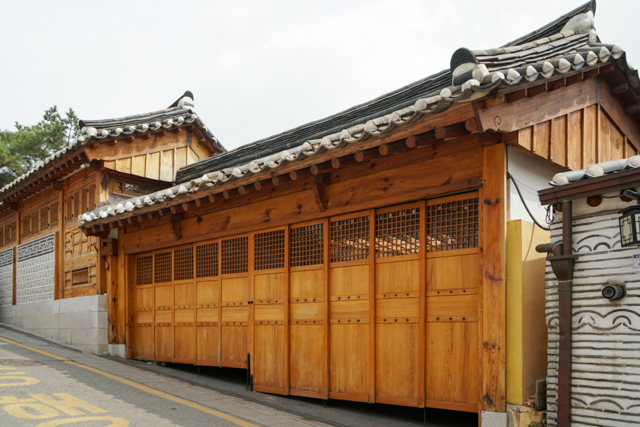
This garage matched the hanok-style.
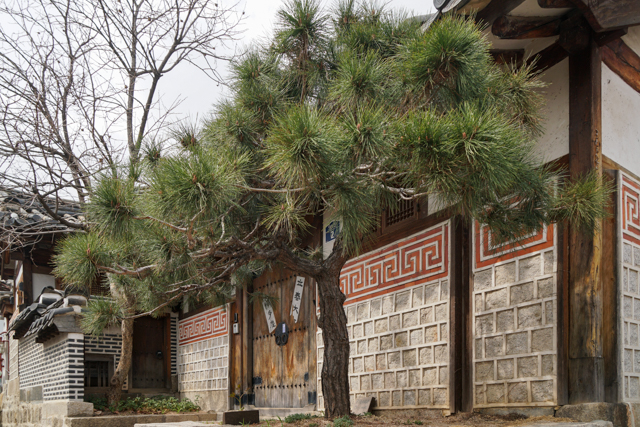
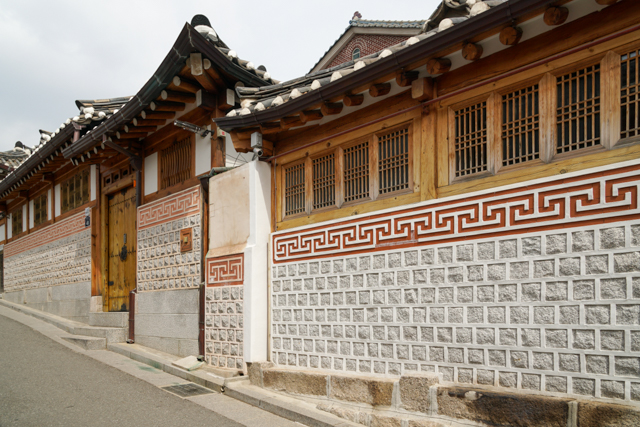
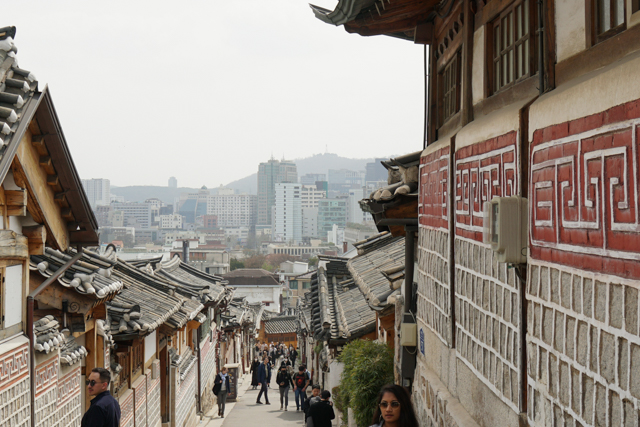
At the end of Bukchon-ro 11ga-gil is the photo spot seen all over the internet for advertising Bukchon Hanok Village. And for good reason, it was easily the best view, but there was not much in between to amuse the tourist.
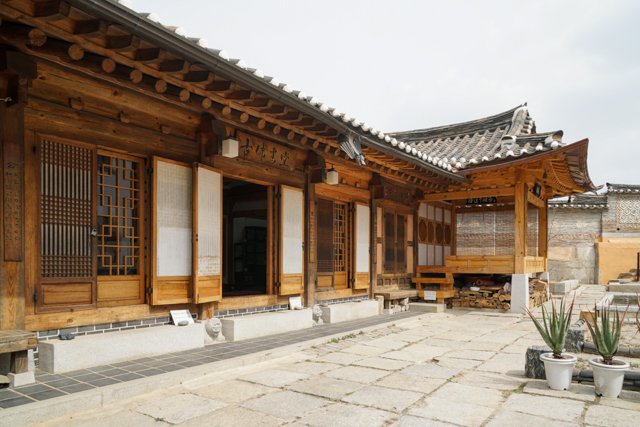
At the top of the road is a misleadingly placed marketing itself as an ‘Asian Tea Museum’. In actual fact, it was a regular cafe boasting admission to ‘Buckhon Best Prospect, Photo Zone’ for an uninspiring offering of regular teas. Not including the ‘London Bagel Museum’ from earlier that morning, this would not be the last time we’d be misled by a place in Korea calling itself a ‘museum’ when in actual fact it was nothing of the sort.
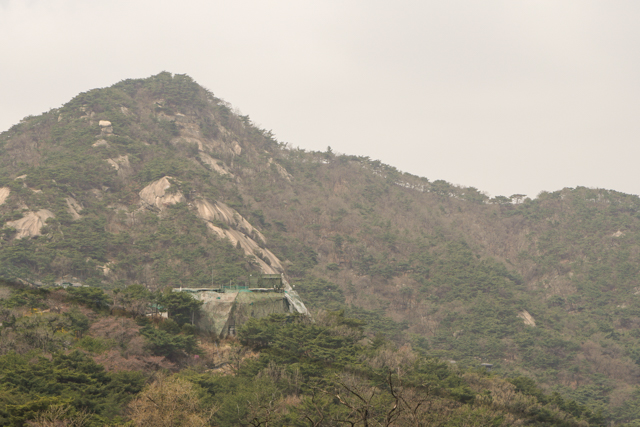
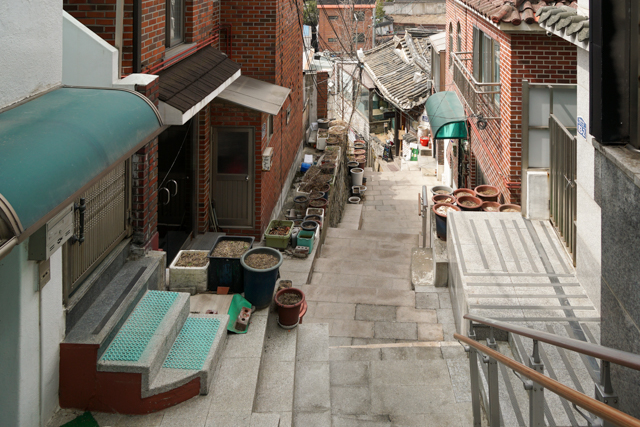
We attempted to stop by Cha Tuel, a well-known tea house in a hanok, but the waiting time for a table was over an hour. By then, we were so uninspired by the Bukchon Hanok Village that we were eager to move on to something a hint more interesting, so we made our way down the hill.
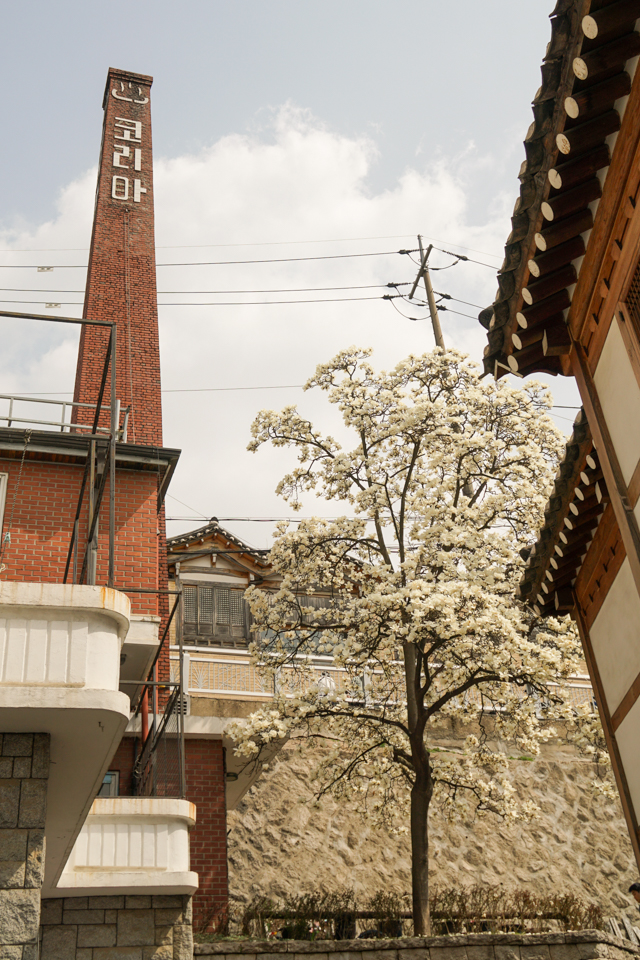
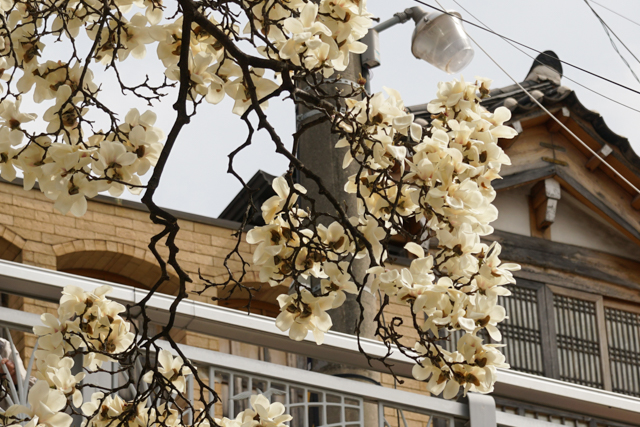
But not before we eat cake…
Samcheong-ro
삼청로, Jongno-gu, Seoul
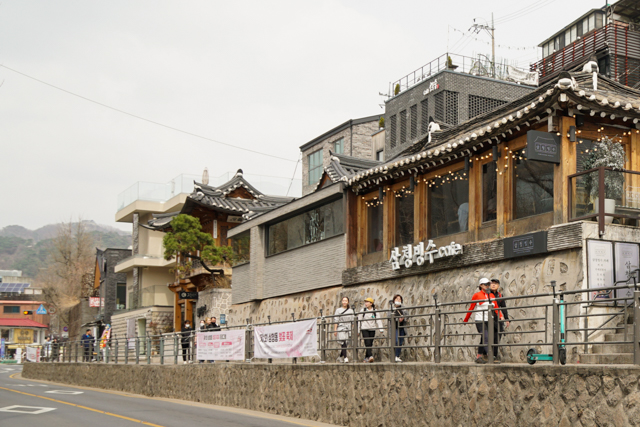
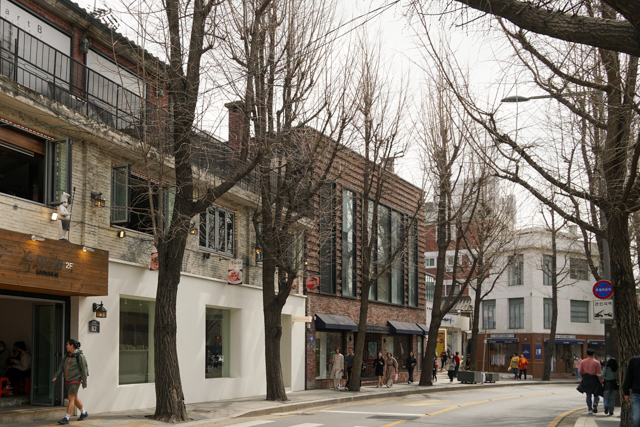
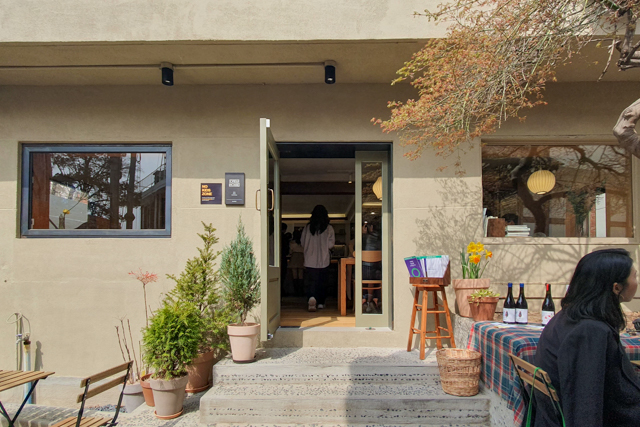
Onew House
오뉴하우스, 76 Samcheong-ro, Jongno-gu, Seoul, South Korea
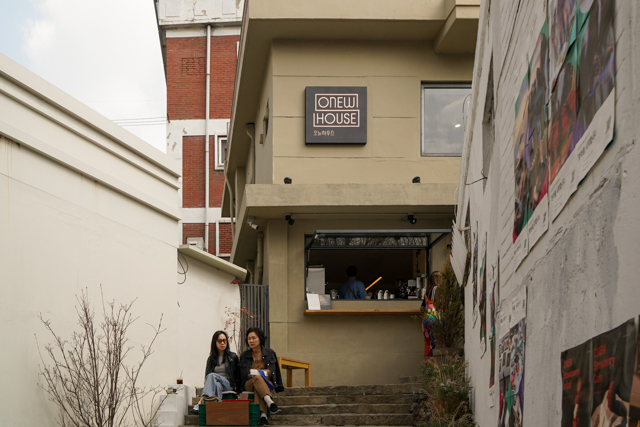
On the way down to Samcheong-ro and hot off a recent obsession with Japanese-style strawberry cake, and in dire need of a sugar hit, I was seduced by the range of strawberry desserts at Onew House.
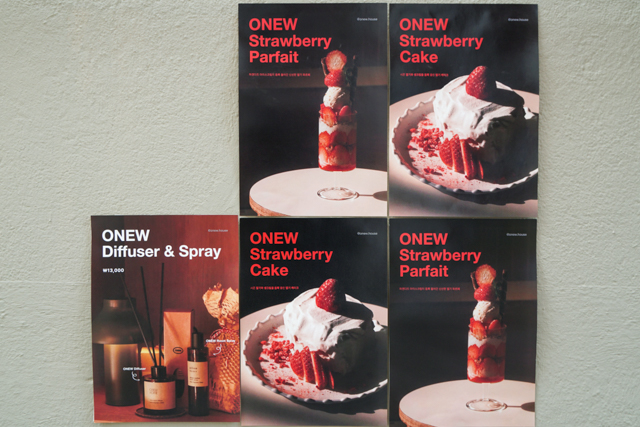
There was a strawberry parfait as well as a strawberry cake on offer.
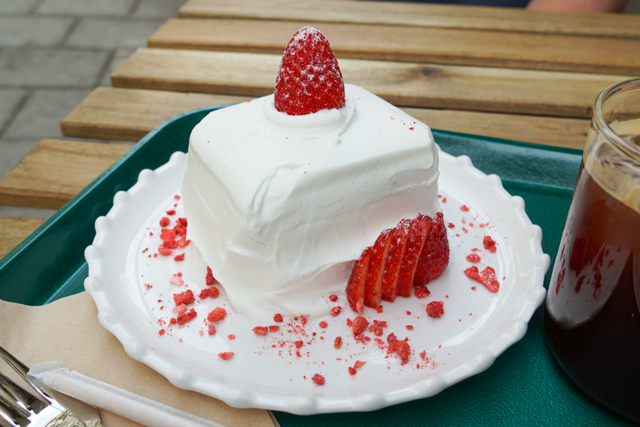
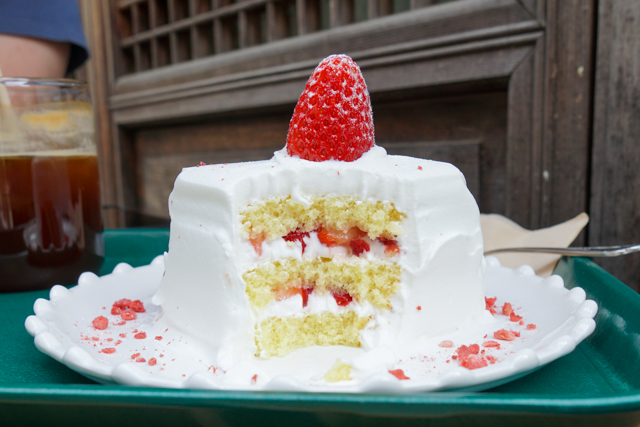
The Onew Strawberry Cake (13,000 won), was covered in smooth and light whipped cream, with three layers of sponge sandwiching layers of cream and strawberries, then dusted in freeze-dried strawberries and adorned with a whole fresh strawberry. The flavour of the strawberry was bright and sweet, while the sponge was light. Despite my initial scepticism of the cream shrouding the cake, it was surprisingly airy and added the light mouthfeel of the cake without overwhelming it.
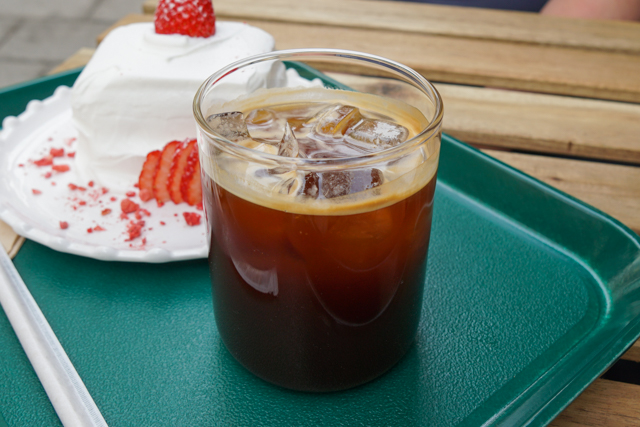
We ordered the Americano because the cafe required that each person order an item. It was decent, but overpriced and unremarkable.
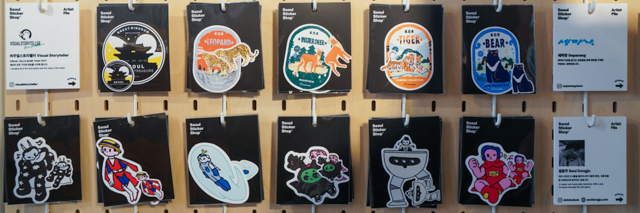
Seoul Sticker Shop
61-1 Hwa-dong, Jongno-gu, Seoul, South Korea
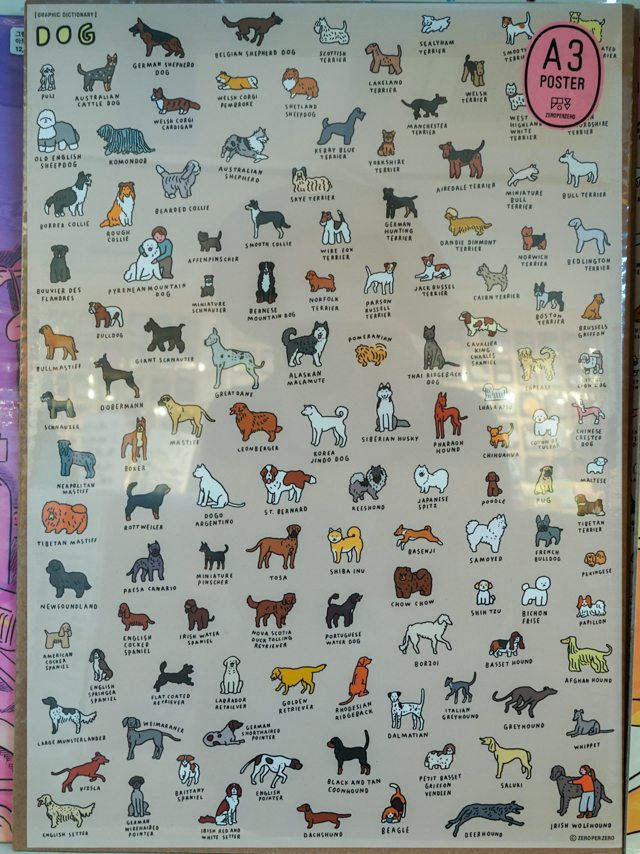
Other shops
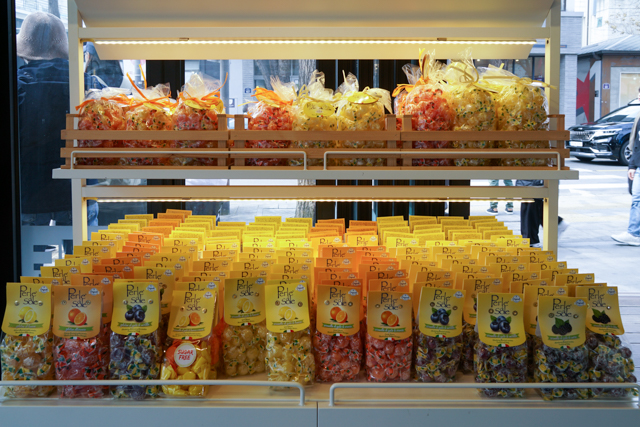
There was a shop selling hard candies from the Italian brand, Perle di Sole.
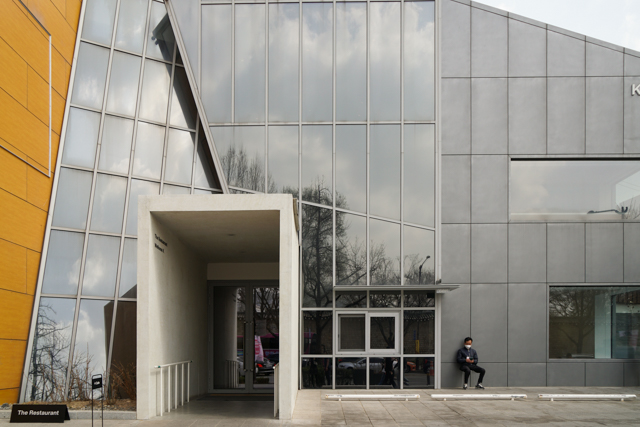
There was a restaurant simply called ‘The Restaurant’.
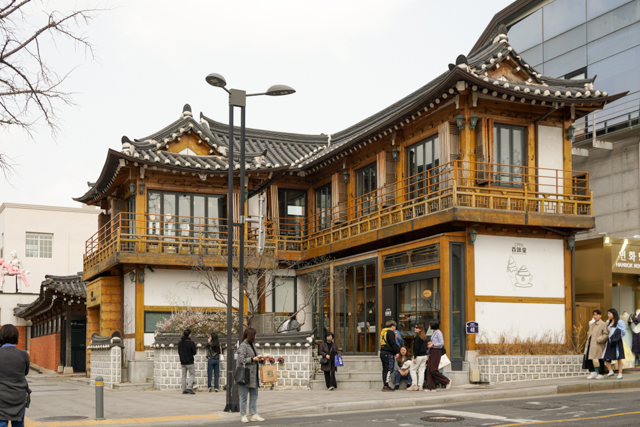
And a cafe, Baekmidang, which would’ve been a decent place for a break had we not already done so at Onew House.
National Folk Museum of Korea
국립민속박물관, 37 Samcheong-ro, Jongno-gu, Seoul, South Korea
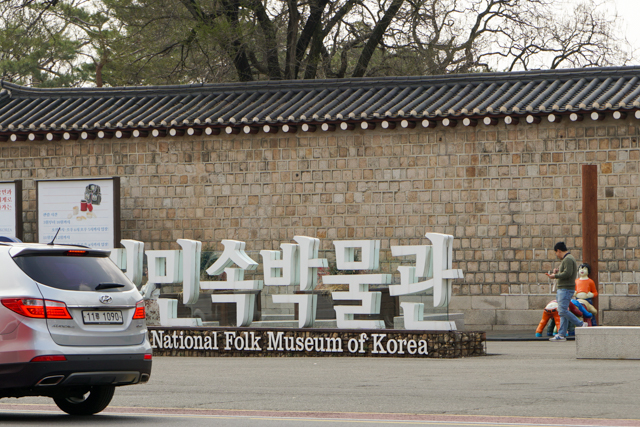
Across the road was the National Folk Museum of Korea, ‘a cultural space that conducts the research, exhibition, education, and preservation of the everyday life culture of Korean people’.
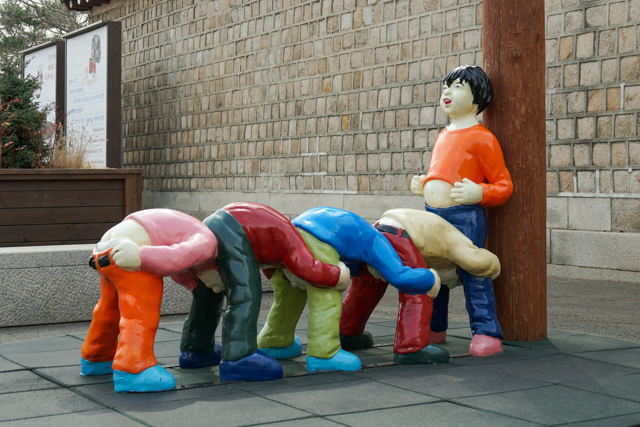
Outside the entrance was a sculpture depicting malttukbakgi, a game played by young Korean kids.
In malttukbakgi, there are two teams. Team A has one person stand up against the wall and the rest of the team have all their heads up in someone else’s butt/crotch area to form what looks like a big horse. Team B then jumps up onto the human horse one by one, each jumping with as much force as possible. If anyone from any team falls to the floor, that team loses. If everyone stays up, then the person against the wall and the person in front will play a game of gawibawibo (rock, scissor, paper) to determine the winner.
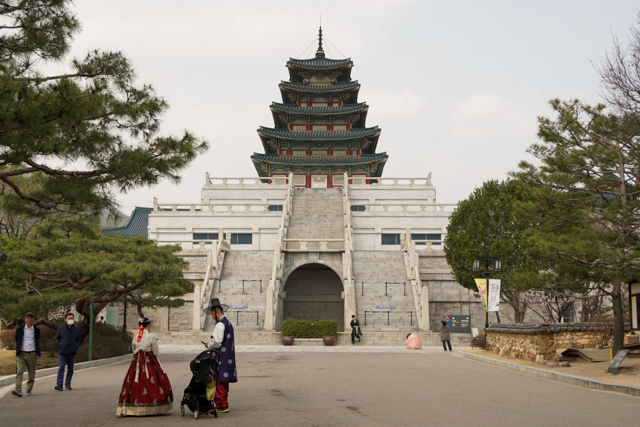
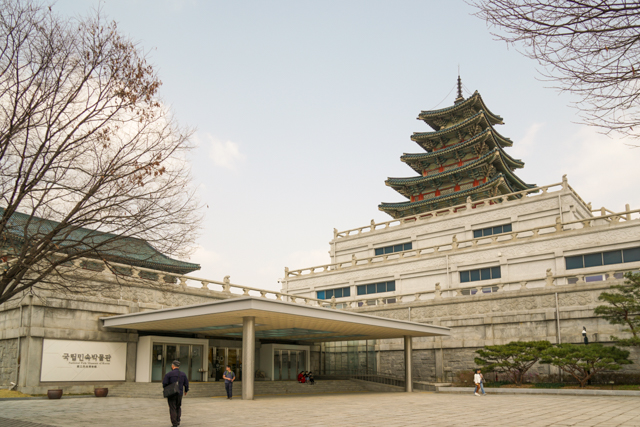
The architecture of the National Folk Museum of Korea was the prize-winning work of the National Museum Design Competition in 1966. The building was used as the National Museum of Korea from 1972 until 1986; since the National Folk Museum of Korea moved here in 1993, it has been in use until today. The stairs at the center were designed after Cheongungyo Bridge and Baegungyo Bridge of Bulguksa Temple. And the tall building at the center, the right side and the left side building are Palsangjeon Hall of Beopjusa Temple, Mireukjeon Hall of Geumsansa Temple, and Gakhwangjeon Hall of Hwaeomsa Temple, respectively.
Permanent Exhibition – Korean Traditional Daily Life
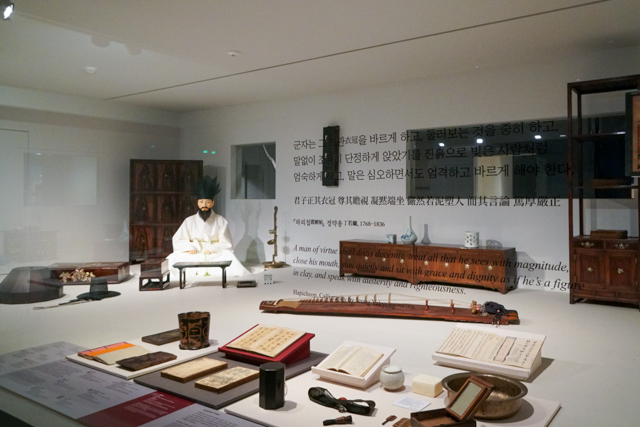
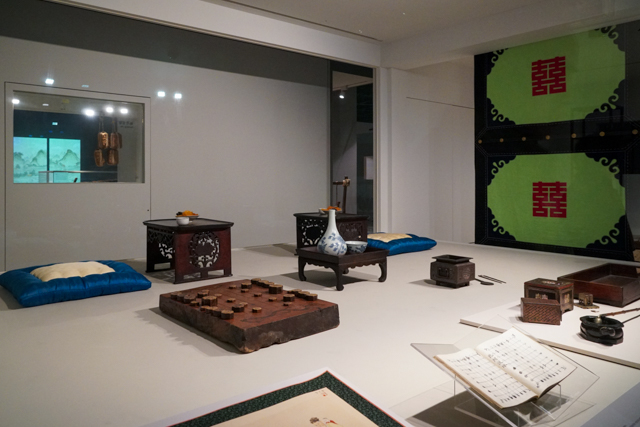
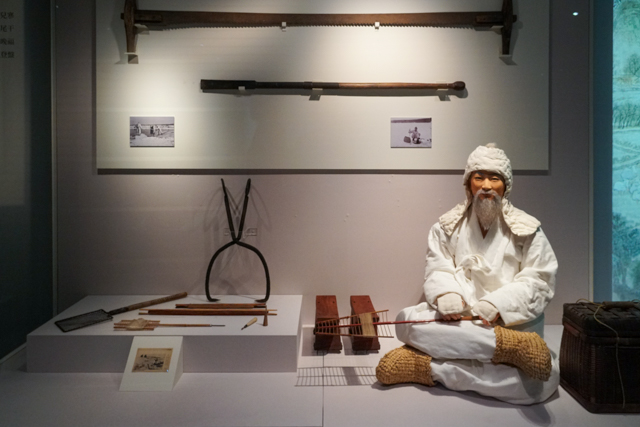
The permanent exhibition 1, “Korean Traditional Daily Life’ presents everyday in seventeenth to twentieth century Korea. A village community formed by a wide variety of people provided an important place to make a living.
This exhibition features items embodying the modest lives of villagers as they work from early in the morning until late at night to coexist in harmony with their neighbors and earn a livelihood.
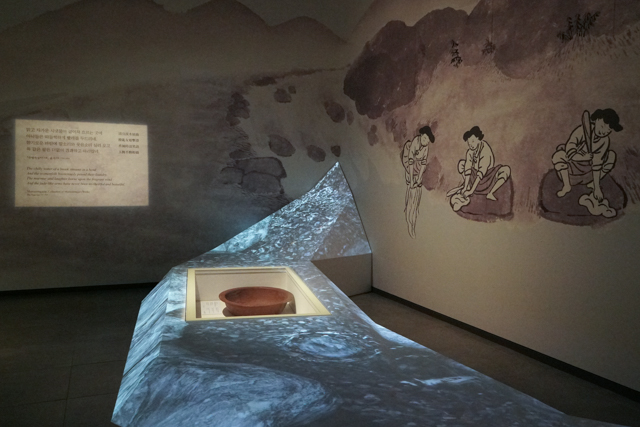
A scholar awakens at dawn, washes his face, and prepares for the day, a farmer prepares for the next year’s crop; an artisan produces daily necessities in his studio; a woman draws water from a well and washes laundry in a stream; a child plays in the field; and a woman lights a fire in the furnace while cooking dinner. A familiar scene of people starting and ending their days unfolds in this exhibition.
This exhibition hall changes with the season to reflect the cycles of daily life among Korean people as they experience and appreciate seasonal changes. The final section of this hall introduces “A Modem and Contemporary Day” as a contrast with traditional society, providing an opportunity to appreciate values that never change.
Morning, a Time of Awakening
As the crowing of a rooster breaks through the cold dawn, the bell ending the nighttime curfew rings out thirty-three times. Fields, rice paddies, and a cluster of houses gradually emerge through the veil of darkness. At last, the day begins.
Next to a well at the entrance of the village, people stand in line with their water jars to collect the clear water of early dawn. A mother prays sincerely for the wellbeing of her family in front of the water she drew at daybreak. A scholar who started the day by washing his face and tidying himself puts on his outer garment and hat and offers greetings to his parents.
A lively morning begins with officials wear light clothes on the way to work or with the jaunty steps of farmers who start the day by checking the weather. These different routines form a familiar yet constantly renewing spring morning scene.
Day, a Time for Work
During the daytime, the hustle and bustle of daily activities from farmwork to household chores is constantly repeated. Once the frozen ground thawed in the warm spring sunlight, farmers busied themselves ploughing their fields and paddies with plows and harrows and revitalizing their fields with fertilizer.
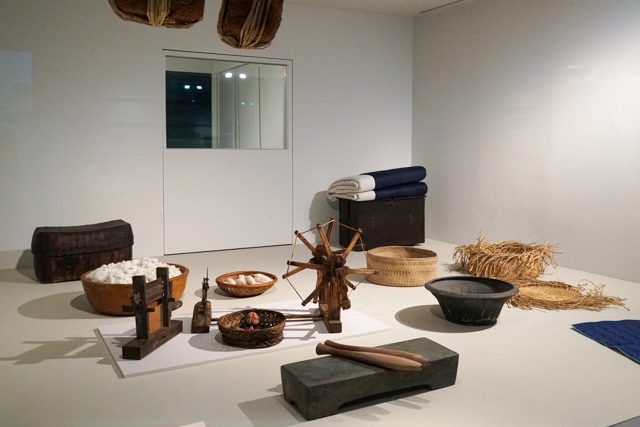
Women occupied themselves collecting spring greens to stimulate the appetite. They were also busy ginning the cotton from winter clothes and completing household chores like laundry. Master artisans made furniture and daily goods from the wood they had dried throughout the winter. Literati families occupied themselves greeting guests since this courtesy was considered an important virtue and obligation of the upper classes.
A market bustles with a crowd of women on their way to buy cloth to make new clothes for the season, merchants carrying daily necessities and selling them, and other people buying or selling products and bargaining over prices.
Night, a Time to Complete the Day’s Work
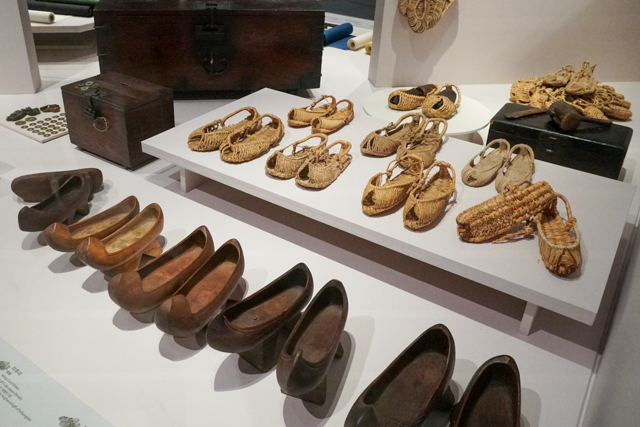
When the sun sets and night arrives, the pressures of the day would ease. At dinner, people relieve their fatigue by eating seasonal food, including spring greens. After dinner, the dim streets are deserted and people focus on tasks that could be done within the home. A scholar absorbed in studying under a lamp, and a woman ironing clothes for her family. They all spend the night preparing for the next day.
Soon, a bell announcing the nighttime curfew is struck twenty-eight times, and those who remain outside hurry back home. They nestle themselves into bed while gazing at the stars in the night sky and longing for the stability and prosperity that comes as spring fills everything with life.
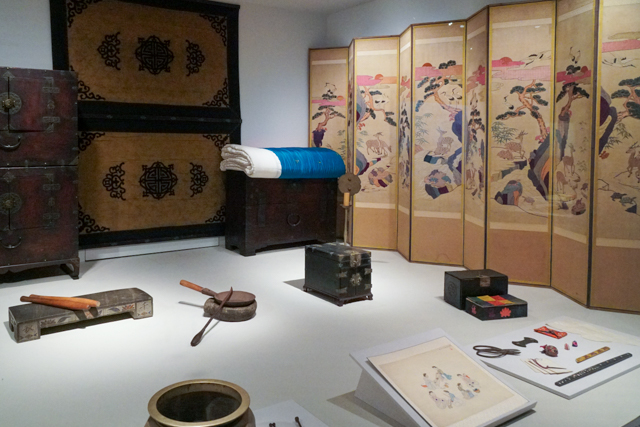
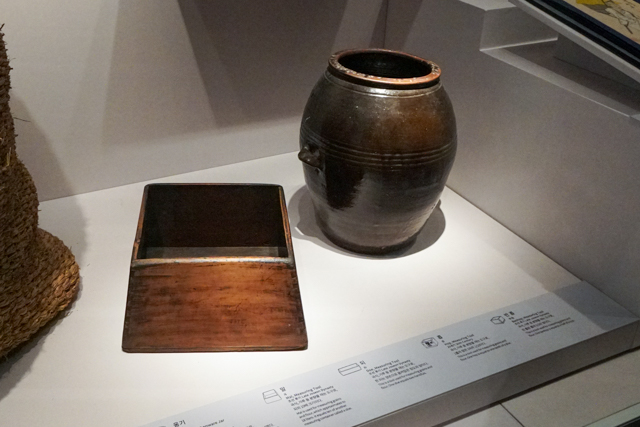
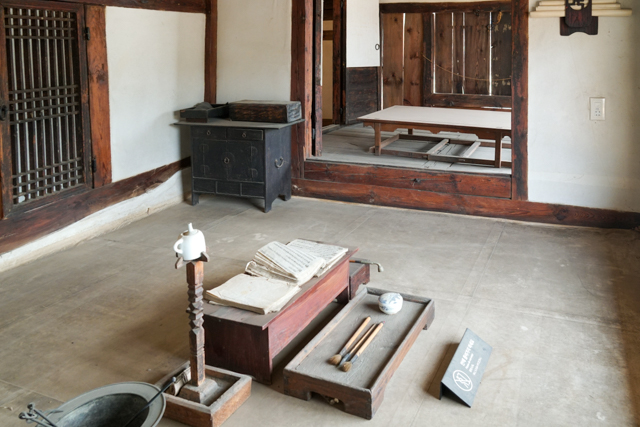
The square box is a mal from the late Joseon Dynasty.
Mal is used for measuring grains and flour, which approximates to 1.8 litres. It equals ten of another measuring container called a doe.
A Modern and Contemporary Day, Continuity in Daily Life
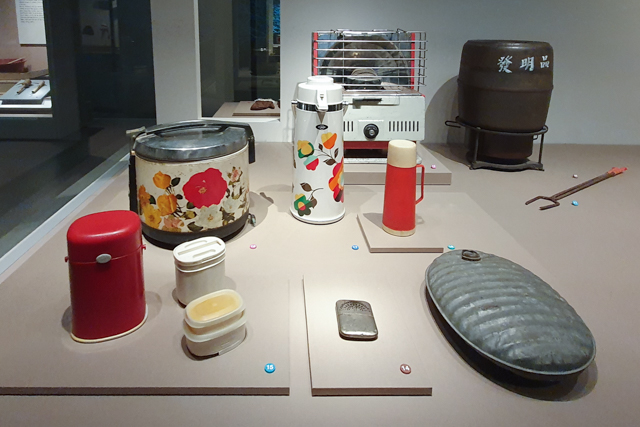
Industrial society brought changes large and small to people’s everyday lives. The crowing rooster that signaled the start of a day was replaced by an alarm clock. Family businesses that had operated for generations fell by the wayside while companies working with many people emerged and a variety of new occupations were introduced. Handicrafts were replaced by machinery. Artificial lighting brightened the night and prolonged daily tasks. Rather than wrapping up the day at dark, people tried to stay up until a time signal from the late-night radio. Nevertheless, greeting each new morning and living every day in pursuit of a better life remain universal.
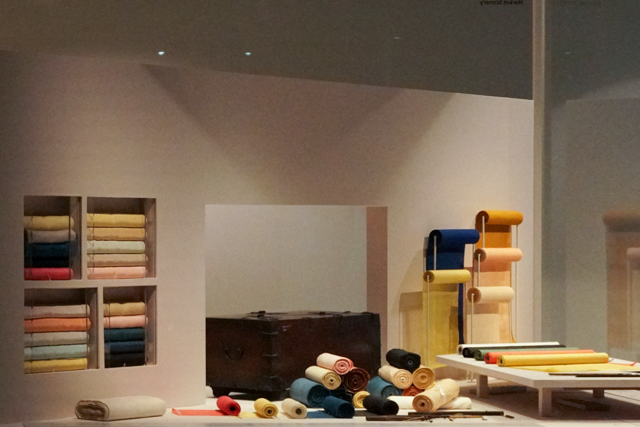
Raw Silk Fabric
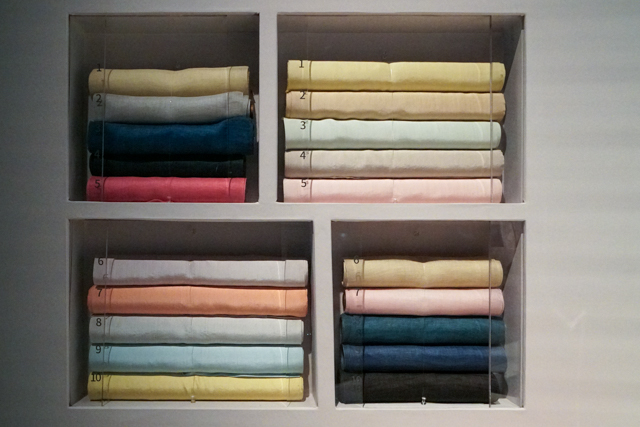
Silk is a fabric woven with fine threads spooled from silkworm cocoons and dyed using natural materials, including sophora flowers, gallnuts, safflowers, Amur cork trees, azaleas, Dyer’s Knotweed leaves and gardenia seeds.
- Sophora flowers
- Acorns
- Dyer’s Knotweeds and sophora flowers
- Gallnuts
- Safflowers
- Dyer’s Knotweeds and safflowers
- Safflowers and Amur cork trees
- Azaleas
- Dyer’s Knotweed leaves
- Gardenia seeds
Korean Folk Performance for Visitors
Every Saturday in March at 3:00 pm, the Folk Museum of Korea held folk performances from different groups in its Museum Theater. Admission was free.
The performance for our weekend was given by the nomadic entertaining troupe ‘Hyeopyulsa’.
‘Hyeopyulsa’ is a name of theatre founded in 1902 and was named regional nomadic Entertaining Troupe performing traditional plays after its closure . At that time, it tried to represent the joyful tune through the skills of Udo Nongak Preservation Association.
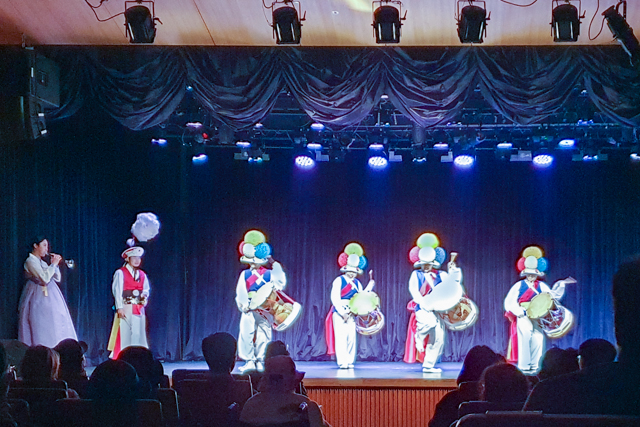
The opening stage Namdo Samhyeon and Sinawe was played in the form of samhyeon-yukgak Orchestra which was commonly used regardless of social ranks. Janngu (drum), piri (oboe), daeguem (fiddle), gayageum (zither) and haegeum (fiddle) are called samhyeon-yukgak.
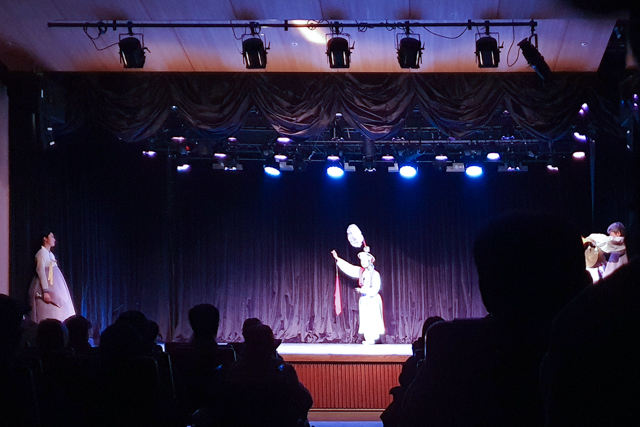
The following stage was Nam-do Chang, a medley in a popular sequence of ‘SeongJu Puri – Namwon Sansung’ and ‘Jindo Airang’. The performer had a headpiece that he could control by moving his head and neck.
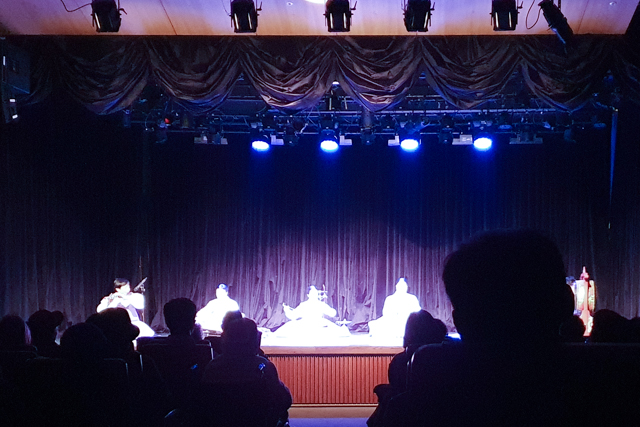
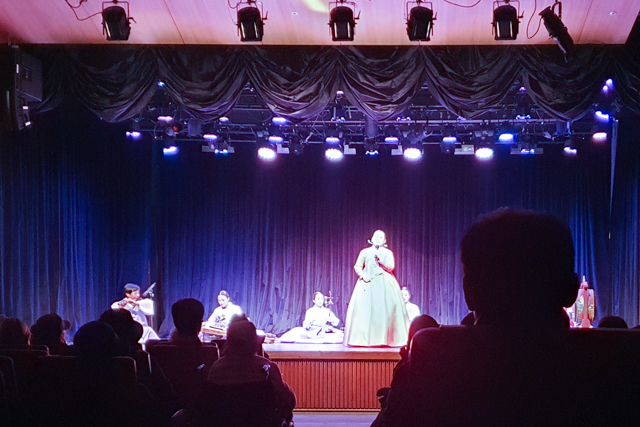
Next was Seoljanggu Nori in the style of Ochae Kim, who once performed with master singer Bangul Im, and Sangsoe-chum, in the style of the late Kyunghwan Jeon, an Intangible Cultural Asset Holder in Jeonnam province.
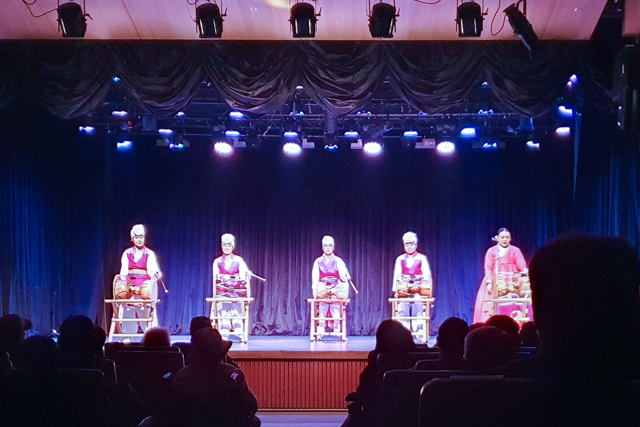
The finale was BTS’s ‘IDOL’ and ‘Dynamite’ played with janggu (drum).
Permanent Exhibition 2: A Year in Korea
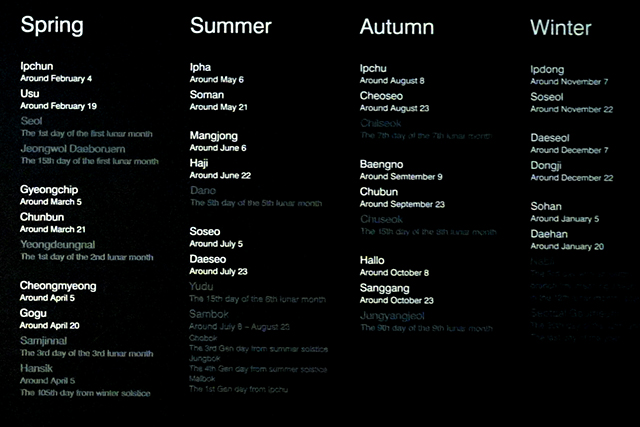
A Year in Korea shows the yearly life of Korean people from the 19th to the 20th century. It depicts our patterned life as it follows the passage of time, or the coming and going of the seasons, such as ‘Jeongwol, (The First Lunar Month)’ ‘Spring,’ ‘Summer,’ ‘Autumn,’ and ‘Winter.’
You can encounter lots of pleasant scenes: in Jeongwol, people dressed in seolbim (New Year’s clothing) celebrate the new year with bokjori (fortune strainer) hung on each house; in Spring, the sound of plowing announces the beginning of the year’s farming while spring blossoms are praised by joyous voices; fans and ramie clothes provide a brief cool break in the sweltering Summer; Autumn comes with the bliss of harvest and abundance of food, leaving us grateful to our ancestors; heated rooms and fellowship of people keep us warm in the coldness of Winter.
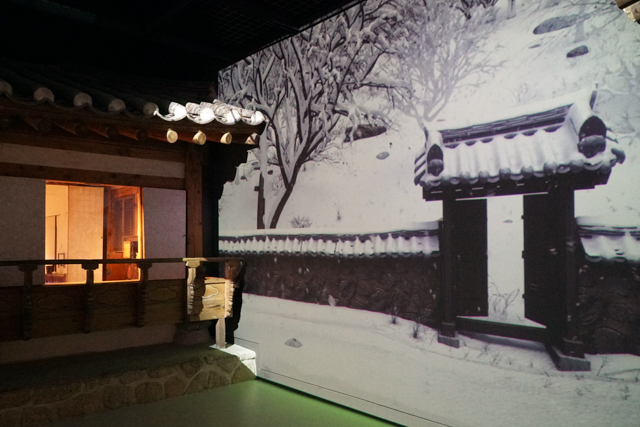
The Winter section leads to a hanok (traditional Korean house), where you can explore seasonal views with vibrant scenes of people living in it through an immersive video.
The exhibit is designed to show not only the seasonal customs — livelihood, beliefs, food, clothing and housing in the traditional era, but their change through the 20th century. The look and the meaning of a year’s life in Korea have been changed during the period, but the value in them remains.
Jeongwol
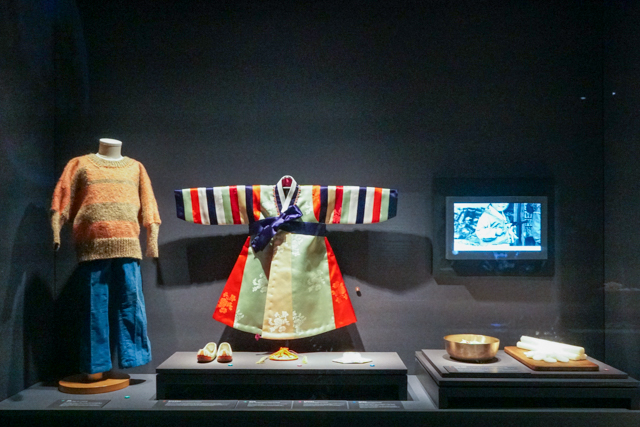
Jeongwol is the first month of the lunar year. As people welcome the new year, various seasonal customs are practiced between Seol (Lunar New Year) and Jeongwol Daeboreum (Great Full Moon Festival) to wish for the year’s abundance and peace. On Seol, people celebrate the Lunar New Year by eating tteokguk (rice-cake soup) and greeting one another with sebae (New Year’s bow) and deokdam (wishes for good fortune in the new year). In Jeongcho (the first days of the lunar year, including Seol), each family wishes for good fortune by hanging a bokjori (fortune strainer) and tries to predict their fortune for the entire year by reading Tojeong Bigyeol (The Secret Divinatory Art of Tojeong). Some of these customs are still practiced today.
On Jeongwol Daeboreum, each village holds a dongje (rites for village tutelary) to wish for the year’s abundance and peace while village people play juldarigi (tug-of-war) and make their wishes on the first full moon of the year. They also play yut nori (a traditional board game with four sticks), which is still enjoyed widely in the villages as well as at home.
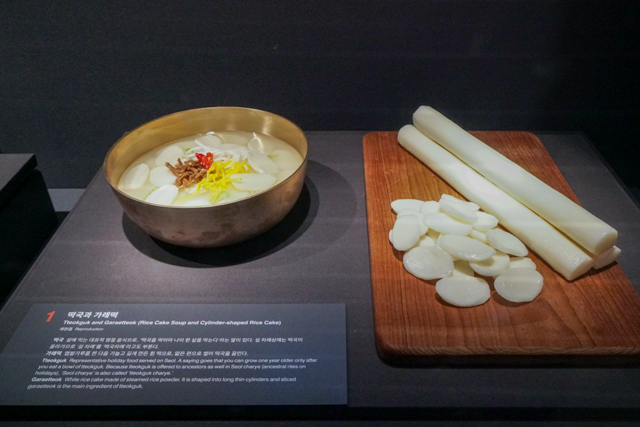
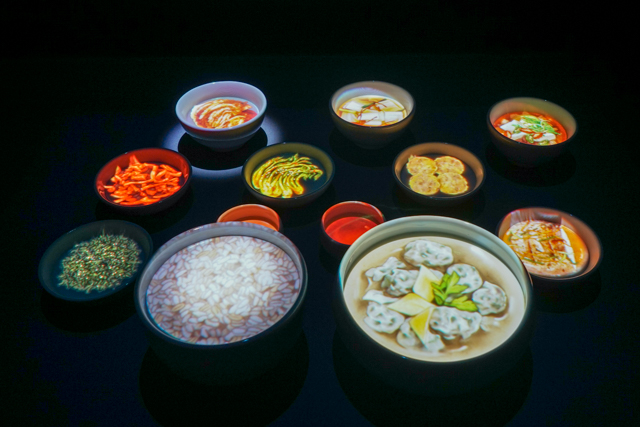
Tteokguk and Garaetteok (Rice Cake Soup and Cylinder-shaped Rice Cake)
Tteokguk: Representative holiday food served on Seol. A saying goes that you can grow one year older only after you eat a bow! of tteokguk. Because tteokguk is offered to ancestors as well in Seol chary e (ancestral rites on holidays), ‘Seol charye’ is also called ‘tteokguk charye.’
Garaetteok: White rice cake made of steamed rice powder. It is shaped into long thin cylinders and sliced garaetteok is the main ingredient of tteokguk.
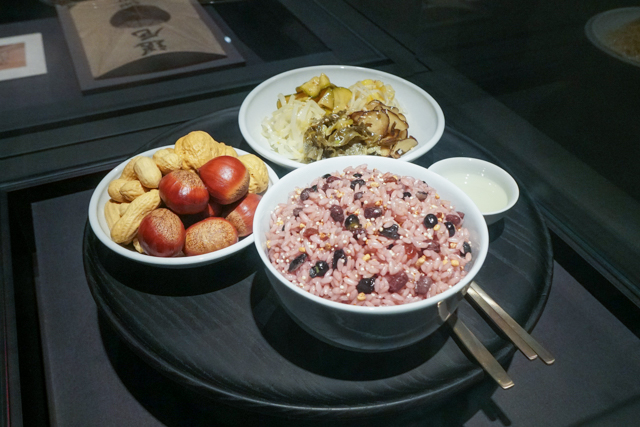
Jeongwol Daeboreum Jeolsik (Holiday Food for Great Full Moon Festival)
Gwibalgisul (Ear-Sharpening Liquor): Rice wine drunk before breakfast on Jeongwol Daeboreum to improve one’s hearing.
Dongguksesigi (A Record of the Seasonal Customs of the Eastern Kingdom): has the record of it: ‘Drinking a cup ot cheongju (refined rice wine) in the morning of Jeongwol Daeboreum is believed to clear the ears and bring pleasant news throughout the year, so every man and woman, young and old, drinks it.’
Bureom (Nuts): Nuts eaten in the early morning of Jeongwol Daeboreum. including raw chestnuts, walnuts, ginkgo nuts, and pine nuts. Bureom kkaegi (crunching nuts) is a custom related to a popular belief that crunching nuts with one’s molars on Jeongwol Daeboreum helps prevent various boils and strengthen the teeth.
Nine Namul (Vegetables): A dish made of nine kinds of vegetables dried in the previous year. Boiled in water and seasoned, these vegetables are eaten with a hope that all the vegetables will be plentiful in the year.
Ogokbap (Five-grain Meal): A dish prepared with five different types of grains including rice, millet, sorghum, red beans and soybeans. Eating ogokbap on Jeongwol Daeboreum means to pray for a good harvest, so it is also called ‘nongsabap (farming meal). Ogokbap is sometimes eaten after wrapped in gim (laver) or chwi (Fischer’s ragwort). In this case, the wrapped ogokbap is called bokssam (fortune wrapper), so eating it is like eating wrapped fortune, because it symbolizes ‘seom,’ a kind of container for grains
Spring
Spring is the season when the ground frozen in winter starts to melt and everything sprouts. It is also the starting point of farming and fishing of the year. Ipchun (Beginning of Spring, around the 4th of Februray), literally meaning ‘Spring enters,’ still belongs to winter. So in rural villages people start to plow the field preparing for full scale farming of the year after Ipchun when it begins to warm. In fishing villages, people start to fish after performing gut (shamanic rites) on Yeongdeungnal (Wind God’s Day) which is also considered the beginning of spring.
Around Samjinnal (Double Three Day), when the spring breeze blows and blossoms bloom, groups of people enjoy flower viewing and dapcheong (outdoor feast in spring), gathering spring namul (wild vegetables) from fields and mountains. Spring also has Hansik (Cold Food Day), when jesa (ancestral memorial rite) is performed at the gravesite and graves are trimmed, to show gratitude to ancestors.
Ipchun, Beginning of Spring
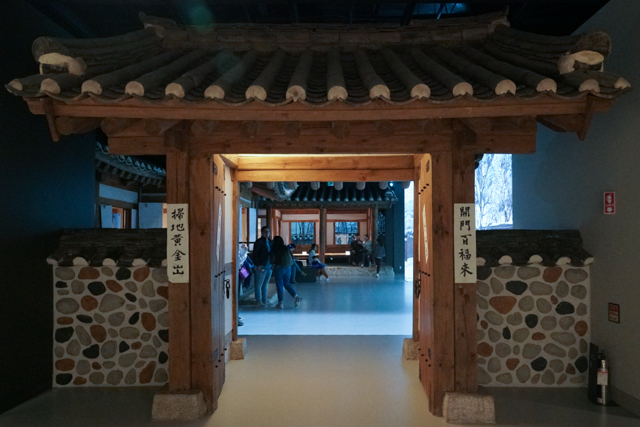
Ipchun is considered the beginning of spring and usually falls on the 4″ of February. Because 24 solar terms are based on the climate of North China. Ipchun is too early to feel the spring weather in Korea Still. Koreans have age-old tradrtion of posting on the gate or the pillars the writings that read they arc wishing for. even celebrating, the begmng of spring this day. This is a way of welcoming spring in advance and wishng for abundance and peace in the tarrWy. In Jeju. they pray tor good harvest in Ipchun gut (shamanic rite).
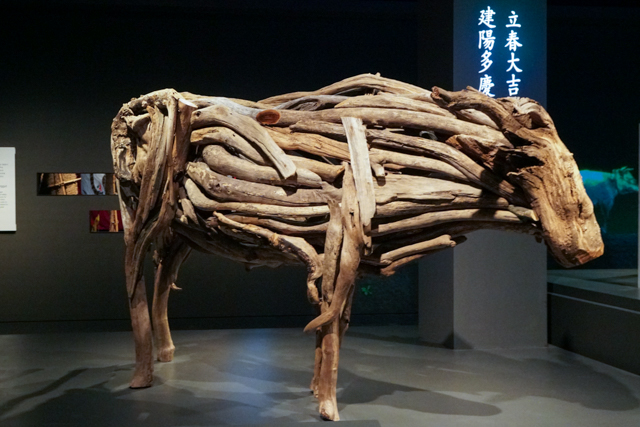
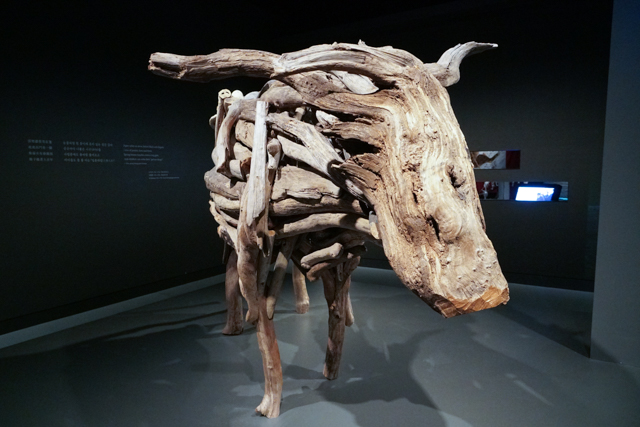
Wooden Cow
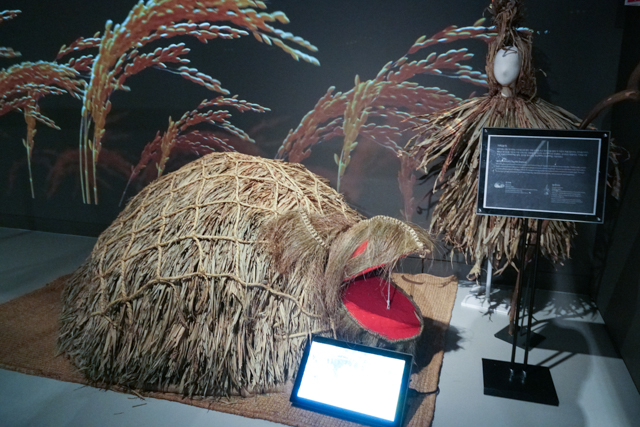
An ox made of wood, used in ipchun-gut (shamanic ritual performed on ipchun) in Jejudo. It is called nangswe in Jeju. This ox appears in mock plowing of ipchun-gut, wishes for a great harvest and announces the beginning of the year’s farming Tamnarok (The Record Of Tamna 1841), written by Yi Wonjo in Joseon period, describes a hojang (chief local official) in full uniform leading a wooden ox with courtesans following him on both sides.
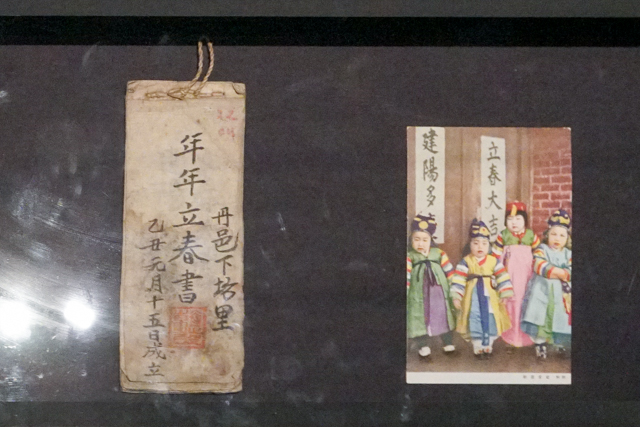
Ipchuncheop (spring welcoming message)
A piece of paper with a verse celebrating or wishing for the coming of spring written on it. It is posted on a gate, a pillar or a door on Ipchun (Beginning of Spring). The most commonly written verses for gates are ipchun daegil (new spring brings great luck) and geonyang dagyeong (vigor and lots of happy occasions). The verse varies according to the nature of the space in the house.
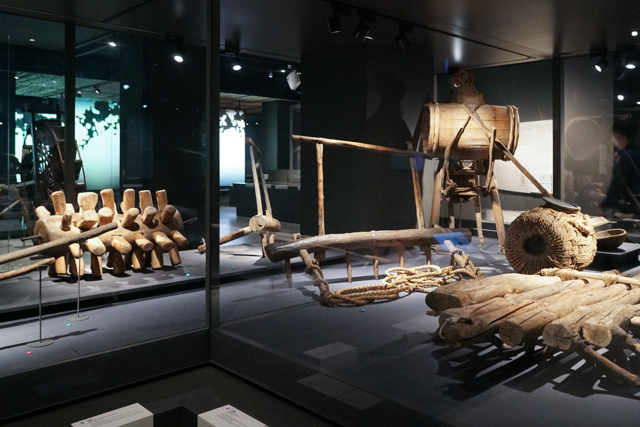
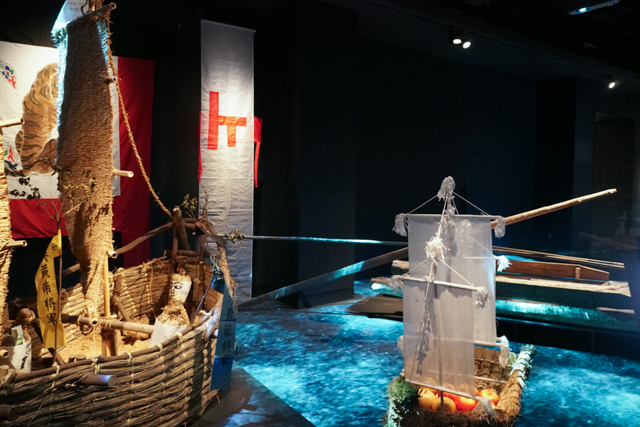
Pungeoje and Yeongdeunggut, Ritual for Good Catch and Ritual for Wind God
In the beginning of every year, fishing villages hold pungeoje to pray for a good catch and safety. The sea is a dangerous place where they work for a living, so safety is the most important for them.
In Jeju, people hold Yeongdeunggut every year on the 1st day of the 2nd lunar month, to pay respect to the wind god Yeongdeung and pray for a great catch and safety at sea.
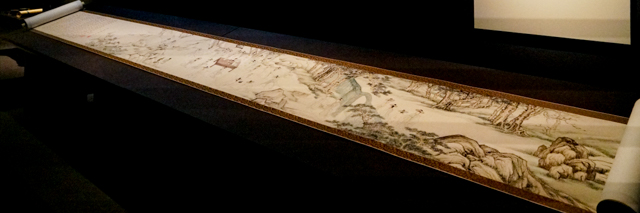
This scroll depicts samjinnal.
Samjinnal falls on the 3rd of the 3rd lunar month. It is considered to be the day of swallows returning from the south, because spring is in full bloom by this time. It is also called ‘Samjungir, ‘Samjinil’, or ‘Sangsail.
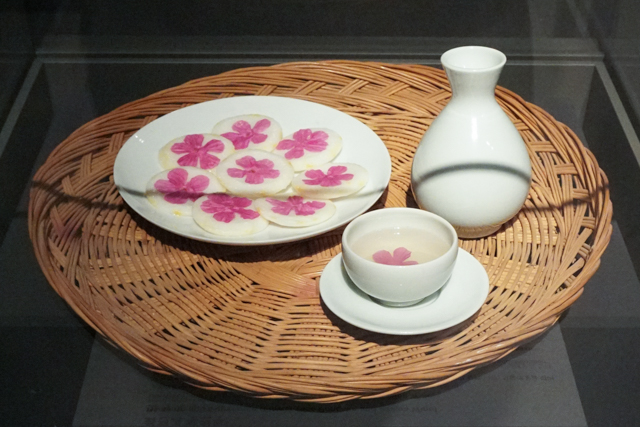
Hwajeon and Dugyeonju (Flower Rice Pancake and Azalea Wine)
[left] Hwajeon – A pancake made of thin, round pieces of soft glutinous rice dough cooked over an oiled pan and decorated with azalea flower petals.
[right] Dugyeonju – Wine made with azalea flowers. Dugyeon means azalea. When it gets warm and azalea flowers bloom,t he flowers are picked and put into nuruk (starter culture) to make wine.
Summer
Summer is the season with lots of sunlight and rain, when crops reach their full vitality. It means the busiest season for farmers though they do take occasional breaks from heat wave and a rainy spell. The most important work in summer is rice planting and weeding. Each village organizes dure (farmers’ cooperative group) to finish the work.
In yeomjeon (salt field) salt is produced in full scale and in coastal areas haenyeo (female divers), vigorously collect seaweed, abalone and sea urchins from the sea. Dano (Festival of the Fifth of the Fifth Month) is the day when people prepare for summer by exchanging dano fans. The term danojang (Dano decoration) refers to the way people decorate themselves on this day, including washing hair in changpo (Korean iris) water and dressing up in cool ramie jacket and skirt. They also enjoy swinging and plaining ssireum (traditional wrestling), and many places such as Gangneung hold festivals called Danoje. On Yudu (Water Festival of the Sixth Lunar Month), people used to go to the rivers or the streams to cool off. This custom is still practiced today when we plan summer vacations to escape the heat.
Key dates
- Dano – the 5th day of the 5th lunar month
- Yudu – the 15th day of the 5th lunar month
- Sambok – around July 8-August 23
- Chilseok – the 7th day of the 7th lunar month
- Baekjung – 15th day of the 7th lunar month
- Chuseok – 15th day of the 8th month
- Jungu – 9th day of the 9th
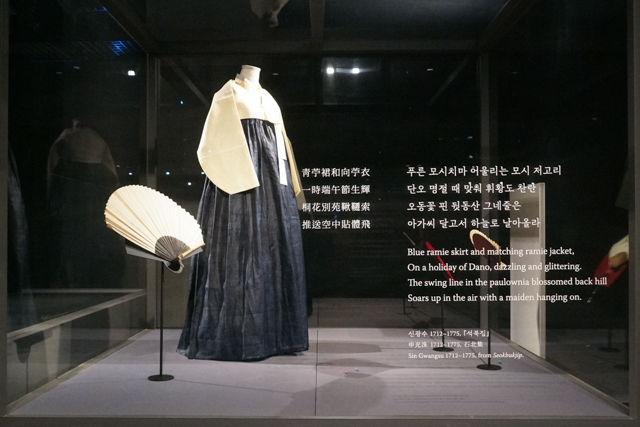
Dano is the fifth day of the fifth lunar month, also called ‘Surrinnal’ or ‘Cheongjungjeol’. It is considered the beginning of summer because it is believed to have the greatest yang (positive) energy of the year. On this day, talismans are made to keep away evil spirits, and people try to keep off the heat by washing their hair in Changpo (korean iris) water or eating surichwitteok (rice cake amde of synylus deltoides) and aengdu-hwachae (Korean cherry punch). They also give fans as gifts to one another and strengthen their bodies with sseireum (wrestling) for men and swining for women.
Some areas hold big festivals. Gangneung Danoje is one of most famous of such festivals, where the staged gut (shamanic ritual) and a nanjang (temporary open market) make amazing scenes.
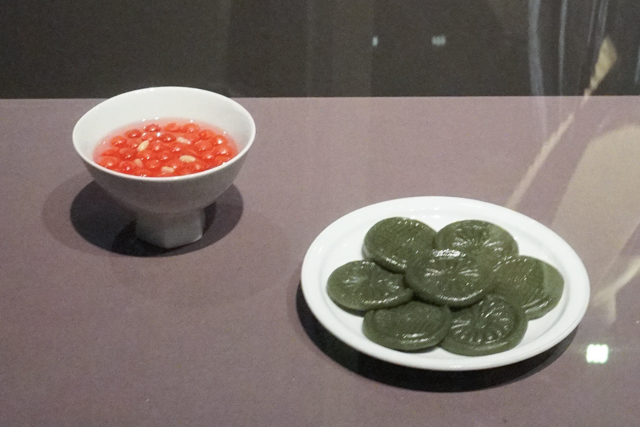
(Right) Surichwi-tteok – Round rice cake patterned with a wheel shape made with mugwort. Mugwort is abundant in the field until Dano [the fifth day of the fifth lunar month], so it is commonly used as an ingredient [in] rice cake.
(Left) Aengdu-hwachae – A seasonal beverage made with cherries preserved with honey. Cherries are in season around Dano [the fifth day of the fifth lunar month]. A few pine nuts are also added before drinking.
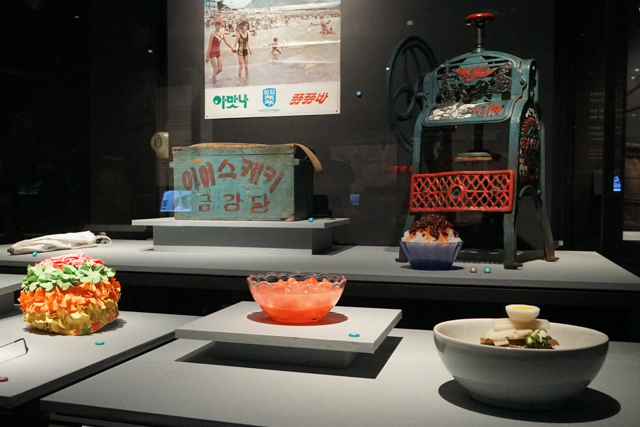
(Front, left): Swimming cap – a rubber cap worn on the head when simming. This one is decorated with flower shaped ornaments.
(Front, centre): Subak-hwachae – made with scooped or sliced watermelon pieces, bits of other fruits, ice cubes, and honeyed watermelon juice. It is a popular summertime refreshment.
(Front, right): Nangmyeon (Cold Noodles) – Noodles waten cold. Usually made of buckwheat noodles in chilled dongchimi (radish kimchi) water. It was originally a winter dish, as it is described as a winter food eaten in the 11th lunar month of Dongguksesigl (A Record of Seasonal Customs of the Eastern Kingdom). However, today it is commonly eaten in summer to cool off the heat.
(Back, left): Box for ‘Ice Cake’ (Popsicle) – A wooden box for popsicles to sell, in the time when refrigerators were rare. It is hung over the shoulder.
(Back, right): Ice Flake Maker – A took to make ice flakes for bingsu; Patbingsu (Shaved ice with Red Beans) – A kind of frozen dessert made of ice flakes with boiled red beans on top. It is one of the most popular summer desserts.
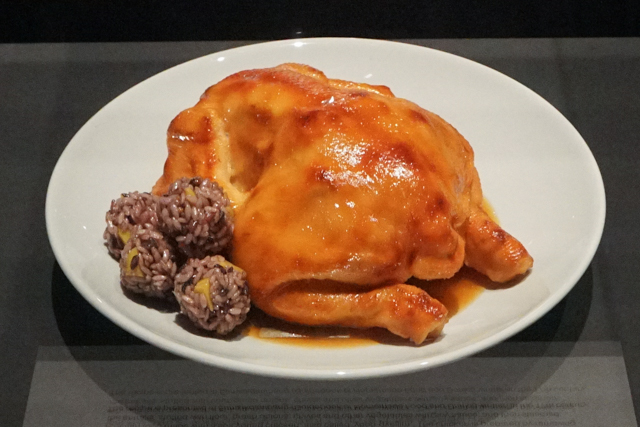
Yeon-gyujeung (Stealed Soft Chicken)
A health food made with a soft young chicken, also called ‘yeon-gyejjim’. The chicken is prepared by removing the entrails, stuffed with flour, green onions, chives and other vegetables with soy sauce, and then steamed. The recipe is presented in Eumsikdimibang (Guidebook of Homemade Food and Drinks) written in the 17th century.
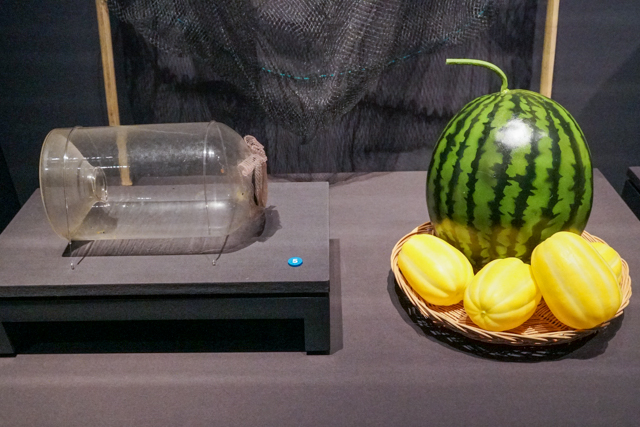
Yudu, Water Festival
Yudu falls on the 15th of the 6th lunar month, and the term is an abbreviation of the phrase dongryu-sudumokyok.’ which means washing hair and taking a bath in the water flowing eastward. It is also called Sodu or Sudu. Sodu means to wash hair and Sudu means to water the head.
Traditionally on Yudu, yangban (noblemen) enjoyed takjok, dipping their feet into cool streams in a valley, and common people went to the valleys or rivers to cool off. Yudu cheonsin is a rite of offering newly harvested fruit, potatoes and corns to ancestors on this day. Farmers also offer rituals at the sluice gate of their paddy to wish for the desirable growth of their rice plants. Yudu culture has passed on to today’s practice of summer vacation when people reach for the seas or valleys to escape the summer heat.
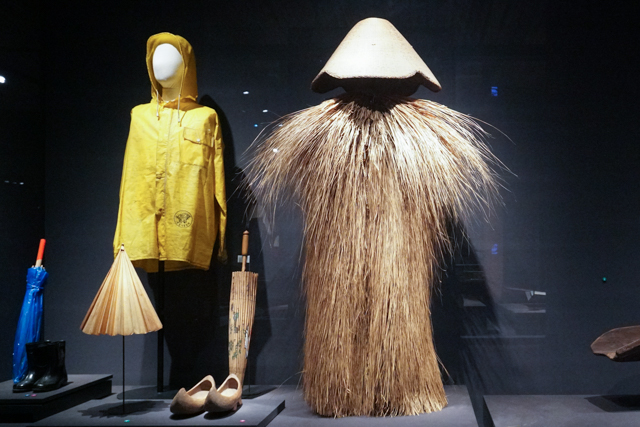
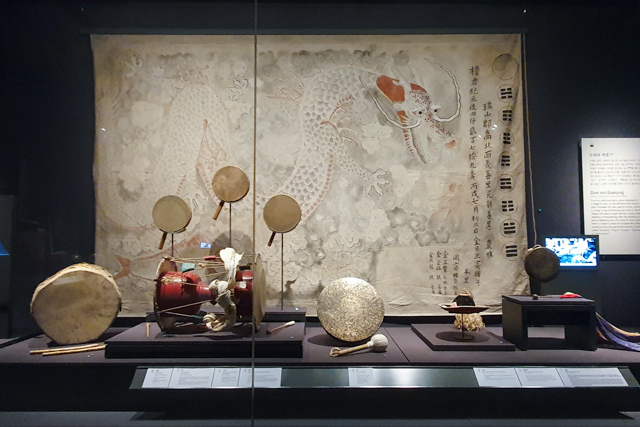
Autumn
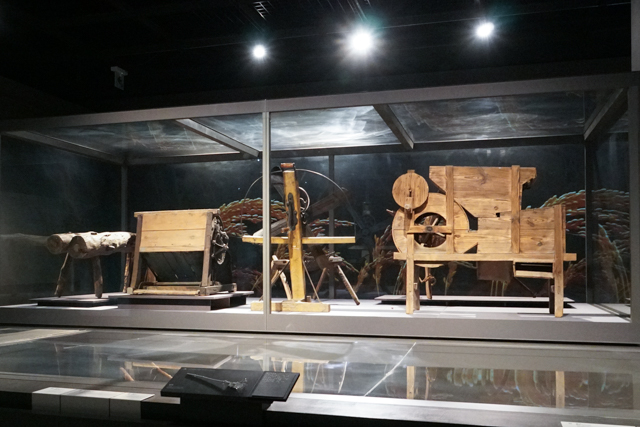
Autumn is a plentiful season when you harvest the crops sown in spring and summer. Farmers are busy wrapping up the year’s farming while cutting, threshing and storing rice.
In the middle of autunn lies Chuseok (Harvest Festival), one of the two biggest festivals in Korea along with Seol. It originated from Gabe, a weaving competition in Silla dynasty. On this day, liquor and rice cake made from newly harvested grains are offered in charye (ancestral rites held on holidays) to show gratitude to ancestors. Since the urbanization and rural exodus, a mass migration of those heading for their hometowns is observed during this holiday. They visit their families and relatives with armfuls of gifts.
Key dates:
- Chilseok – the 7th day of the 7th lunar month
- Chuseok – the 15th day of the 8th lunar month
- Jungyangjeol – the 9th day of the 9th lunar month
- Ipchu – around August 8
- Cheosseo – around August 23
- Baengno – around September 9
- Chubun – around September 23
- Hallo – around October 8
- Sanggang – around October 23
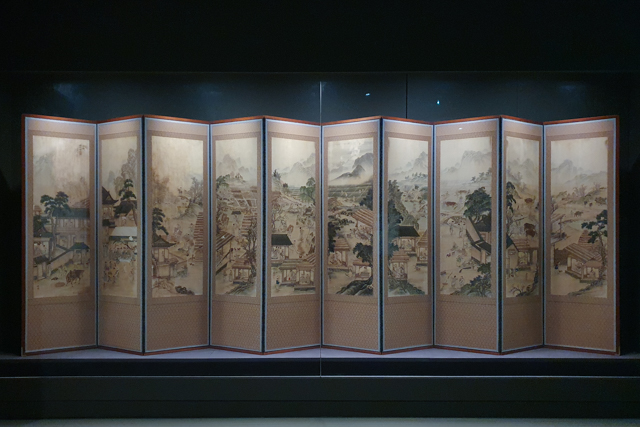
Ten-Fold Folding Screen with Genre Paintings, before 1938 by Gim Yunbo (pen name: Iljae; 1865-1938)
A piece of genre art depicting seasonal activities of an agricultural village, including plowing in spring, sowing, planting, weeding and harvesting. It also contains various scenes from everyday life: serving guests, weaving, laundering, having a feast, and so on.
Winter
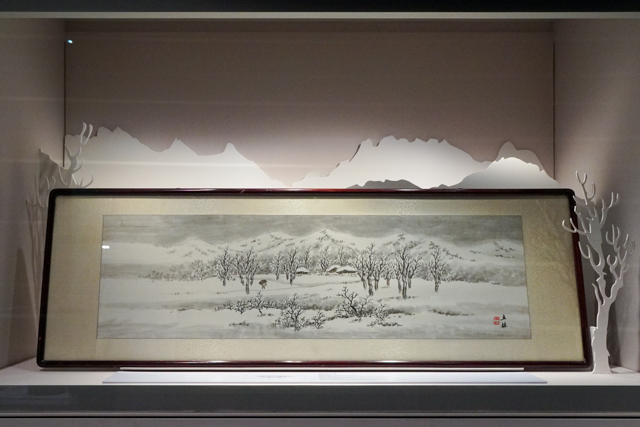
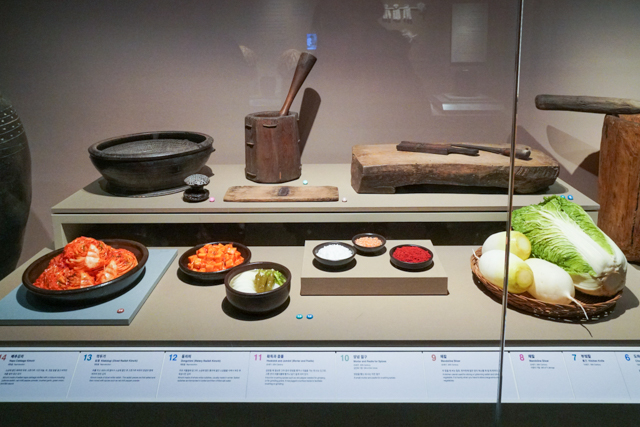
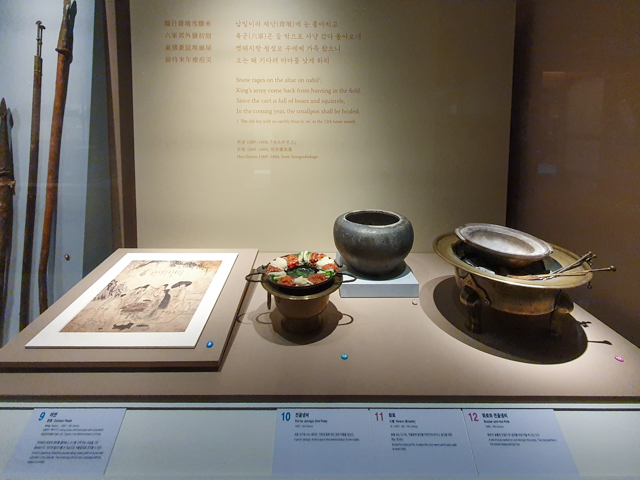
Winter is the season with snow and biting cold. While farmers spend the end of the year doing things to prepare for the new year, such as getting firewood, repairing farming tools and resting, fishermen are busy cultivating oysters or laver and catching skate and pollack. For many families, winter is the season for Kimjang (making Kimchi to store and eat during the winter). They also make meju (fermented soybean brick) for soybean paste and soy sauce, and try their best to keep warm.
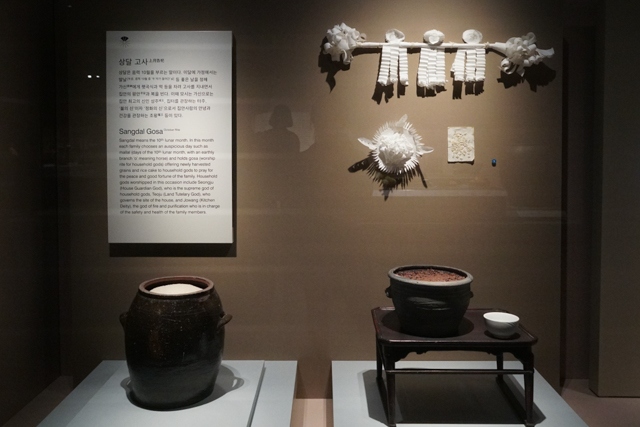
In Sangdal (the 10th lunar month), Sangdal gosa (October Rite) is held, where they wish for the peace and good fortune in the family by offering harvested crops to various household gods. Dongji (Winter Solstice) is the day when people exchange next year’s calendars. This is called Dongji Chaengnyeok. They also make Dongji patjuk (red been porridge) to eat or sprinkle on the gates and exterior walls to keep away evil spirits. In recent years, Dongji is also the season when Christmas carols and Salvation Army’s bells start to ring on every street to send the end-of-the-year message and people get busy sharing year-end greetings with one another.
Gukhwaju (Chrysanthemum Wine)
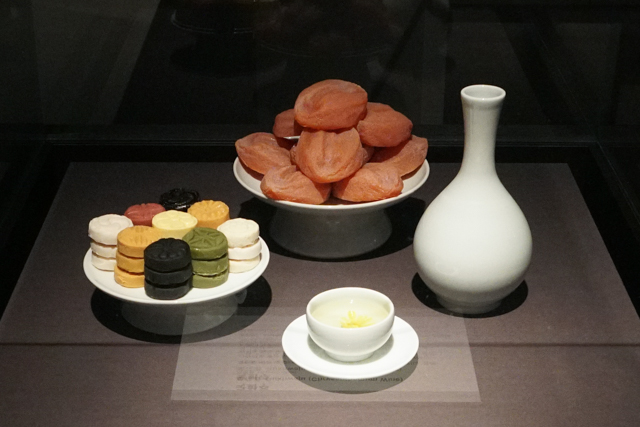
A kind of wine brewed with chrysanthemum. It is enjoyed on Jungyangjeol (Double Ninth Festival) when chrysanthemums are in bloom. ALong with dugyeonju, a kind of wine brewed with azaelea petals in spring, it is representative Korean seasonal wine.
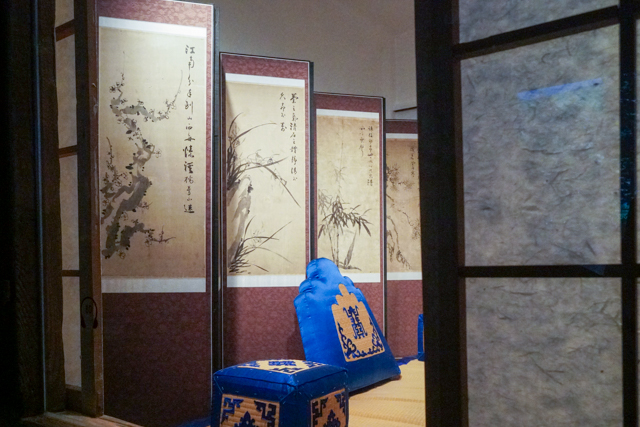
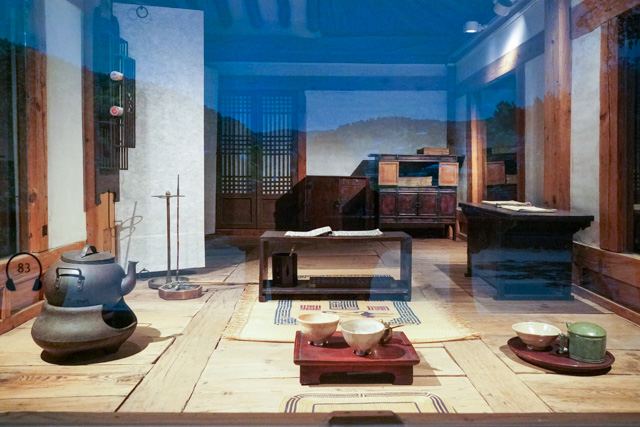
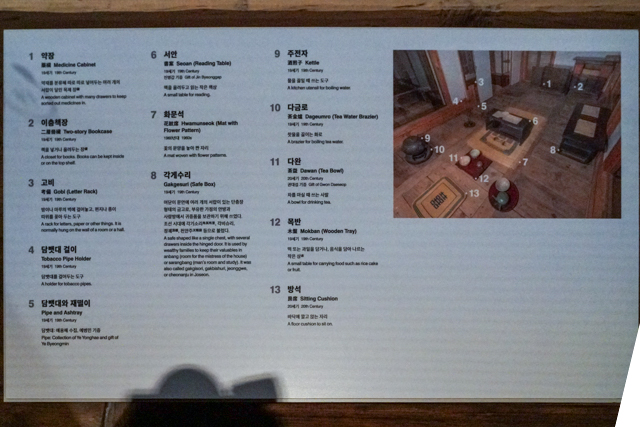
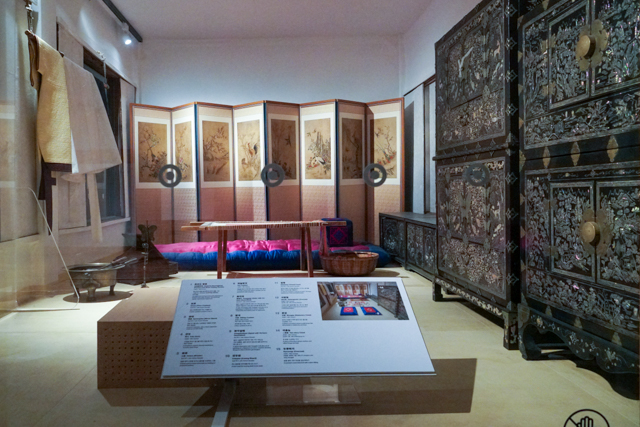
Seasonal Landscape and Life in Hanok (Immersive Exhibit)
Feel the beautiful scenery of spring, summer, autumn and winter of a hanok, in its sarangchae, anchae, yard and jangdokdae. Experience everyday life in these special spaces.
Permanent Exhibition 3: Korean Life Passages
In the exhibition gallery titled Korean Life Passages, important life events from the Joseon Dynasty to the early 20th century (1392-1910) are displayed.
According to the ideology of the Joseon Dynasty’s, Confucianism, having a son was very important in order to continue the family lineage. During pregnancy, the family would ardently pray up until the child’s birth for a son. After the child’s 100th day and 1st birthday, the family would throw a celebration for hitting both respective milestones healthily. When males turned 20 years old, a coming-of-age ceremony (gwanrye) was held. Females also had a coming-of-age ceremony (gyerye), however, the ceremony was held at the age of fifteen. After having a coming-of-age ceremony, which symbolizes becoming an adult, the next step in life is marriage. Through marriage (honrye), a new family is formed. The males aspired to obtain a position within the government by passing a state exam, then would support their family, the females would manage the household. Funeral ceremonies (sangrye), members of the family would grieve by carrying out ancestral rites for the deceased. Through this, deceased ancestors are treated as a minor deity, with the family wishing for prosperity and harmony.
Due to changes in ideology, modern day child birth has become important regardless of gender. While the coming-of-age ceremony is reduced and the wedding ceremony relatively became simpler than before, the basic structure and meaning of those ceremonies have not changed. The concept of family has been diversified, with males and females no longer sticking to their traditional roles. Though funerals and rituals have changed with the times, the core methodology of honoring their deceased ancestors and wishing for harmony has remained.
Birth
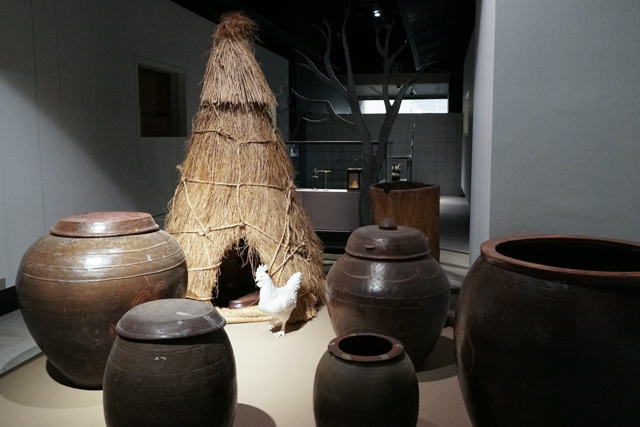
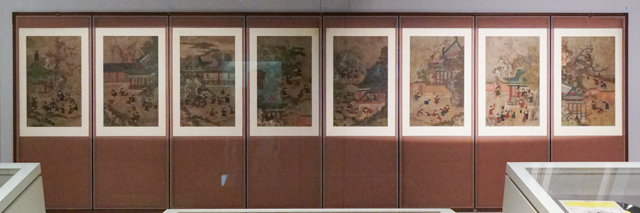
During the Joseon Dynasty, family lineage was passed down from father to son. The family commonly prayed for the birth of a healthy son, as well as for the “prosperous descendants”, to the goddess of childbearing named samsin halmeoni. After the child was born, a straw rope (taboo rope) was hung in front of the house gate as an announcement of the birth, and to ward off unwanted guests, spirits, and diseases. The placenta was placed into a dedicated pot and buried in a clean area, or was burned as a ritual to pray for the child’s well-being. Due to the high infant mortality rate, When the child made it to their 100th day, a large ceremony was held. Similarly, when the child turned 1 year old, another celebration took place along with the child’s future predictions.
Today, families continue the custom of celebrating when a child is born as well as their 100th day and the 1st birthday, irrespective of gender. However, the rituals and taboos of childbirth are disappearing as more births occur in hospitals.
Education
In the Joseon Dynasty, there was an effort to establish a higher morality in their culture through Confusian ethical education based on samganggoryun, three fundamental principles and the five moral disciplines in human relations. In order to reinforce this ideology, awards were given to the filial sons and dutiful daughters from the government. An illustration book titled “Samgang haengsildo (Illustrated Conduct of the Tree Bonds, 1434)” showing the three fundamental principles of human relations was translated and distributed widely for people to learn and follow. Men started learning reading and writing at village schools (seodang), and then they attended local public schools (hyanggyo) or private academies (seowon) to study Confucian scriptures and history to prepare for and to pass the state exams. On the other hand, women learned hanguel (Korean alphabet) at home, so they would expand their knowledge by exchanging letters or reading books translated into Korean.
Today, unlike the Joseon Dynasty, knowledge is learned through kindergartens, elementary, middle, and high schools, and is available to everyone, regardless of social class or gender. After graduating high school, or an equivalent institution, students take various aptitude tests and evaluations to either enter a university or the workforce.
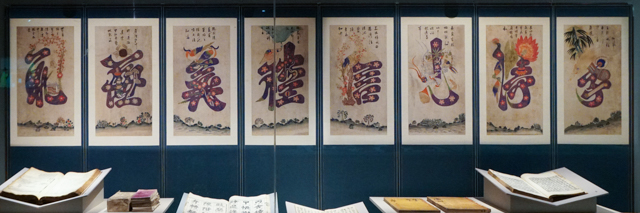
Hanja, Korean name for a traditional writing system consisting mainly of Chinese characters, was used during the Joseon Dynasty, so from an early age, people studied Cheonjamun one Thousand Characters) in order to learn the meaning and sound of Chinese characters at a village school. In addition, to obtain basic ethical knowledge, people studied the “three fundamental principles and five moral relationships” and the achievements of the wise by reading Dongmong seonseup (Children’s First Learning) and Sohak (Introductory Book to Neo-Confucianism) as well as Jujagorye (Family Rites by Zhu Xi).
In order to learn Confucian virtues and prepare for the civil service examinations, people studies the authoritative books of Confucianism, the Four Books and Three Classics {Great Learning, Doctrine of the Mean, Analects, Mencius. Classic of Poetry, Book of Documents. Book of Changes). Chinese history book called the Essentials of the Comprehensive Mirror to Aid in Government, and the collection of prestigious Chinese writings, Genuine Treasures of Old Literature, to acquire writing skills and senses.
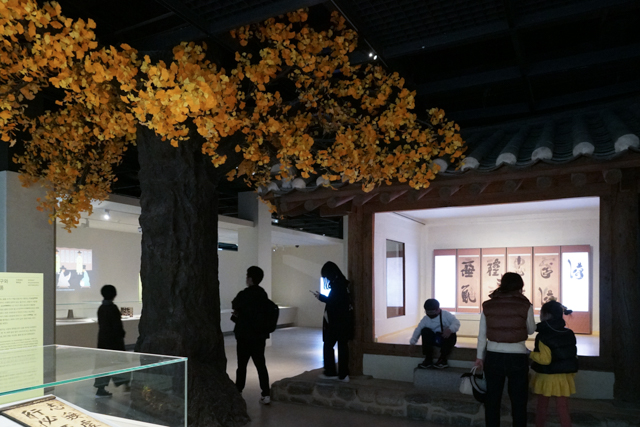
Government office and job
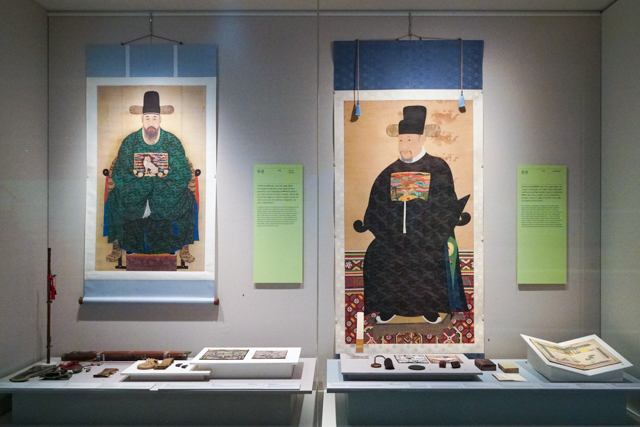
The Joseon Dynasty followed a strict hierarchy system. Despite this, it was possible for someone to climb up through the social hierarchy by passing the highest-level state examination for ranking officials. In a Confucian society, education was highly regarded, therefore, civil servants were given priority over military officers. Also, positions and occupations that one could achieve varied due to status and gender.
In 1894, the Gabo Reform abolished the class system, causing occupation restrictions to disappear. While occupations such as an auction house dealer (gaqwae), a realtor (saqwae), cosmetic dealer (maebungu), etc. have continued from the Joseon Dynasty, there have been occupations which disappeared. Today, individuals can participate in society without gender discrimination. Many specialized occupations are obtainable depending on conditions and abilities.
Coming of Age Ceremony
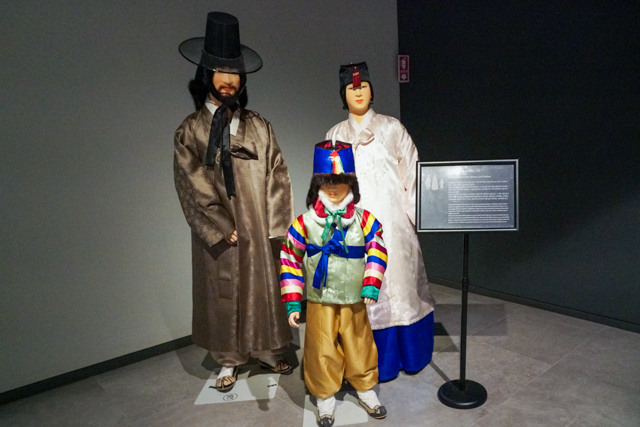
The coming-of-age ceremony was a turning point for a child to become an adult, depending on gender, class, and age. During the Joseon Dynasty, the coming-of-age ceremony was influenced by a book originating from China titled “Jujagarye (Family Rites by Zhu Xi)”, included were writings detailing customary formalities of a family. Largely adopted by the noble class, the male coming-of-age ceremony was called gwanrye, while the female ceremony was called gyerye. When a male reached the age of 20, he would undergo the coming-of-age ceremony by tying his hair in a knot on top of his head (sangtu), and wearing a hat called gat. Then, while in front of the elders in his family, he would be granted the title “Ja”, which is the name given when one reaches adulthood. When females were around the age of 15, their hair was put up in a chignon and wore a traditional ornamental hairpin (binyeo). However, for females, coming-of-age ceremonies were substituted with marriage ceremonies. If the male came from a farmhouse and reached a certain age, he would be evaluated by the village community for his strength and skills in handling farm equipment. If he passed, he would be recognized as an adult.
These days, a coming-of-age ceremony has been smaller than in the past. By reaching the age of 19, they are recognized as being an independent adult, and able to exercise legal actions without the consent of a guardian.
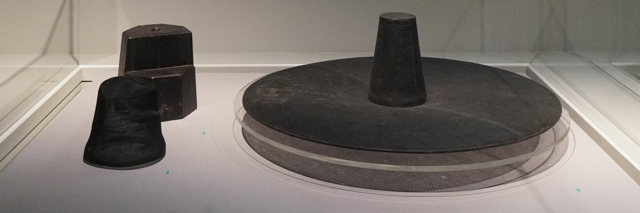
Left, front: tanngeon, men’s inner cap. A tanggeon worn by seonbi (scholars) of the Joseon Dynasty underneath the gat (traditional men’s hat). I tis low in the front and rises high in the back, and was normally worn by noblemen at home.
Left, back: tanggeontong, inner cap box, late Joseon Dynasty.
Right: heungnip, men’s black hat. Men’s formal hat in the Joseon Dynasty when outside or participating in ceremonies. The heungnip is also commonly referred to as the gat.
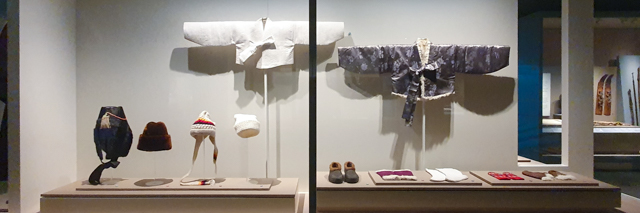
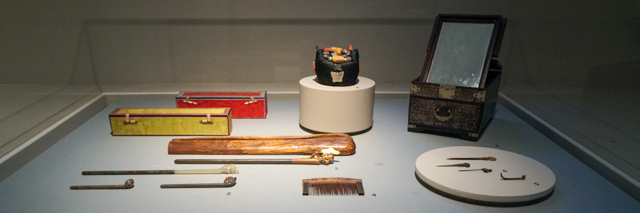
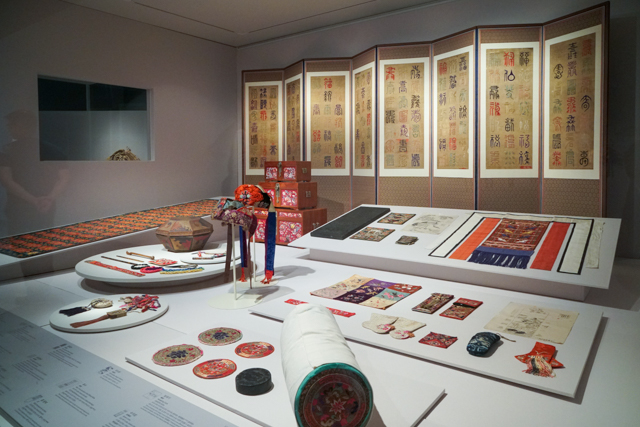
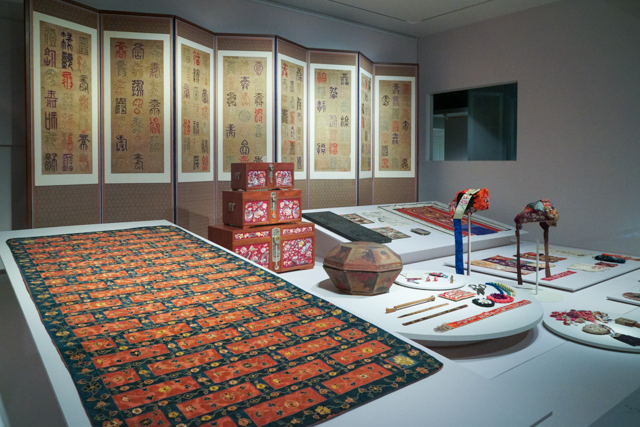
Oxhorn comb, late Joseon Dynasty: A tool used by women to neatly comb their hair. Combs that were decorated with thin oxhorn plating were often cherished.
Cheopji, hair ornament for court ladies, early 19th century. A hair ornament worn by the queen, ladies in the royal family, or women with official ranks living inside and outside the palace. A cheopji would be placed at the top of one’s head, along one’s part, when hair was styled in a low bun. It also would secure one’s hwagwan (bejeweled coronet) or joduri (ceremonial coronet) when one was dressed in ritualistic garb.
Dwikkoji, ornamental hairpin, late Josen Dynasty-early 19th century. A hair accessory used to ornament a low bun along with a stick-shaped hairpin (binyeo). Dwikkoji were often adorned with desgins of flowers, plum blossoms, chrysanthemums, butterflies or written characters that symbolise longevity.
Marriage and Family
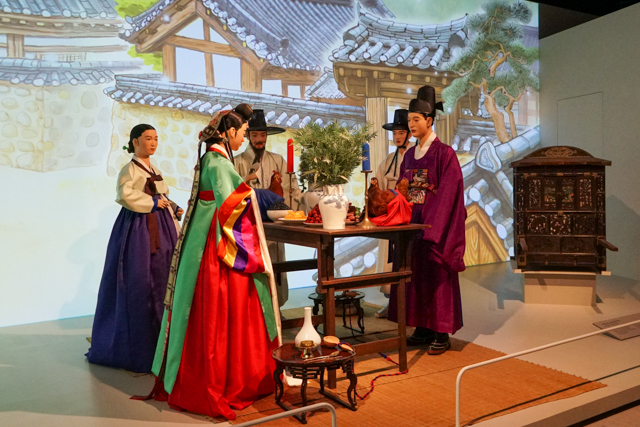
During the late Joseon Dynasty, wedding ceremonies which used to be influenced by “Jujagarye (Family Rites by Zhu Xi)”, a book outlining the formal etiquette, and traditional practices were compromised. The groom held the wedding ceremony at the bride’s house. Then, on the same day or three days later, the groom would return to his home to deliver the greetings to the ancestral spirits at the family shrine, and offering pyebaek (bride’s formal greetings to her parents-in-law by making a deep bow and offering gifts). It was a filial duty for the son to form a family and inherit the family lineage from his father. In which the roles and obligations of men and women were assigned respectively in order to have peace in the family.Today, wedding ceremonies have changed including venues and garments. Also, new wedding customs like a honeymoon have emerged. However, the basic structure and the meaning of having a wedding has not changed much. The roles and forms of the family are indistinguishable and diversifying, for example, changing from a large family with relatives to a nuclear family. In addition, as the number of international marriages are increasing, long-standing traditions are also evolving.
Longevity Banquet
During the Joseon Dynasty, when an adult turns 60 years old, a ceremonial feast for longevity called suyeonrye was held, and usually refered to as hoegap. Due to medical technology not being as advanced as today, being over 60 years old was regarded as achieving longevity. Thus, descendants would invite relatives and friends for a birthday celebration, expressing filial piety.
Today, it has become common to go on a commemorative trip when turning 60, instead delaying their longevity banquet until their 70th or 80th birthday. As the concept of longevity changes, the rituals of praying for and celebrating longevity are also changing.
[…]
Suyeollye is a ceremony for an elder’s birthday or other special occasion after the age of 60, which has been carried out to celebrate one’s longevity. According to the book “Jaemulbo”, which Yi Manyeong (1748-?) composed in the late Joseon dynasty, “after the age of 60, a feast should be prepared to celebrate”, showing the interest in life after 60. In traditional society, Suyeollye was used as a way to encourage people to practice filial devotion. In recent years, the occasion for the birthday celebration has changed from 61st (hwangap) to 70th (chilsun), as well as the style, from holding a banquet to traveling. The ceremonies for celebrating and praying for longevity are changing with the trends of the times.
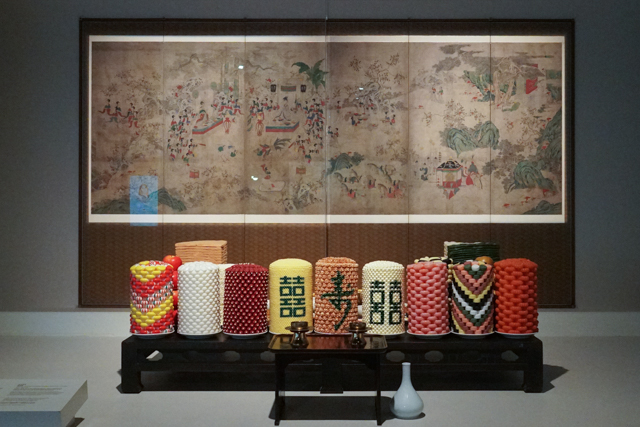
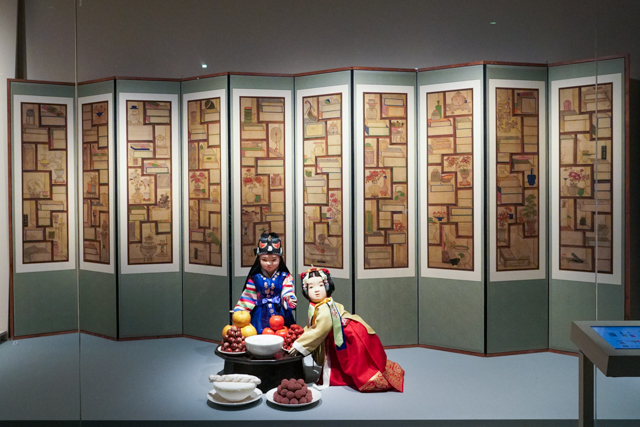
Table setting for hoegap, the 61st birthday celebration
Hoegap is a term for turning 61 years old in the Korean age, which literal means return to the gap, or competing the circles of the zodiac’s twelve years five times, and is also called hwangap, hwagap, hwangap, hoegap,jugap, hwagap, or hwanryeok. On the morning, grown-up children prepare a special banquet table called hoegapsang as an expression of gratitude and wishes of longevity. At the banquet, the husband usually sits on the east side of the table, and the wife to the west. However, in accordance with ancestral rites for the living, there are occasions where the couple changed places. For Hoegap, unlike the table settings for other festivities, dozens of chestnuts, jujubes, and other fruits are stacked high to show filial love, along with decorations of symbolic characters representing great happiness and long lifespan. In front of the main banquet table (hoegapsang), there is a separate table (heonjusang) with alcohol and drinking glasses. Descendants and relatives offer alcohol and pray for good health and longevity by bowing deeply one at a time.
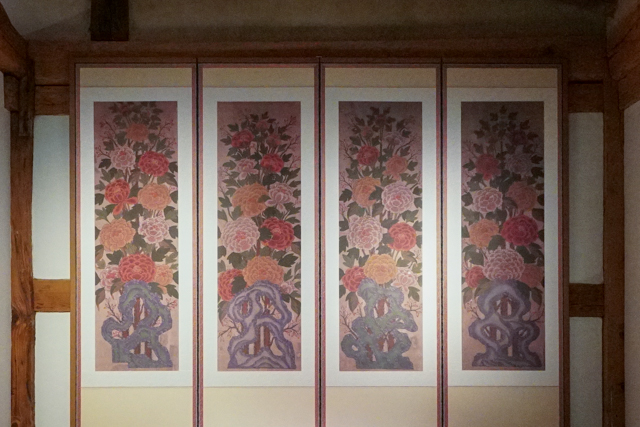
Yojiyeondo, The Banquet of Seowangmo (Xiwangmu), Queen Mother, 19th century
Yojiyeondo, The Banquet of Seowangmo (Chinese: Xiwangmu), Queen Mother signifies the desire for immortality and fortune. This picture contains the happiness and fortune in this lifetime. The people at the banquet, combined with many auspicious scenes of nature and animals, depict a paradise full of happiness. It captures the wishes of those who dream of immortality.
Healing
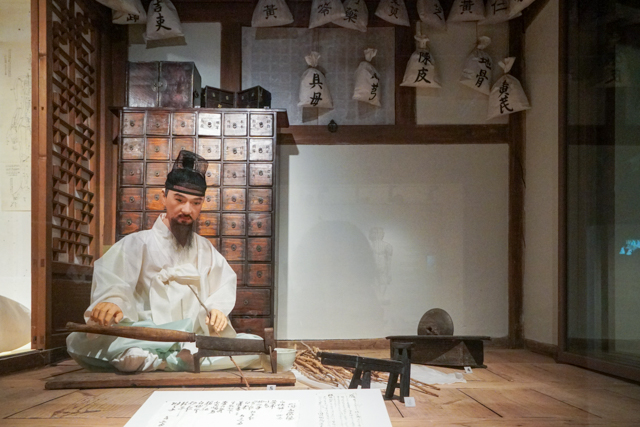
As people age, they become more susceptible to diseases. In the late Joseon Dynasty, when people fell ill or became weak, they were treated at traditional medicine clinics. At these clinics, doctors largely referred to Chinese medical books. However, with the release of “Donguibogam (Principals and Practice of Eastern Medicine)” written by Heo Jun (1539-1615), patients were treated with acupuncture and moxibustion in accordance with their symptoms from a disease and provided with medicine to treat their disease. Other people believed supernatural powers, such as shaminic rituals and amulets, would prevent illness or give them comfort.
Currently, Western medical technology and medicine along with Oriental medicine are increasing the lifespan of humans due to new advancements in science and technology.
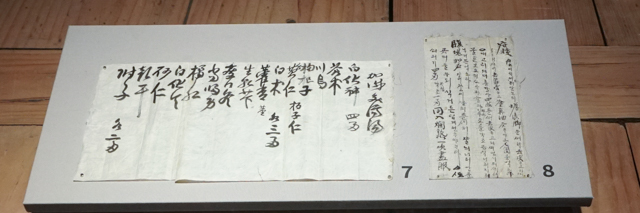
These were examples of prescriptions from the late Joseon Dynasty. The document included the names and the treatment for a parasitic disease. Treatment included toads, frogs, and beef.
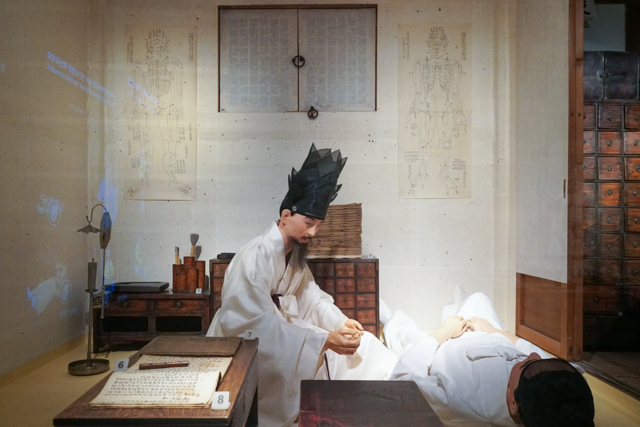
This display showed anatomical acupuncture charts (back, left and right), donguibogam (back, centre) (Principles and Practice of Eastern Medicine), as well the medical book used for recording symptoms, prescriptions and preparing medicine for various diseases (front, left).
Funeral Rites
Sangrye, a funeral rite, is a burial ritual of the deceased, performed by changing their garments to a shroud and burying them in the ground. According to the Confucian ethics of “filial piety” during the Joseon Dynasty, a three-year mourning period was regarded as the child’s duty. The parent who had passed away was placed in an extravagantly decorated bier and was buried with myeonggi (burial objects) for the afterlife. The children would then resign from their farming duties or government positions, taking care of their deceased parent as though they are still alive by building a small hut next to the grave over a period of three years. The culture and ceremonial procedures have changed significantly in the modern day. ‘Family Ritual Standards’ and funeral directors are common and burials and cremation ceremonies became simpler, the meaning of funeral rites for the deceased has carried on from the past.
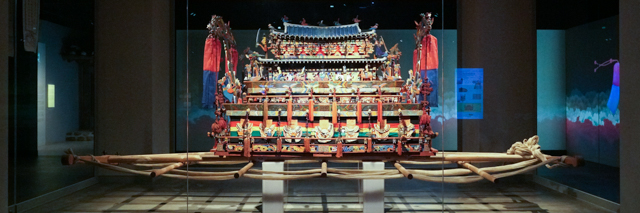
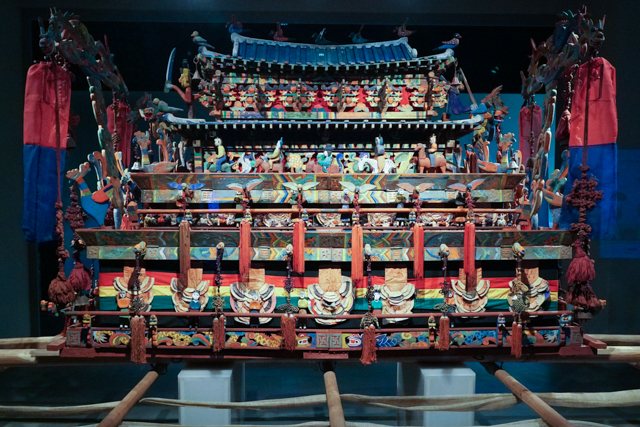
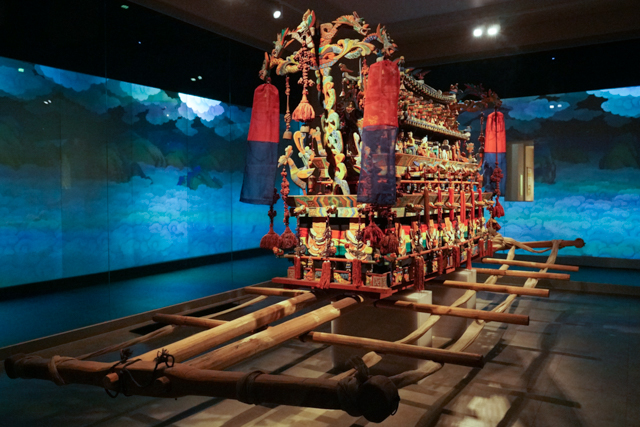
Sangyeo, Bier
Biers were used for conveying the coffin of the deceased to burial sites. Depending on the size, it is called a large bier (doeyeo) or small bier (soyeo). Originally, carts pulled by oxen, horses, or people would transport the bier to the site. However, being influenced by Jujagarye (Family rites by Zhu Xi), the custom changed to carrying on people’s shoulders. Even the bier’s figure resembles the palanquin, but the long-carrying poles on the body characterizes the bier to carry on the shoulders of 12 to 24 pallbearers. Generally, villages had a bier for common use, which could be disassembled and reassembled in parts. It was commonly stored in a hut a short distance from the village. This exhibit is a bier of the Choi clan from Jeonju, Sancheong-gun, Gyeongsangnam-do, made in 1856 for the funeral for Choi Pilju (1796-1856). The bier features 4 levels. Sculptures of humans, beasts, and the 12 zodiac animals are placed on each level, signifying deities leading the deceased to the afterlife.
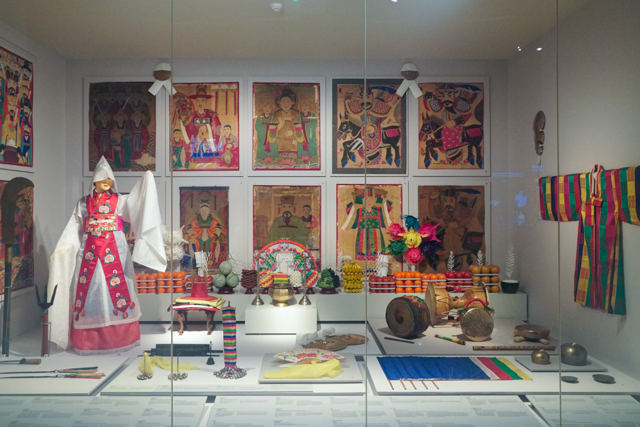
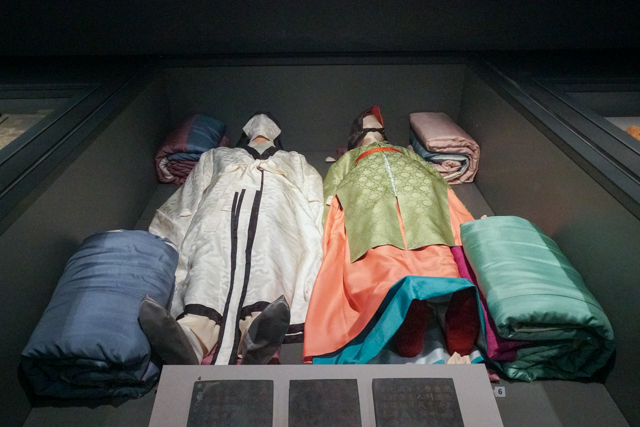
Suui, shroud
Funeral procedures include washing the body of the deceased and dressing it in a burial garment. Typically, the deceased’s ceremonial attire was used, but there were cases where a new garment was made for this purpose. Garments of the latter type are sewn with undyed fabric, and larger than the actual size. Some, however, preferred to have them made in more vivid colors because dressing a parent’s body in colorful silks was considered a symbol of filial piety. There is a saying that a burial outfit prepared in advance will being long life. So, many made shrouds for their parents as they approached their sixtieth birthdays. The task was most often done during a leap month in the lunar calendar with older women invited to help in the sewing process.
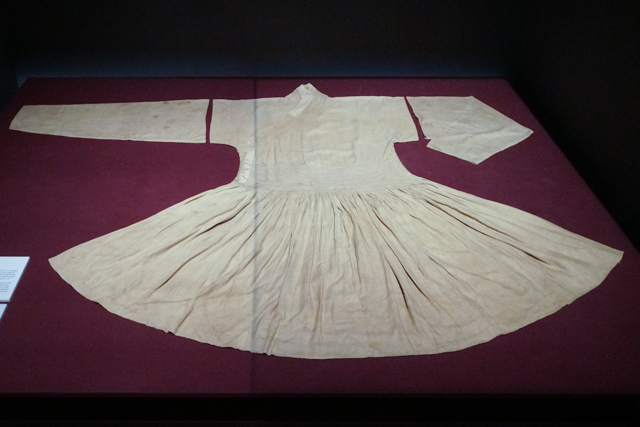
Garment excavated from the grave of Beyon Su
Chultobokshik refers to diverse grave goods including the burial garment worn by the deceased and the objects placed in the grave to fill empty space. The objects placed in this way included the deceased’s clothing and tools that they used during their life. Excavated grave goods vary slightly depending on the time period, class of the deceased, and location. As a result, it is possible to accurately discern the deceased’s social status, as well as the time period in which they lived. From the grave of Byeon Su, a total of 30 pieces of clothing have been excavated including various types of garments, accessories, and a hat. Through examining these, one can see the characteristics of various types of clothing in the early Joseon Dynasty.
Yoseon Cheolik, men’s robe
Men’s outerwear excavated from the grave of Byeon Su (1447-1624) in Yangpyeong-gun, Geyonggi-do. AN outer robe with a decorated waist, the lower portion is pleated, making it very convenient for activities such as horse riding or hunting. This robe is from the 16th century during the early Joseon Dynasty, and is styled the same as those described in the Annals of the Joseon Dynasty. Garments of this type were particcularly popular among the nobility of the time.
Eumtaekpunsu, selecting the gravesite
Since ancient times, our ancestors have used geomancy (feng shui in Chinese) to decide the sites for houses and graves. There were numerous books explaining the principles and methods of geomancy (pungsuseo), a book from China titled “Jinnangjing (Classic of Feng shui)” was regarded the best among them. Just as Jinnangjing was called jangyeong and jangseo, it valued the notion that if we place our ancestors’ graves in an auspicious site (myeongdang), they will benefit from the mountains and streams’ positive energy, and their descendants will be proportionately blessed. During the late Joseon dynasty, Confucianism led people to criticize the negative aspects of the custom. Nonetheless, making multiple attempts to locate a proper grave site for one’s ancestors, or delaying their funeral, continued to be considered virtuous acts.
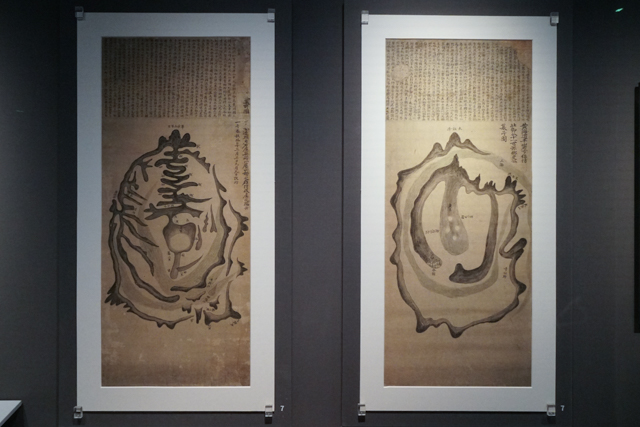
Myeongdangdo, a diagram showing a propitious burial site.
This type of image called a sando (painting of mountain’) or myosando (painting of tomb and mountain) indicates propitious sites for graves based on geomancy.
It depicts the tomb of Shin Sunggyeom(?-927),tbe progenitor of the Pyeongsan Shin clan, in Chuncheon, Gangwon-do Province and the tomb of Eosagong, the eleventh direct lineal descendant of Shin Sunggyeom,in Pyeongsan, Hwanghae-do Province.
Ancestral Memorial Rites
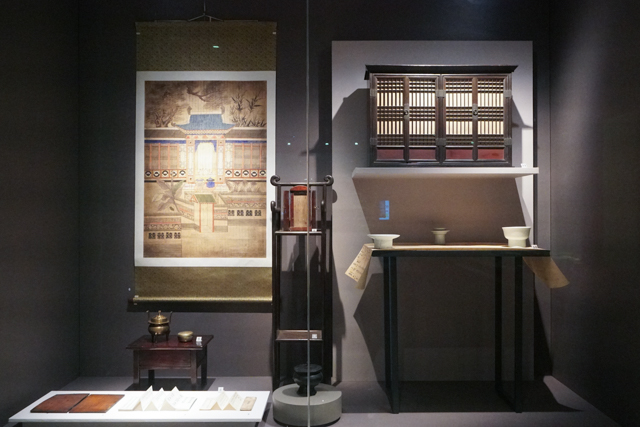
Jesa is holding an ancestral rite for the deceased ancestors. During the Joseon Dynasty, serving ancestors as though they were still alive was considered to be the foremost filial duty. In accordance with Confucian ancestral beliefs, family shrines or tabernacles were constructed in the home. Four generations of ancestors had a place in the shrine, from great-great-grandparents to parents. The ancestral rites would be performed by the living descendants and held annually on the death day of each ancestor along with holidays, for example, Lunar New Year (seol) and Harvest Festival (chuseok).
Nowadays, as people migrate away from Confucianism to other religions and ideologies, the custom of performing ancestral rites and having strong filial bonds with ancestors is changing. However, even though people’s ideologies are changing, the way they honor their ancestors and seek the well-being of their descendants is not very different from the past.
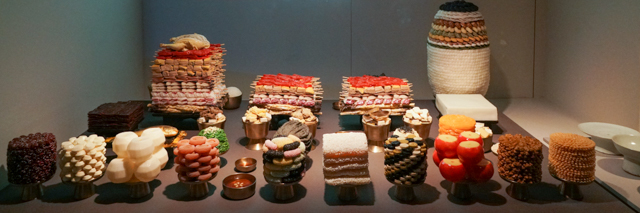
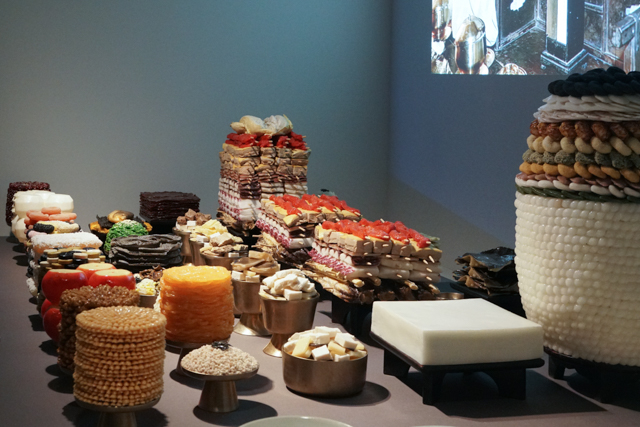
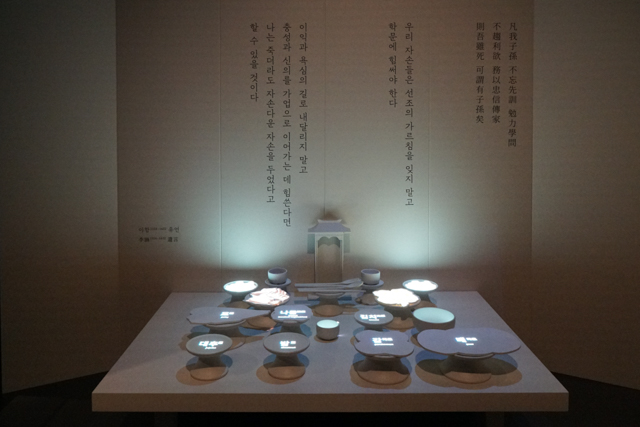
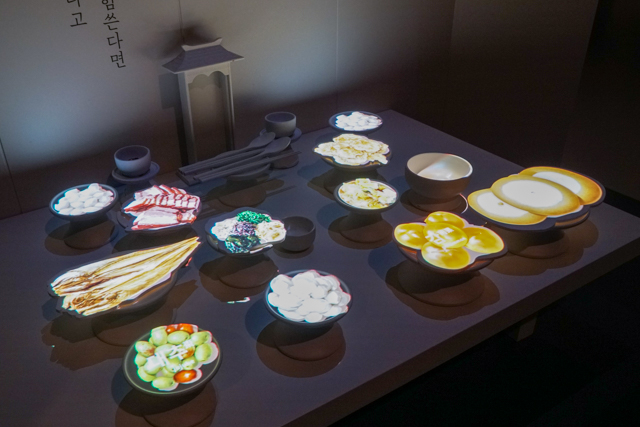
The table for ancestral rites of the Gwon Beol Family, Head Family of the Andong Kwon Clan
A reconstruction of the table setting during bulcheonwi* ancestral rites in the family of Chungjae Gwon Beol (14 78-1548), who was the head of the Gwon family in Andong of Gyeongsangbuk-do province. In 1591, 43 years after his death, he was enshrined to an immovable ancestral tablet because he was recorded 1st on the record of civil retainers in the book ‘gwangguk wongjong gongsin’. Although all tables prepared for ancestral rites follow the basic principles, each family adds different unique features to the table setting. In this case, twelve different kinds of rice cake are used to create multiple layers instead of a regular rice cake. There are also five-colored rice puffs, a local delicacy.
Bulcheonwi Jesa, rite for ancestors honoured in perpetuity
Bulcheonwi is a meritorious official who contributes greatly to the country, excels in scholarly knowledge and virtue, and exhibits honor, integrity, and fidelity to their principles. Rather than their ancestral tablet being moved from the family shrine after four generations, the bulcheonwi ancestral tablet is kept by future descendants and included in family rites forever. So, the bulcheonwi rite is an honor for the deceased’s family and descendants, and symbolizes the family’s status.
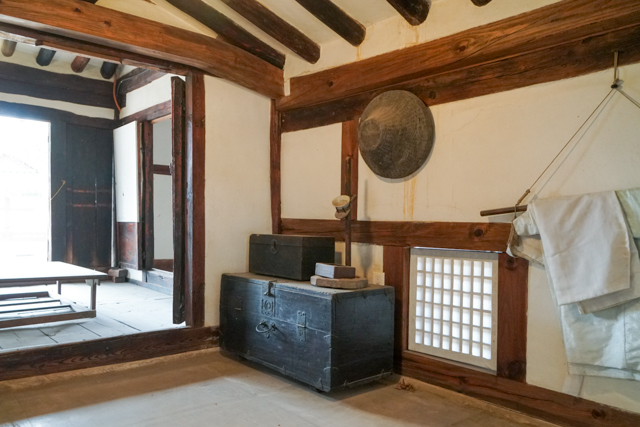
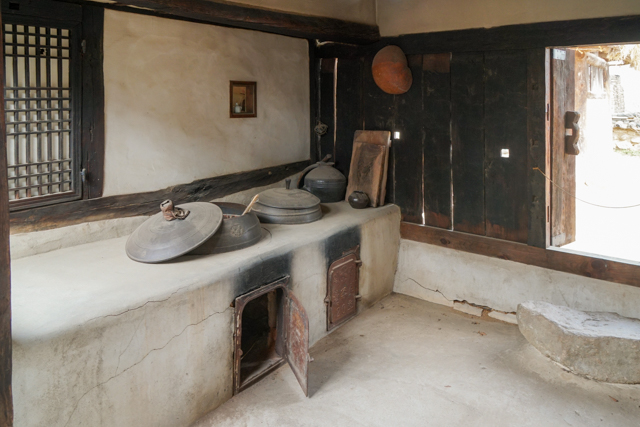
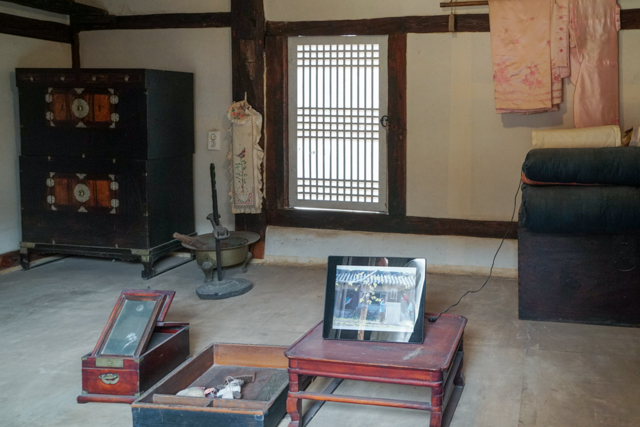
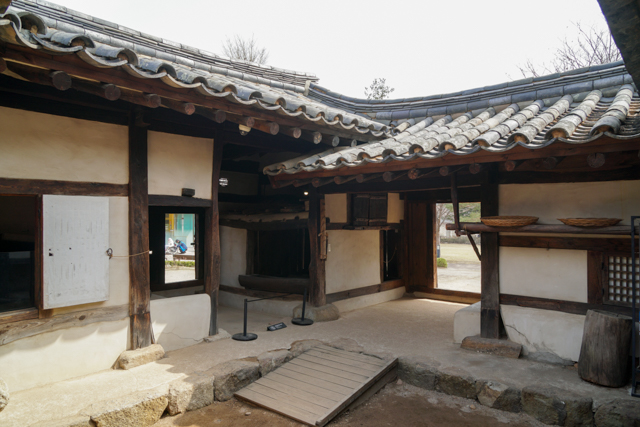
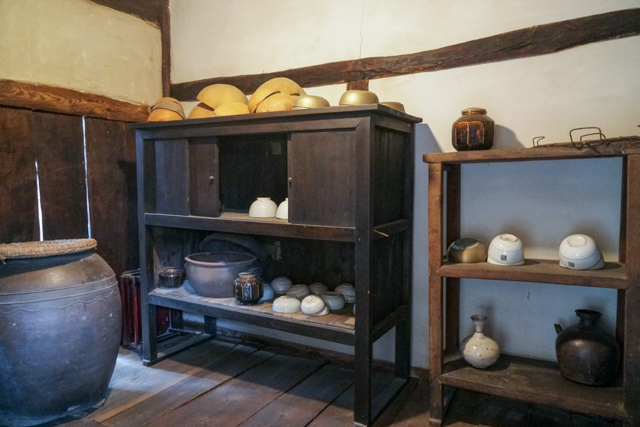
Ochon House
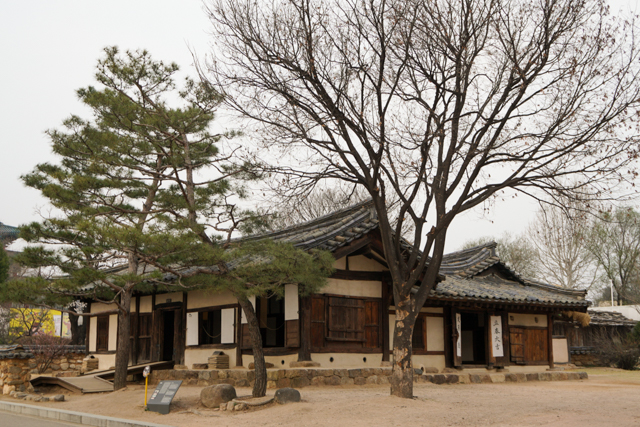
1848, donated by Nam Byeong-hyeok, original location: Wongu-l-ri, Yeonghae-myeon,Yeongdeok-gun, Gyeongsangbuk-do
It demonstrates typical features of a house belonging to a local family with medium income during the late Joseon period. “Ochon” in the building’s name comes from Ochon-ri, the name of the birth village of a woman who married into the Nam family.
When the house was dismantled for relocation, an inscription indicating the year of the construction, 1848, was discovered. The house was built in a square shape with a yard in the center. All roof ridges were connected and the women’s quarter was smoothly linked to the men’s space.
There are four rooms (for the male owner, his wife, guests, and servants), two open floor spaces, and two spaces for storage. There are entrances on all sides except the back of the house.
Ajar stand is located in the back of the house, and a mill, well, and outhouse are on the right
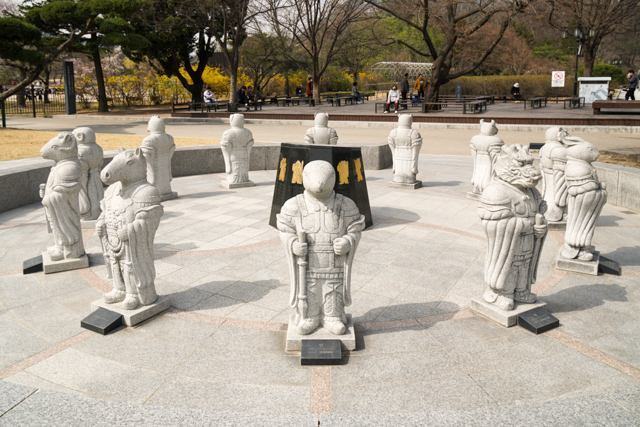
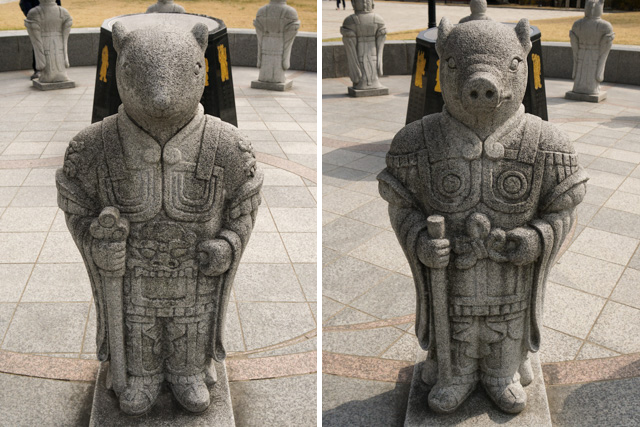
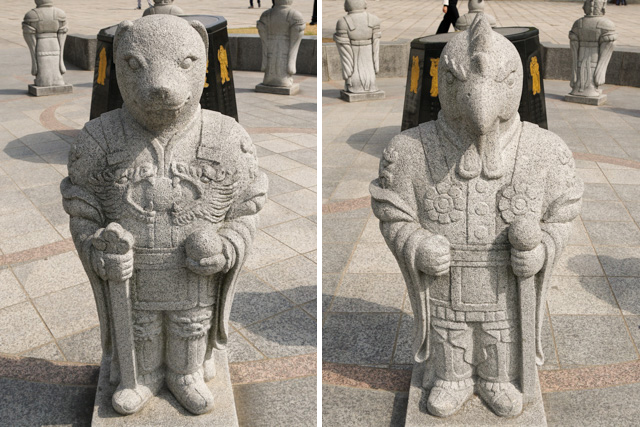
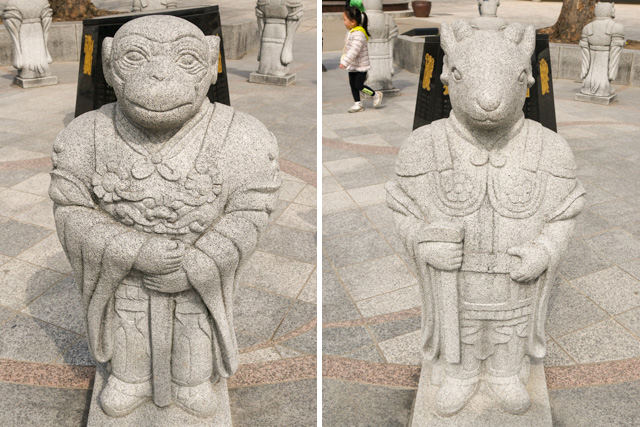
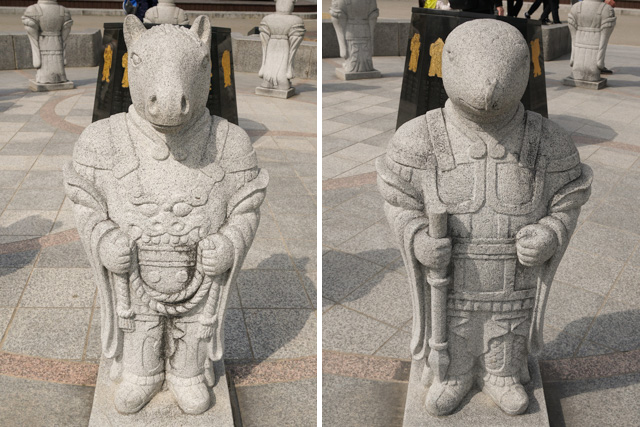
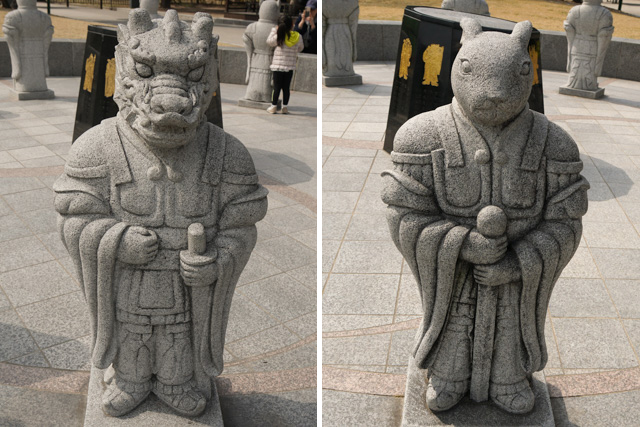
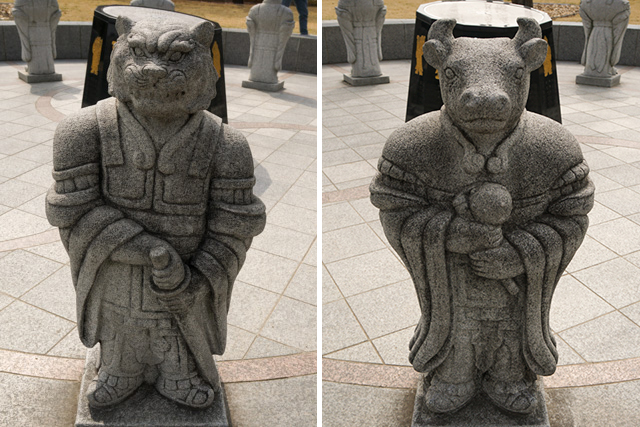
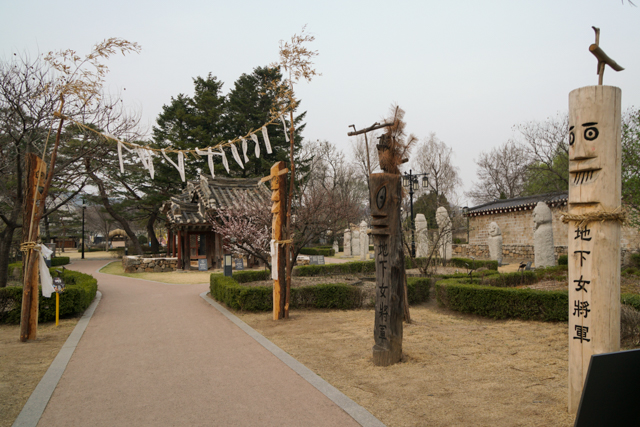
Twelve Zodiac Sculpture
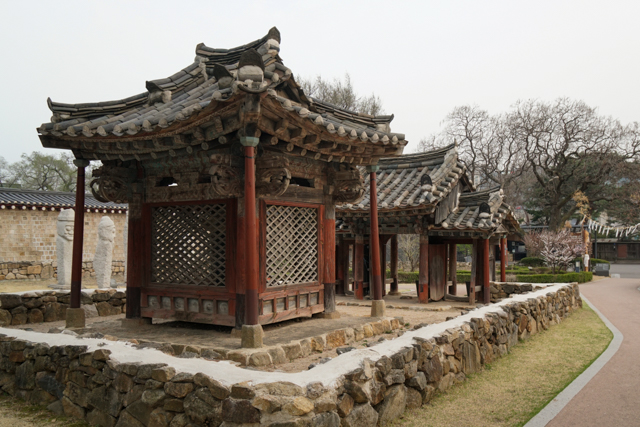
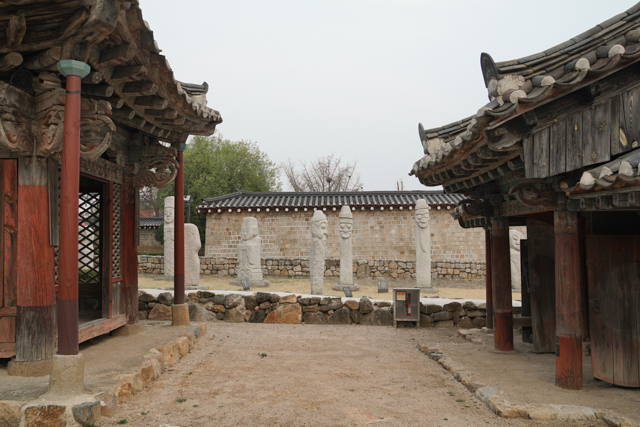
Traditional Culture Centre
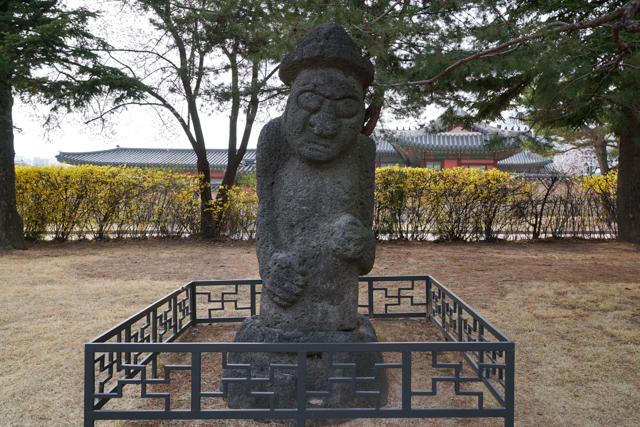
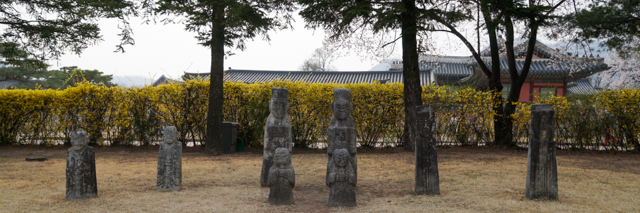
Young Boy Statues – Guardian Posts – Civil Official Statues (19-20th century, donated by Cheon Sin-il)
Young Boy Statues were placed in front of a tomb to guard the tomb, attend to the deceased, and console their spirits.
Guardian Posts were errected at the entrance to a village or temple. They marked the boundaries and served as guardian spirits of the place.
Statues of Civil Officials were placed at tombs for protection of the deceased, one to the right of the tomb and one to the left. They were carved out of stone and depicted a civil official wearing a formal hat and holding official’s tablet.
Gyeongbok Palace
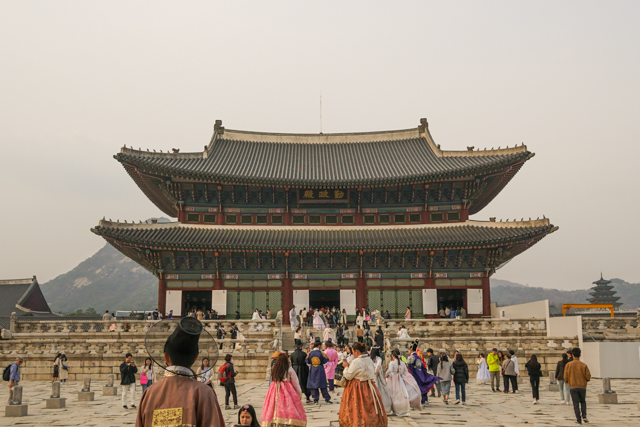
It was in 1395, three years after the Joseon Dynasty was founded by Yi Seong-gye, when the construction of the main royal palace was completed. The palace was named Gyeongbokgung, “the Palace Greatly Blessed by Heaven.” With Mount Bugaksan to its rear and Mount Namsan in the foreground, the site of Gyeongbok Palace was at the heart of Seoul and, indeed, deemed auspicious according to the traditional practice of geomancy. In front of Gwanghwamun Gate, the main entrance to the palace, ran Yukjogeori (Street of Six Ministries, today’s Sejongno), home to major government offices. Along the central axis upon which Gwanghwamun Gate stood was the nucleus of the palace, including the throne hall, reception hall and king’s residence. The government ministry district and main buildings of Gyeongbok Palace formed the heart of the capital city of Seoul and represented the sovereignty of the Joseon Dynasty.
All the palaces in the capital were burned down during the Japanese invasion of 1592-98. Changdeokgung, a secondary palace, was rebuilt in 1610 and served as the main palace while Gyeongbok Palace was left derelict for over 270 years. It was finally reconstructed in order to restore the greatness of the Dynasty in 1867. The reconstructed Gyeongbok Palace was harmoniously incorporated into both the tradition and present of the Joseon royal court. Some 500 buildings were built on a site over 691,921 m’ and constituted a small city.
Gyeongbok Palace was largely torn down during the Japanese occupation. Almost all of the restored buildings were dismantled, Gwanghwamun Gate was removed, and an enormous building housing the Japanese Government-General was constructed in front of the main sector of the palace. An effort to fully restore Gyeongbok Palace to its former glory has been ongoing since 1990. The colonial Government-General building was removed, and Heungnyemun Gate was restored to its original state. Gwanghwamun Gate as well as residences of the king, queen and the crown princu was restored to its original state.
- 1395: Gyeongbok Palace founded
- 1592: Gyeongbok Palace destroyed by fire during the Japanese invasion
- 1867: Gyeongbok Palace reconstructed
- 1873: Geonchonggung compound constructed
- 1915: Buildings in the east of the palace removed on the pretext of exhibition by Japanese Colonial Government
- 1926: South of the palace severely damaged due to construction of Japanese Colonial Government-General building
- 1990: Restoration of palace begins
- 1997: Colonial Government-General building removed
- 2010: Gwanghwamun Gate restored to its original form
- 2010: First phase of Gyeongbokgung restoration project completed (25% of all original structures restored)
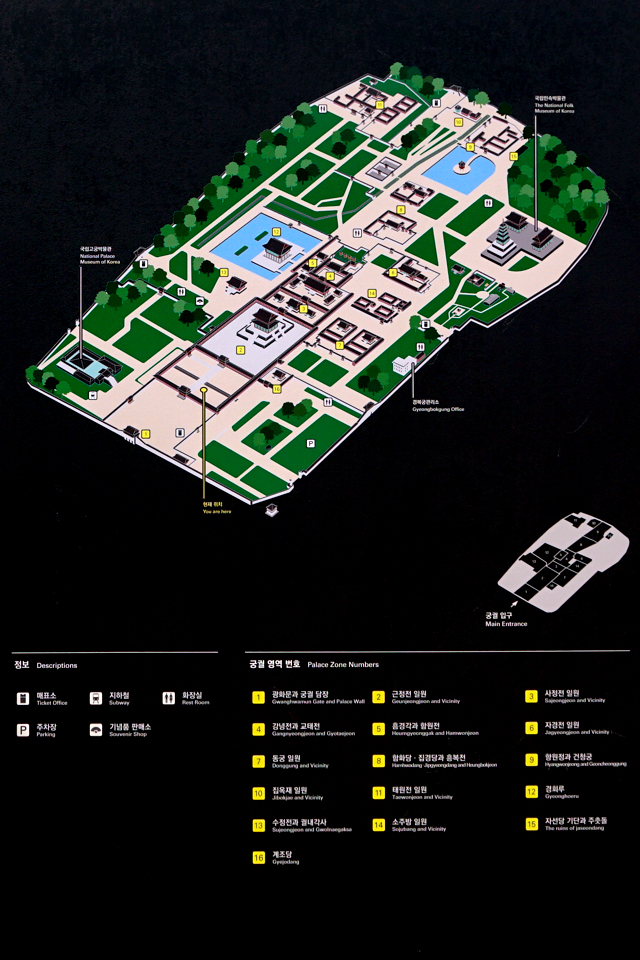
1. Gwanghwamun Gate and Palace Wall
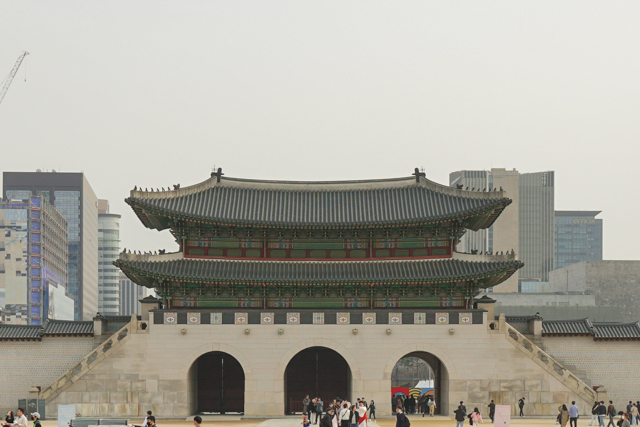
This is the main and largest gate of Gyeongbok Palace (internal view). As a landmark and symbol of Seoul’s long history as the capital city during the Joseon Dynasty, the gate has gone through multiple periods of destruction and disrepair. The most recent large-scale restoration work on the gate was finished in 2010.
Geonchunmun Gate
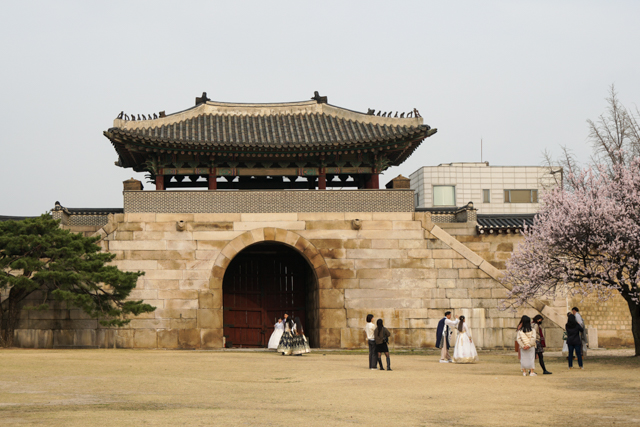
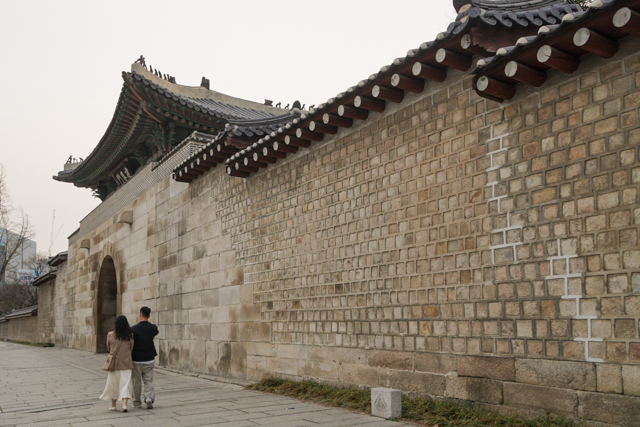
This is the east gate of the Gyeongbok Palace. Its name, literally “promoting spring”, originates in the ancient belief that the east corresponds with spring. A high stone foundation was constructed with an arch-shaped gate in the center. The arch is 16.5 Ja high and 15 Ja wide according to the linear measure used during the Joseon period.
A tower rests on the foundation. It is divided into three sections, the central one being the largest with 17 Ja and the right and left ones measuring 8 Ja each for a total of 33 Ja in width. The pillars are 8 Ja high. Similar gates were constructed in the west, called Yeongchumun, and in the north, called Sinmumun.
(1) Substructure and Staircase of Geonchunmun (Gate)
Its structure is as follows: the substructure was constructed higher than that of a palace wall. The gate is pierced through by an arch, topped with a tower. When necessary, sentinels climbed up to the tower. They utilized stone staircases, one at the right and the other at left. The staircases incline so steeply that one feels as if the person were climbing a ladder. However, railings are installed in consideration of safety.
Leaving the staircase, one reaches a side entrance which is connected with a wall along the edges of the substructure.
(2) Dragon Painting on the Ceiling of Geonchunmun (Gate)
Clouds and dragons are drawn in this painting with five colors-blue, red, white, yellow, and black. The Blue Dragon is placed in the east and the Yellow Dragon in the west. Each has five claws and a magic ball in the mouth, which symbolize king.
2. Gunjeongjeon and Vicinity
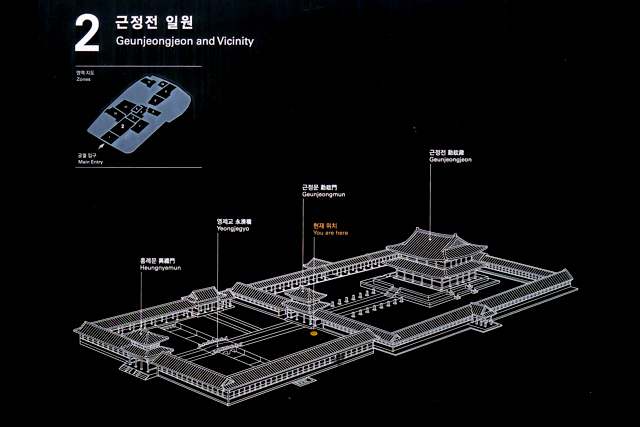
Rebuilt in 1867, Geunjeongjeon Hall, or Hall of Diligent Governance, was the main hall of the palace for important national mfirings and events. The ball has a spacious inner courtyard surrounded by cloisters. Government officials stood on the rank stones placed in the stone pavement of the courtyard according to their rank. Rank stones placed in two rows, and natural granite pavestones presented a symbolic image of the place.
Outside of Geunjeongmun Gate (south gate of Geunjeongjeon), there is another courtyard enclosed by outer cloisters. There are no other structures in the vicinity except for the king’s path over Geumcheon Stream which demands ascetic dispositions from the people and the king after crossing. The two-story ceiling renders dignity and grandeur to the throne set in the front centre of Geunjeongjeon Hal. Heungnyemun Gate, the outer cloisters, and Youngjegyo Bridge were restored in 2001.
Gwanghwamun Gate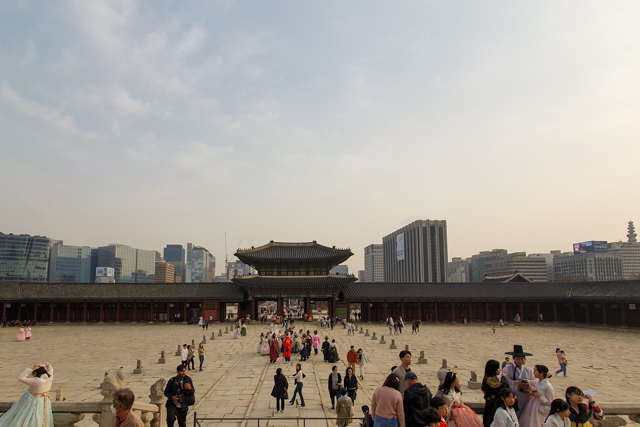
Geunjeongmun Gate
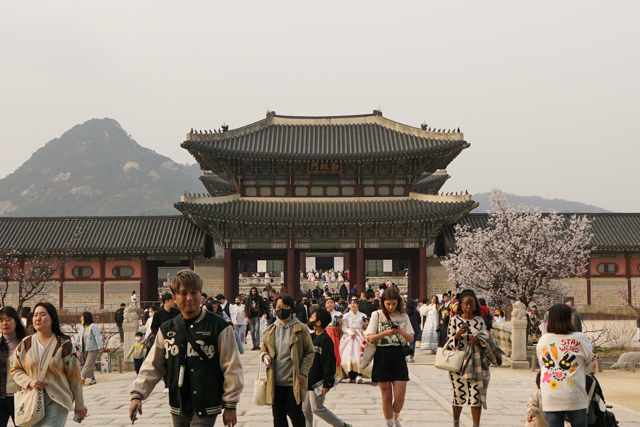
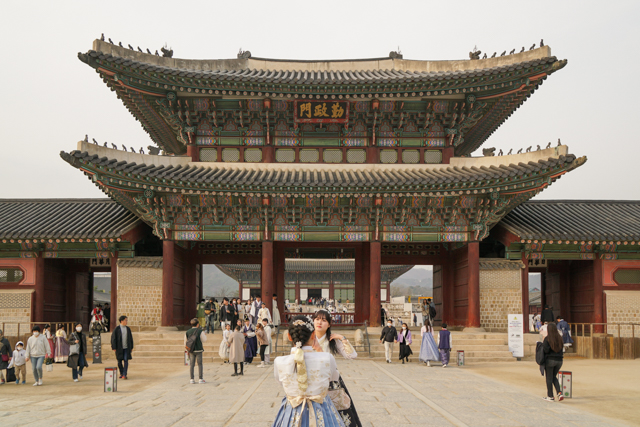
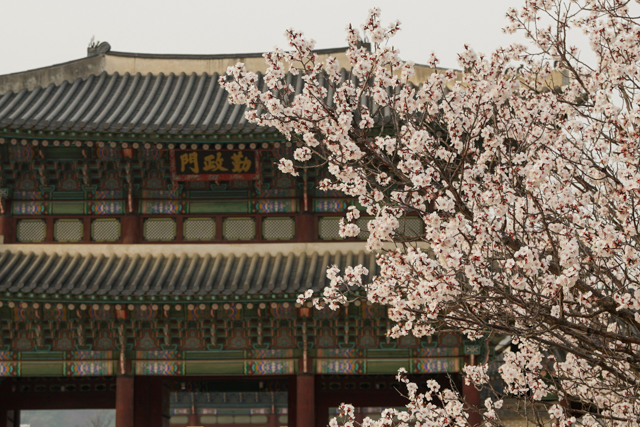
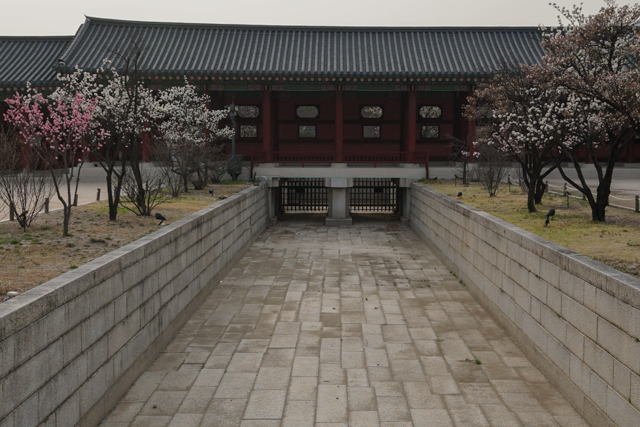
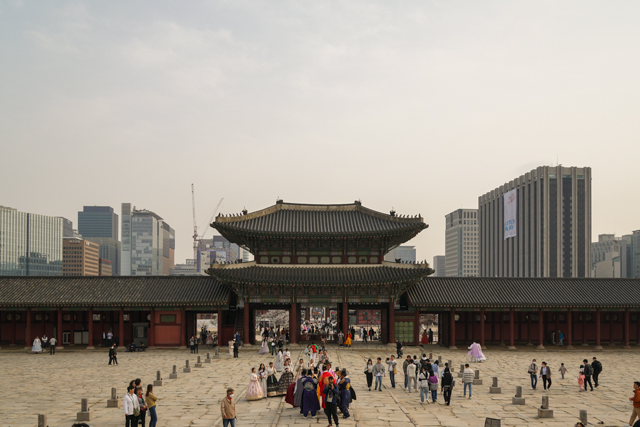
Passing by the Gwanghwamun Gate, a visitor arrived at the Heungnyemun Gate in the center. The person was then led to the Yeongjegyo Bridge. All these structures were lost when the government-general building was constructed. Remaining now are the Geunjeongjeon Hall block and the Geunjeongmun Gate.
The two-storey gate usually was closed. Civil and military officials entered the Geunjeongjeon Hall court through the Ilhwamun Gate in the east and the Wolhwamun Gate in the west.
Geunjeongjeon Hall
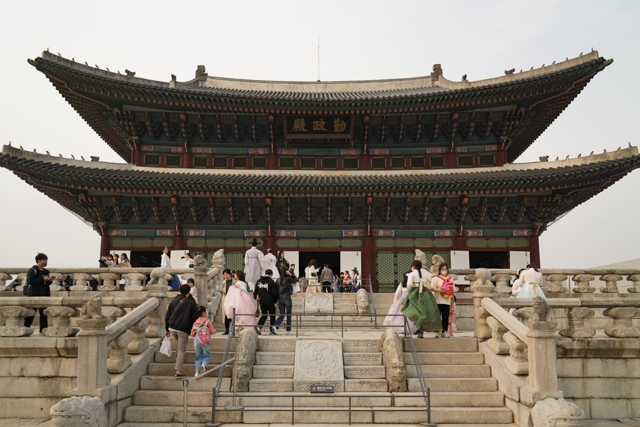
Geunjeongjeon Hall is the main hall of Gyeongbok Palace. Kings conducted state affairs, held official functions, and received foreign envoys here. High ranking officials, including military officers, assembled in this court to pay highest respect to their kings. From 1399-1546, seven of twelve kings were enthroned here: Jeongjong, Sejong, Danjong, Sejo, Seongjong, Jungjong, and Myeongjong.
This hall was built in 1394, in the third year of the reign of King Taejo. It was burned down during the Japanese aggression of 1592 and rebuilt in 1867, the fourth year of the reign of King Gojong.
The throne is centred toward the back of the hall. There were ritual objects there, but none remain. The building is a high-ceilinged structure with a single room.
Formerly there were three consecutive gates south of the entrance, between Geunjeongjeon Hall and the city. Geunjeongmun Gate can be seen in the centre of the south corridor. Heungnyemun Gate was torn down to make way for the capital. Gwanghwamun Gate is in the outer wall of the palace, in front of the capital (now being renovated for the new National Museum of Korea). An impressive view of the harmony created between Geunjeongjeon Hall and Bugaksan, the mountain beyond, can be seen from the second pillar from the east end of the south corridor. (National Treasure No. 223)
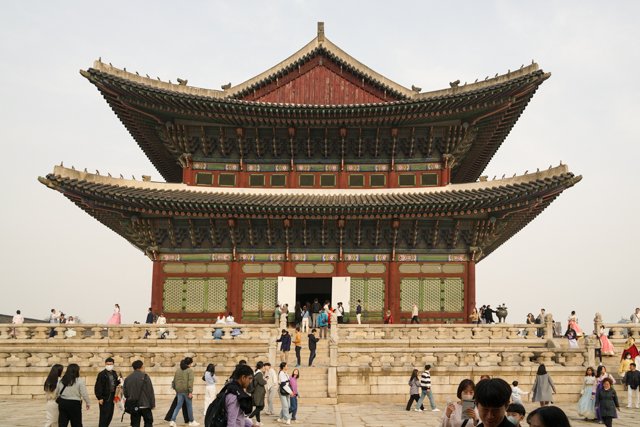
(2) Stone Foundations of Geunjeongjeon Hall
The stone foundations, double-tiered in this case, were constructed for the purpose of elevating the Geunjeongjeon Hall. The foundations are really broad. The hall was constructed on a layer of stones placed above the stone foundations. Its front court is far broader than the rear court. From the front court, one can command a broad view of the palace. The stone railings are conspicuously lower than the hall itself in consideration of drainage. The location of the Geunjeongjeon Hall was a result of a precise calculation. Thorough calculation was needed to divide the palace effectively.
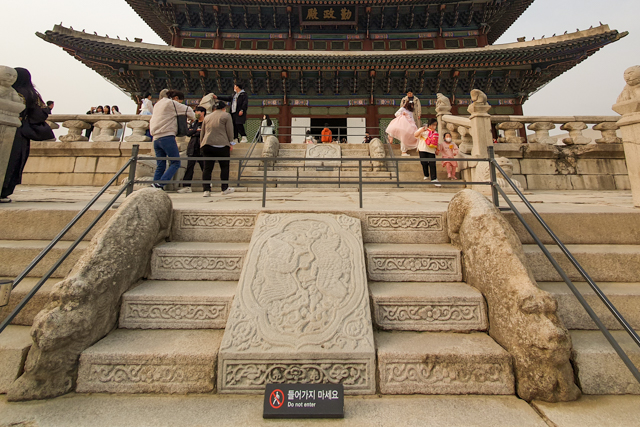
There is a stepping path in the centre of the southern side of the stone foundations supporting the Geunjeongjeon Hall. There is a narrow stairway on both sides which are capped with big stone covers.
The stone cover is in the shape of a Haetae lying long and flat on its belly. Inscribed on the stepping path is a phoenix with a magic ball in its beak playing in the cloud. The imaginary bird symbolizes the high status of royalty. An arabesque design is carved on the whole surface of the stairway flanking the stepping path. These inscriptions imply that the people lived with royalty above while animals capable of expelling evils like Haetae protected them.
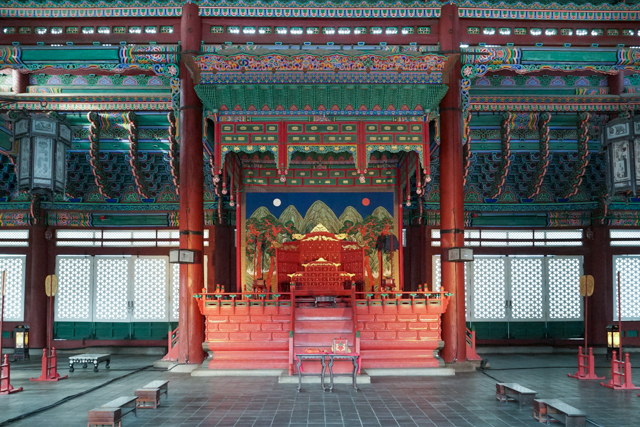
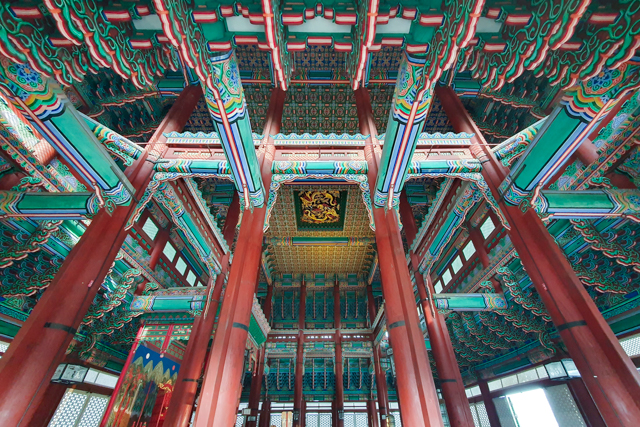
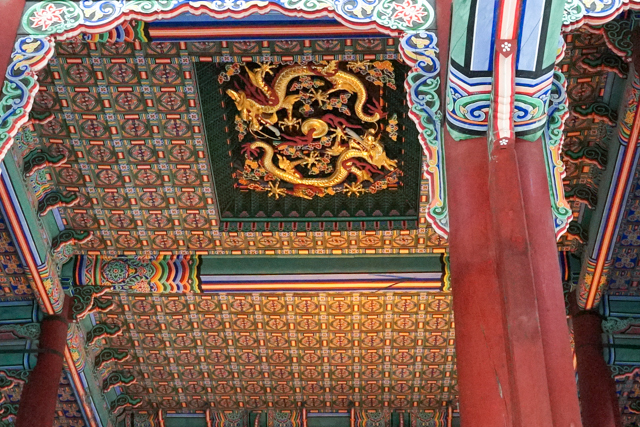
(1) The Inside and Ceiling of Geunjeongjeon Hall
The hall is single-storeyed. Standing on the tiled floor, one can look up at the recessed ceiling. The height of the ceiling and pillars around the hall is imposing, as if to symbolize royal authority. A wooden canopy is located over the throne. The hall once had been filled with ceremonial facilities and instruments designed to enhance the dignity of the king sitting on the throne. The throne is the architectural climax of this building.
The latticed ceiling is high up above the floor. It is decorated with traditional dancheong coloring. A pair of dragons in the clouds struggling for a jeweled ball is carved on the recessed portion in the centre of the ceiling. Dragons symbolized kings.
3. Sajeongjeon and Vicinity
4. Gangnyeongjeon Gyotaejeon
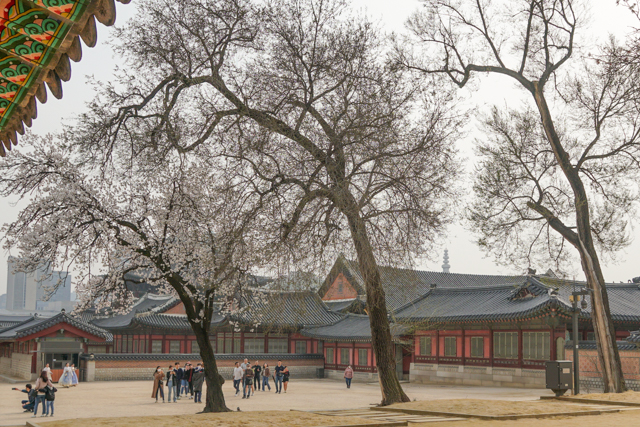
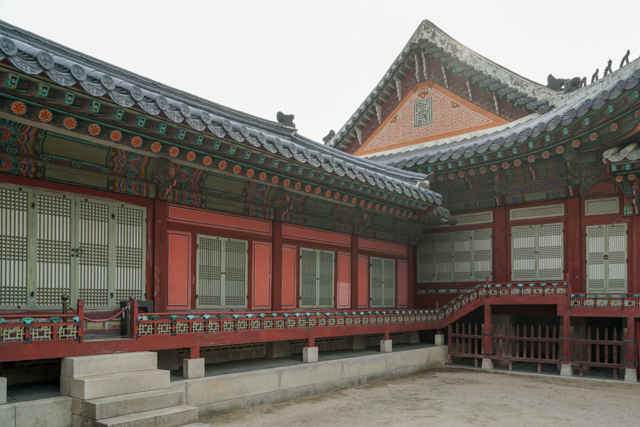
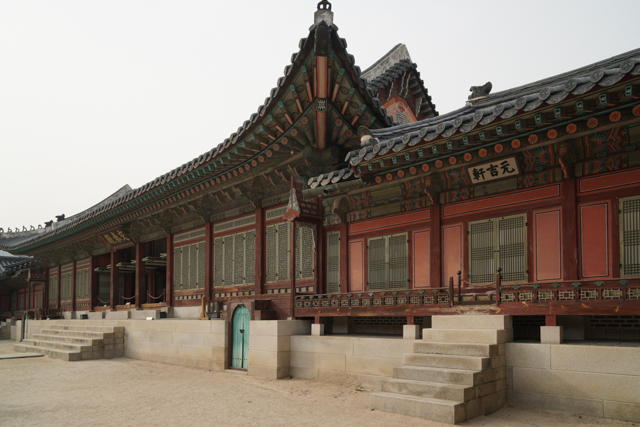
5, Heumgyeonggak and Hamwonjeon
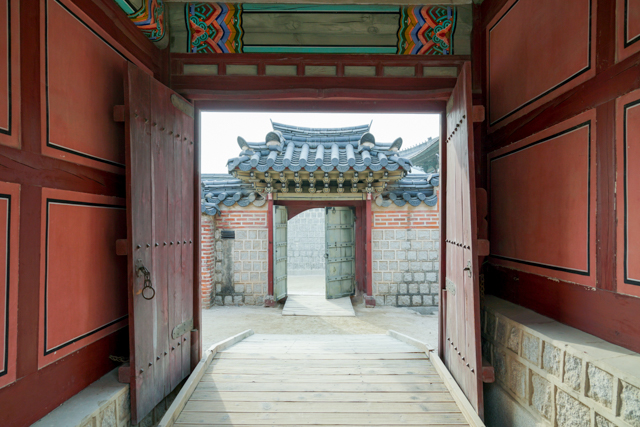
6. Jagyongjeon and Vicinity
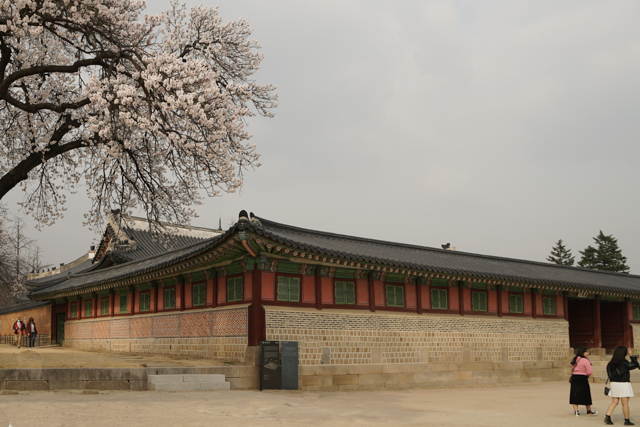
Jagyeongjeon Hall was the living quarters where Queen Dowager Jo, the mother of King Heonjong (r.1834-1849), 24th King of the Joseon period lived. It was built for her by Regent Lee Ha-eung (the Daewongun), father of King Gojong, the 26th King (r.1863-1907) of the Joseon period. The present quarters were built in 1888 after the original structure were burnt down. This is the only building with a bedroom remaining in Gyeongbok Palace.
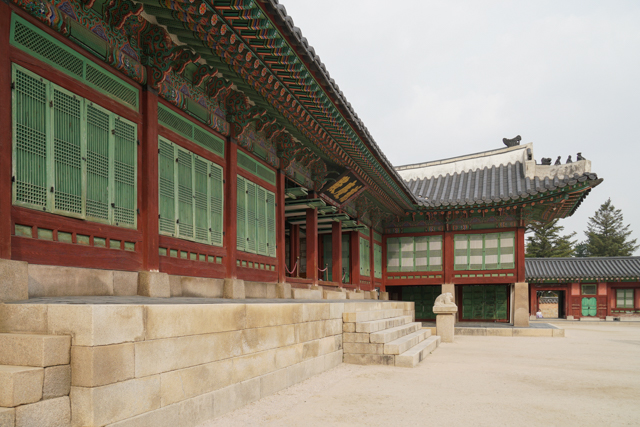
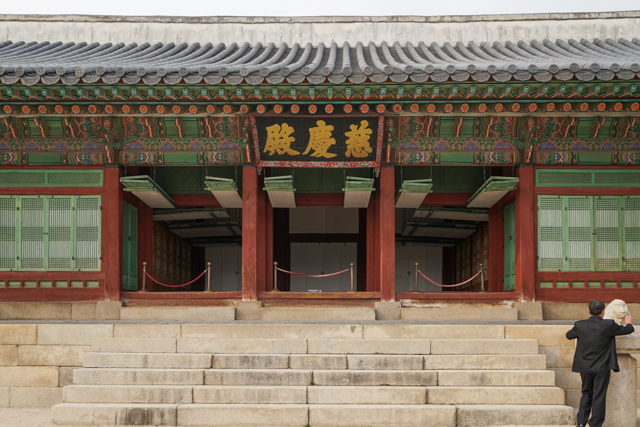
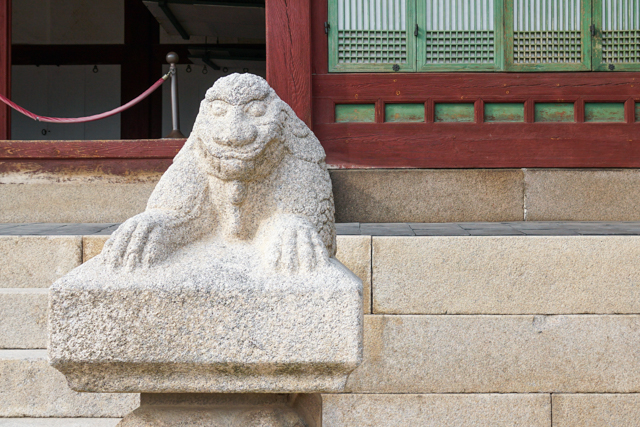
Bogandang, the bed chamber, is situated to the northwest and is heated by ondol. Cheongyeonnu, a pavilion with elevated floor for use in the summer, is to the southwest. There had been a number of additional walls, and a two-post gate with roof. All that remains is the wall with the ten symbols of long life and the freestanding chimneys in the rear garden, plus the wall with flower and plant designs in the west.
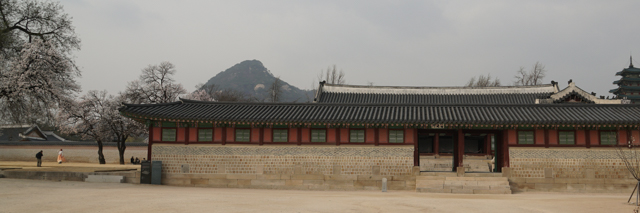
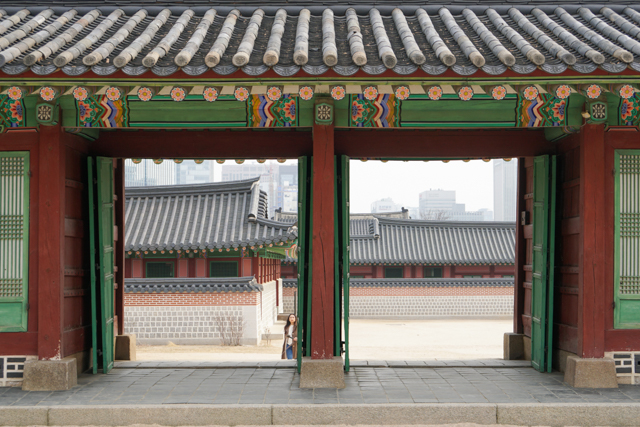
(1) Mansemun of Jagyeongjeon. This is the south gate in the southern wing. The gate occupies the span from the 8 to 10th kan from the west among the 30.5 kan of the corridor.
The gate is so arranged as not to give a change to the overall height of the corridor. The gate structure with four entrances covers 3 kan. This style can be found in the Seonpyeongmun Gate in the southern corridor in front of the Daejojeon Hall in the Changdeok Palace. This suggests the possibility that a gate of this style may have once served the Gyotaejeon Hall, the queen’s residence, adjacent to the Jagyeongjeon. South gates to royal bed chambers were generally in this style.
(3) The Chimneys of the Jagyeongjeon. On the upper part of the chimneys which are 381cm wide, 236cm high, and 65cm long, there is a dragon and on the right and left side of it, bricks with a crane design are inserted. In the middle there is the sun, a mountain, cloud, rock, pine tree, turtle, crane, the sea, a deer, grape, lotus, bamboo, and an herb which gives immortality to man, etc. On the lower part, there are two Haetae images, and on the right and left side there is a bat and an arabesque design.
The dragon symbolizes the king, the crane subject, the sun the rock, and the turtle, etc. longevity, the grapes many offsprings, the bat wealth, and the Haetae warding off evil.
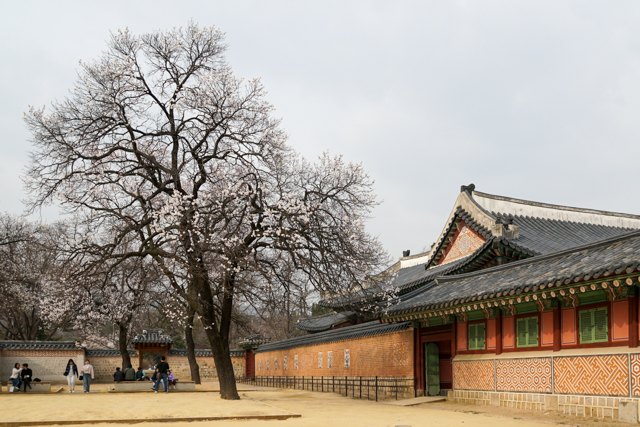
(4) The Wall of the Jagyeonjeon. The western wall of the Jagyeongjeon, made of yellow bricks, is very beautiful. The rear side of it is decorated with the Chinese character “萬壽”(Mansu), a lattice work, a plum, an octagon, etc. and the outer side with a peach, chrysanthemum, bamboo, butterfly, lotus, etc., from which one may infer how excellently the walling then constructed.
7. Donggung and Vicinity
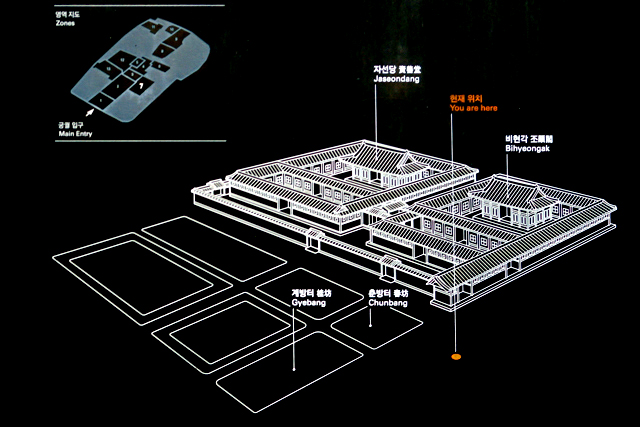
Donggung or East Palace was intended for the crown prince. The crown prince was regarded as a rising sun, and for this reason his palace was built to the east of the king’s palace. Donggung Palace included not only a residential area but also government offices in charge of education, protocol and state affairs for the crown prince. Jaseondang Hall was a residential area for the crown prince and his consort, while Bihyeongak Hall was where the crown prince attended to state affairs. During the Japanese occupation, this area was badly damaged. Jaseondang Hall was moved to Japan and burned down there during the 1923 Great Kantō Earthquake. Only the foundation stone was returned from Japan. The buildings we see here were restored in 1999.
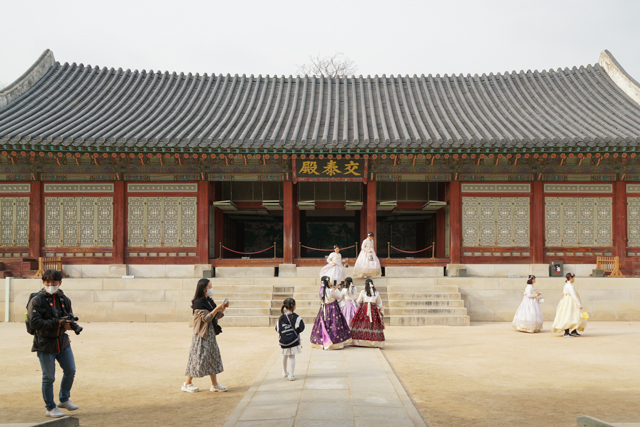
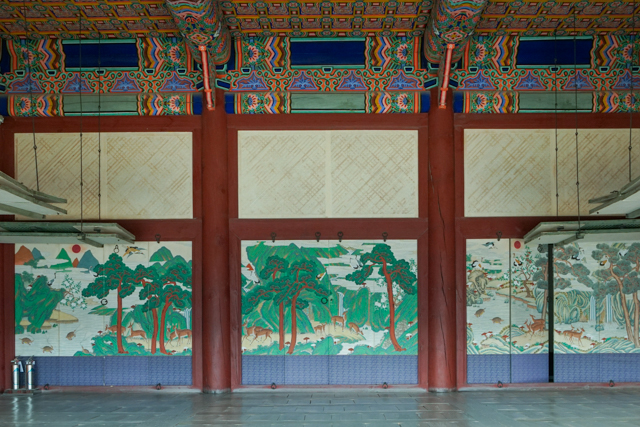
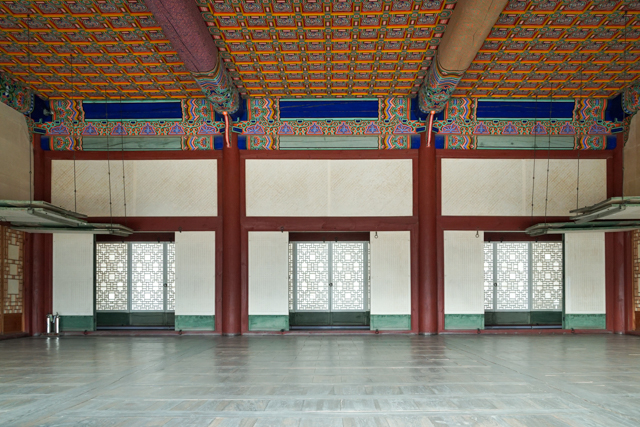
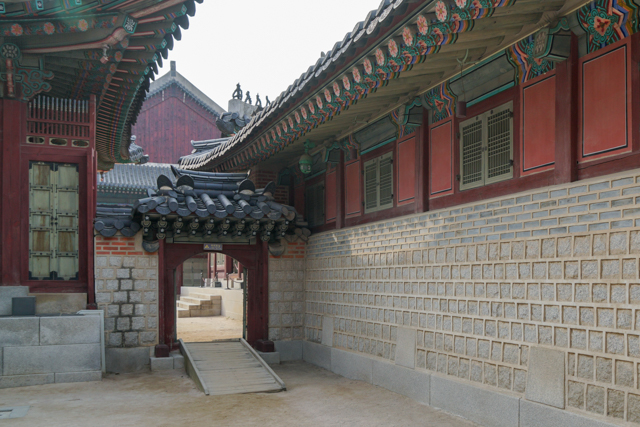
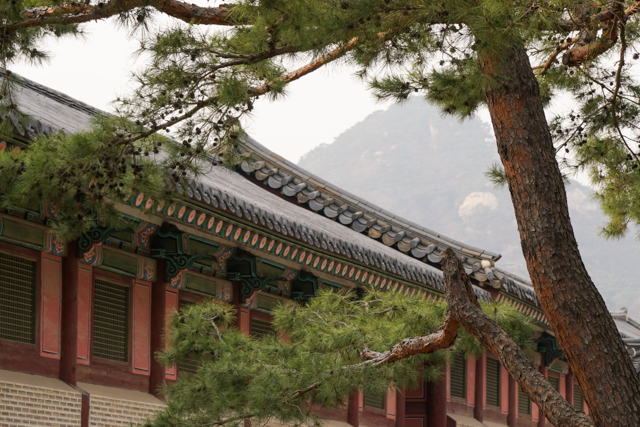
8. Hamhwadang, Jipgyeongdang and Heungbokjeon
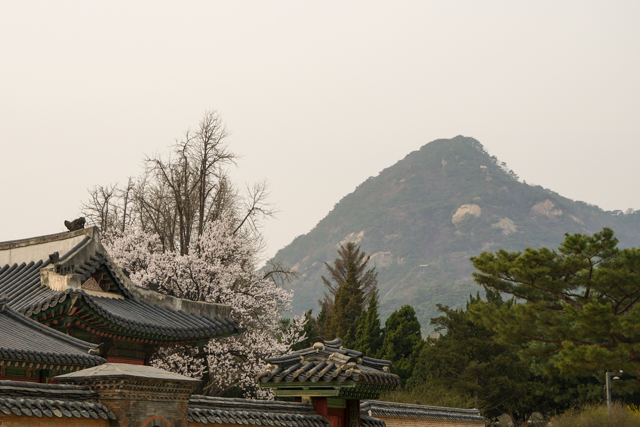
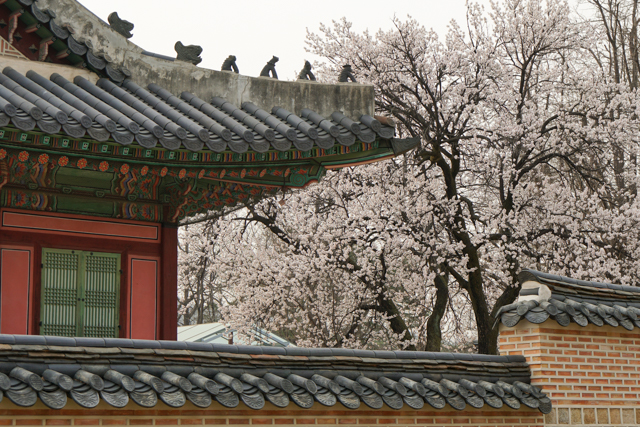
9. Hyangwonjeong Pavilion and Geoncheonggung Residence
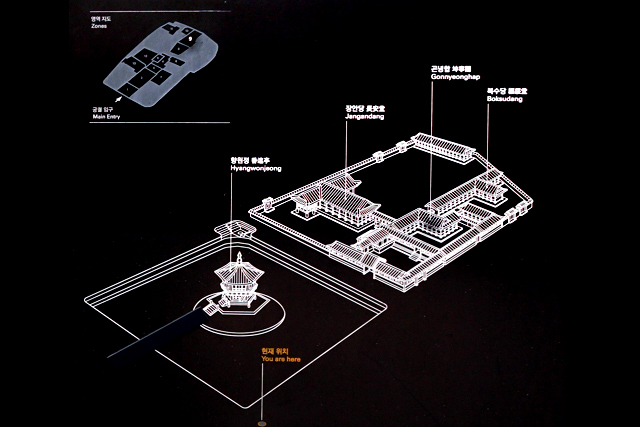
In 1873, King Gojong(r. 1863-1907) built Geoncheonggung Palace in the northern part of Gyeongbokgung to assert his political independence from his father, Prince Regent Heungseon. This northern palace included quarters for the king and several bedrooms. A tragic chapter in Korea’s history was recorded here in 1895 when the Japanese assassinated Empress Myeongseong. The garden here had been developed as a rear garden of the concubines’ quarters. Originally, Chwirojeong Pavilion stood on the islet at the centre of the pond and was replaced by a hexagonal pavilion named Hyangwonjeong when Geoncheonggung was built.
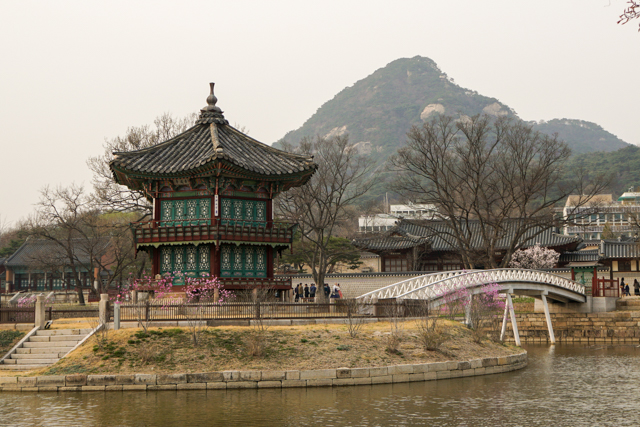
There was once a hall called Jangandang Hall north of the Hamhwadang Hall. As the northern corridor of this building was near the northern palace, one soon reached the Gyemumun, a secret gate to the palace, once one left the corridor. There was the Konnyonggak Pavilion east of the Jangandang, and there was the Boksudang Hall north of the pavilion. There is a pond south of this hall’s southern corridor, namely, south of the Geoncheonggung Palace. There is an isle in the centre of the pond. A hexagonal two-story pavilion named Hyangwonjeong perches on the isle. At present we can reach the pavilion through a wooden bridge in the south. But the bridge was once located in the north for crossing the Geoncheonggung Palace. The bridge is called Chuihyanggyo.
(1) The Hyangwonji Pond and Chuihyanggyo Bridge
Constructed in 1456, the Hyangwonji Pond belongs to the rear garden of the Gyeongbok Palace. It can be also found in an ancient Korean chronicle. According to the record, the pond was built along with the Chuirojeong Pavilion, and lotus flowers were planted in it.
The existing pond was reconstructed in 1873, and the hexagonal pavilion of Hyangwonjeong and Chuihyanggyo Bridge were built then. The area of the pond is 4605 square meters.
Waterweeds can be found there along with carp swimming in the pond, by which trees, including zelkova, chinese juniper, maple, pine, oak, pear, etc. stand.
On the island in which the Hyangwonjeong Pavilion is erected shrubs, including royal azaleas and maple trees grow, and south of the pond, one finds a stone pond with “荷池”(Haji) inscribed on the side and there are also stone tables here.
The water of the pond springs up from the northern hill and the well called Yeolsangjinwon. The pond is at its most spectacular when the Mt. Bugaksan, the pavilion painted in diverse colors, and the wooden bridge are reflected on the water in the pond.
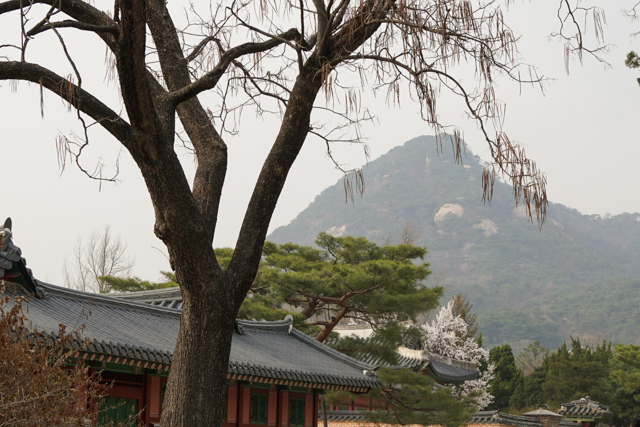
11. Tawwonjeon and Vicinity
12. Gyeonghoeru
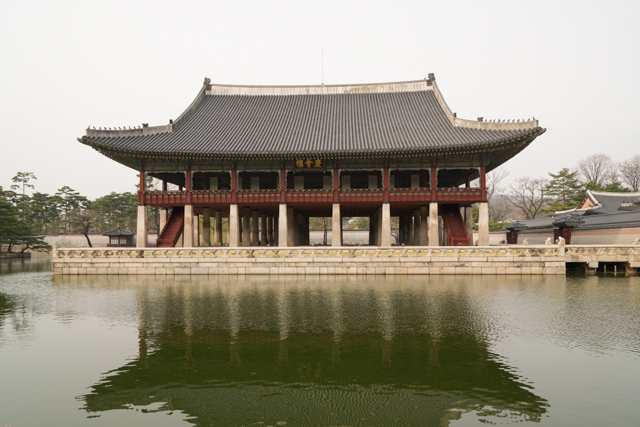
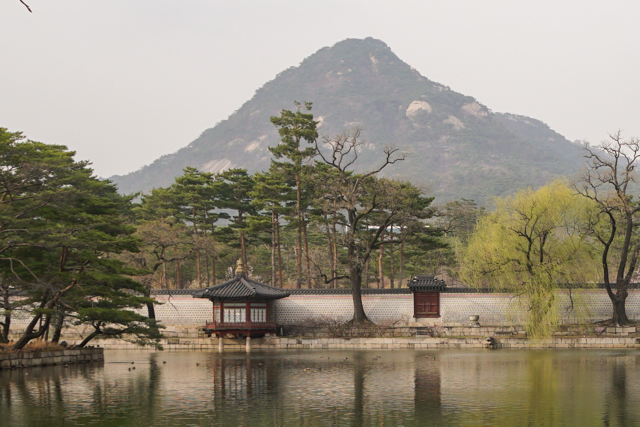
King Taejo, founder of the Joseon kingdom and builder of Gyeongbok Palace, had this pavilion erected in this man-made lake in the western section of the palace. He named it Gyeonghoeru, or pavilion of Joyous Meeting. It is now the largest elevated pavilion in Korea. King Taejong (r.1400-1418) commissioned Park Ja-cheong to supervise construction on the pavilion and the lake. Minister Park built a square island supported by long stones and constructed the larger pavilion. Forty-eight stone pillars, sculptured with dragons, supported the second floor.
Two more islets were made in it. During the Japanese aggression in 1592, the original Gyeonghoeru Pavilion was burned down, leaving only the stone supports. When Gyeongbokgung was built in 1867, the fourth year of the reign of King Gojong, the pavilion was reconstructed. The pillars were replaced by new ones that lack the splendor of the former. But animals were carved on the stone bridges and railings. There are such stone structures as the Lotus Pond, Lotus Platform, and dragon-shaped conduits along the lake. This pavilion was used for royal banquets during the Joseon period and is used today for special functions.(National Treasure No.224)
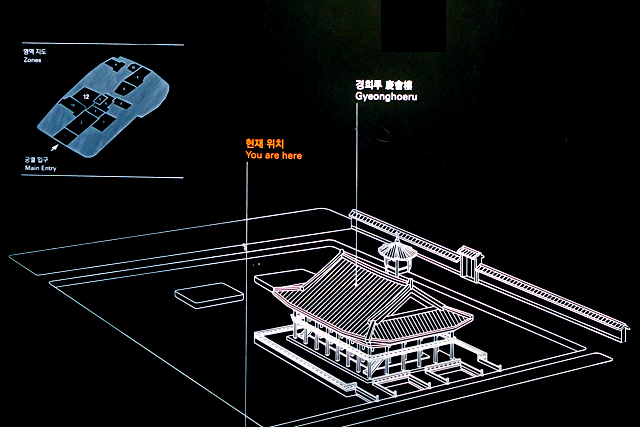
(1) Fire-Eaters in Gyeonghoeru Pavilion
It was believed in the old days that there was a beast which engulfed fire. It resembled an elephant but possessed many features that caused it to be reversed as a deity.
The most dreadful thing for a wooden building is fire. The revered beast was called a Bulgasari. The animal was erected on the stone railings to defend the Gyeonghoeru Pavilion from any approaching flames. It was perhaps due to the protection of the Bulgasari that the Gyeonghoeru Pavilion remained intact throughout heavy artillery fire during Korean War. Though struck by the splinters, the animal kept the edifice from a disaster. There are images of various other auspicious animals along the stone bridges.
(2) The Square Pond of the Gyeonghoeru Pavilion
Located to the west of the Chimjeon in which the royal couple led their life, the square pond of the Gyeonghoeru Pavilion was made for the purpose of holding a party, enjoying boating, and greeting foreign emissaries visiting the country. The pond is 113m wide and 128m long. There are also three round islands in it. The easternmost and largest of them is connected with the land by three beautiful stone bridges to the grand Gyeonghoeru Pavilion. The water of the pond springs up from underground, and the water from the pond of Hyangwonji flows into the pond through the dragon headed waterway on the eastern bank of the pond, which looks a fall. There is another waterway in the shape of a dragonhead on the northern bank.
According to an ancient chronicle recorded in 1506, to the west of the pond, was the mound of Mansesan with many beautiful flowers and small replicas symbolic of palaces, including Bongnaegung, Ilgung, Wolgung, and Byeogungung, decorated with gold, silver, and silk. The king enjoyed boating on the boat called Hwangyongju in the pond with lotus flowers and coral in it. Sometimes candle lamps in shape of flowers and animals which were decorated with gold and silver, floated on the water in the pond, and incense fires made the pond as bright as day even at night. To the west and the north of the pond, there were zelkova trees and pinetrees. The square pond of the Gyeonghoeru Pavilion is representative of the garden pond constructed in the Joseon kingdom in beauty, scale, and landscape.
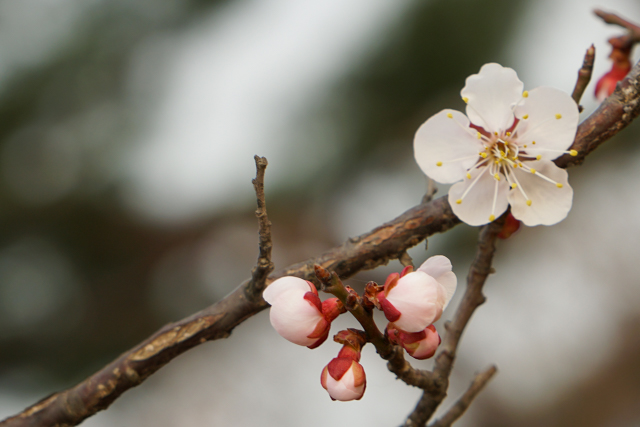
13. Sujeongjeon and Gwolnaegaksa
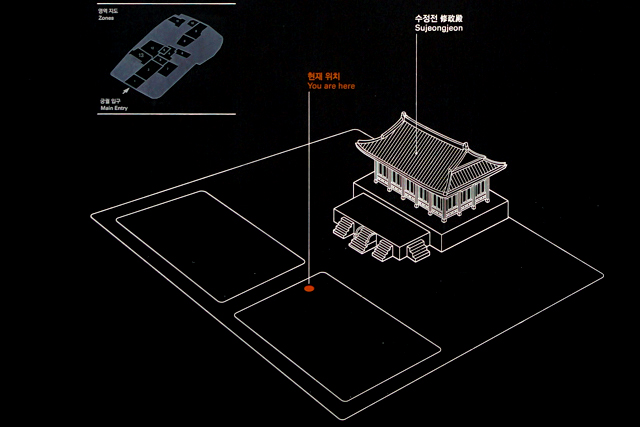
Government units engaged in royal family affairs were built within the palace and collectively referred to as Gwolnaegaksa. Many small buildings to accommodate guests, messengers, censors, medical officials and a dispensary once stood to the west of Geunjeongjeon Hall. Jiphyeonjeon, or the Hall of Worthies, was originally built here by King Sejong. This was where Hangeul, the Korean alphabet, was invented. Rebuilt in 1867, its name was later changed to Sujeongjeon. This place was visited by the king so frequently that a double stone platform was built in front as a mark of respect. Sujeongjeon was used as the cabinet office during the Reform Movement of 1894.
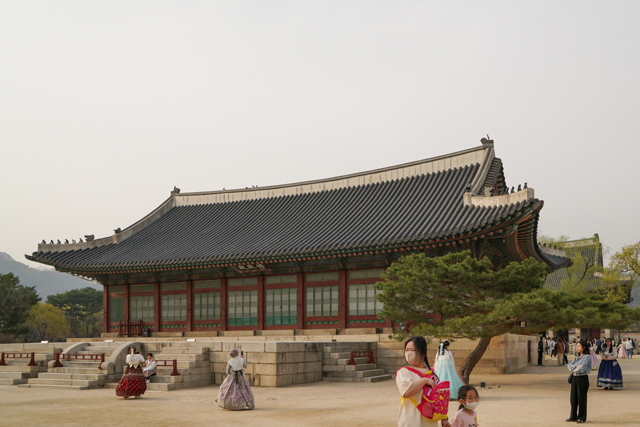
King Sejong constructed the Borugak and the Heumjeonggak south of the Gyeonghoeru Pavilion and west of the Cheonchujeon Hall. He also built the Jiphyeonjeon. On the site where these buildings were located, King Gojong constructed the Sujeongjeon Hall in 1867 after they were burnt during the Japanese invasion in the 16th century. This is the largest among Gyeongbok Palace buildings in the private quarters that are extant. It is 40 square kan. Its eastern corridor is 13 kan long and its western corridor is 9 kan long.
It was once used as the Office of Gungukgimucheo during the Daehan Empire period. After 1895, it was used as the cabinet office. In the neighborhood, there were many small buildings to accommodate guests, messengers, censors, a dispensary, medical officers, etc. But they were all demolished, and only Sajeongjeon Hall remains.
14. Sojubang and Vicinity
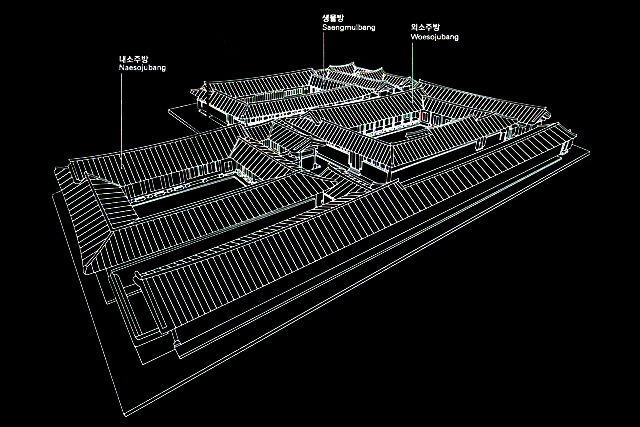
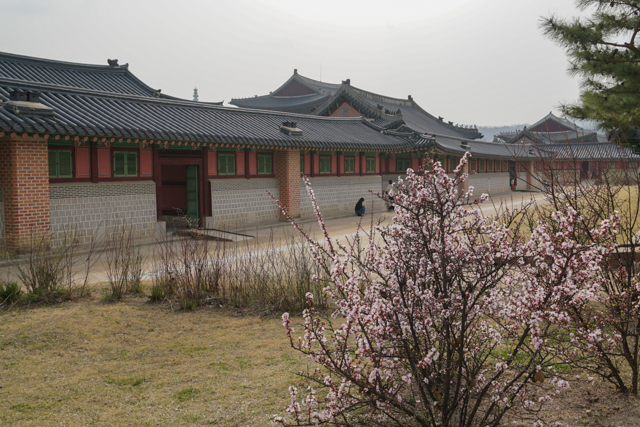
Sojubang is Royal Kitchen where the king’s breakfast and dinner and foods for royal banquets are prepared. Sojubang complex is composed of three quarters ; Naesojubang, Woesojubang and Saengmulbang. Naesojubang is the kitchen for king’s daily meals, Woesojubang is the kitchen for royal banquets and ancestral rites. Tea, sweets, porridge, fruit, and rice cakes were prepared in the Saengmulbang. It was built during the 4th year of the reign of King Taejo in 1395, but all of the buildings of Gyeongbok Palace, including the kitchen, were burned down or badly damaged during the Japanese Invasion of 1592. The buildings were rebuilt in 1867 (during the 4th year of King Gojong’s reign), but the kitchen was later demolished to provide space for the Joseon Production Promotion Exhibition held by the Japanese colonialists in 1915. Restoration of current Sojubang site was started in 2011 and completed in 2015.
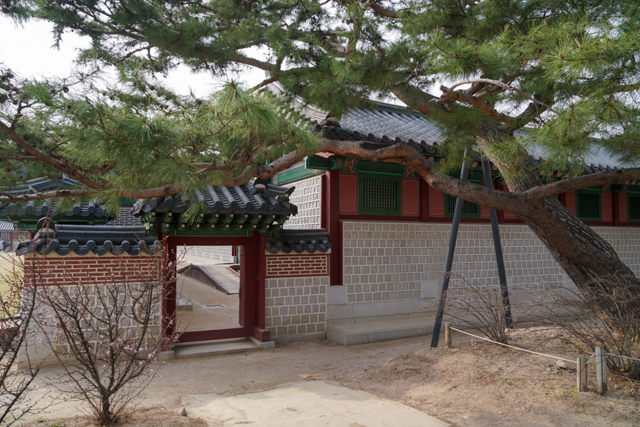
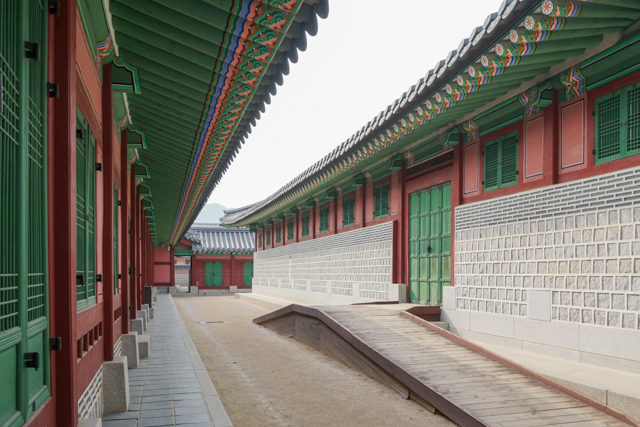
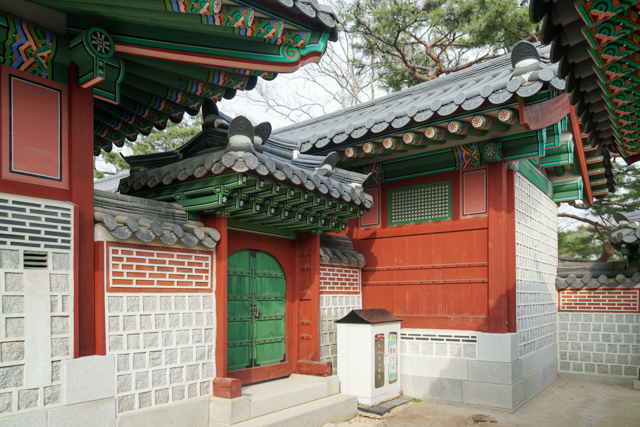
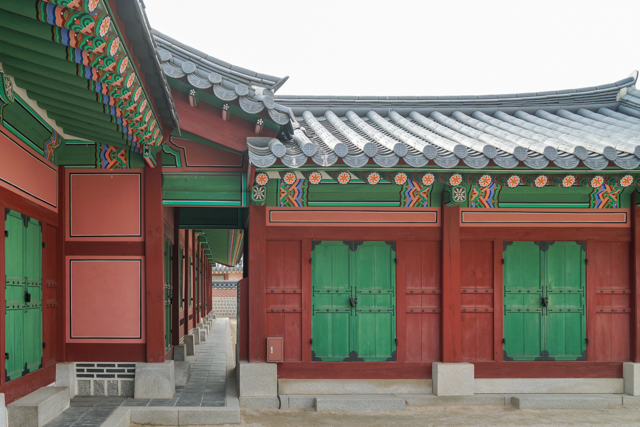
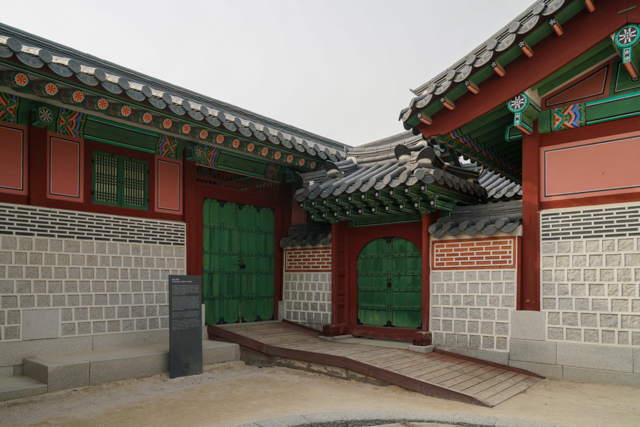
Naesojubang, known as the Ansojubang, or ‘Inner royal kitchen,’ is where food was prepared and cooked for the main meals, including breakfast, lunch and dinner, that were served to the kings and queens of Joseon. Royal meals were prepared by top-grade cooks with only the very best ingredients, which included special and rare local products brought to the capital from all around the country. The meals prepared in this royal kitchen were arranged on three tables. Daewonban(a large red-lacquered round table). Sowonban(a small round table). Chaeksangban(a square table), of which the last was used to cook a hot pot. or jeongol. consisting of meat and fresh vegetables.
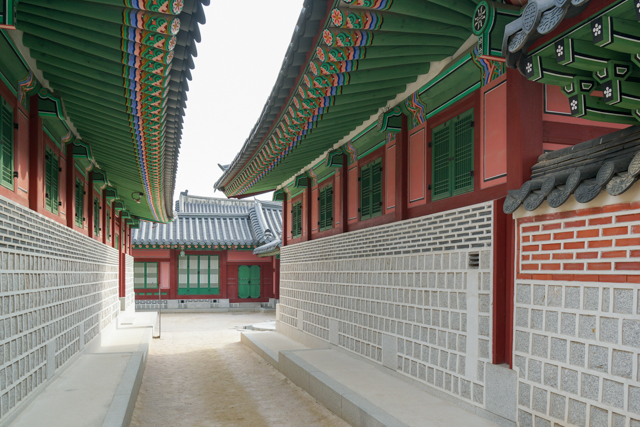
Saengmulbang (refreshment room) known by several different names such as Bokhoedang (blissful gathering hall), Saenggwabang(fresh fruit room), and Saenggeotbang(fresh food room), was the royal kitchen in which desserts or snacks, largely consisting of fresh or cooked fruits, confections, tea, punches and porridge, were prepared for the kings of Joseon. Besides the meaning of animals and plants alive, Saengmul also means making various foods. The refreshments prepared in this part of the royal kitchen were sometimes carried to the Naesojubang or Oesojubang.
Jung-gu
Myeongdong
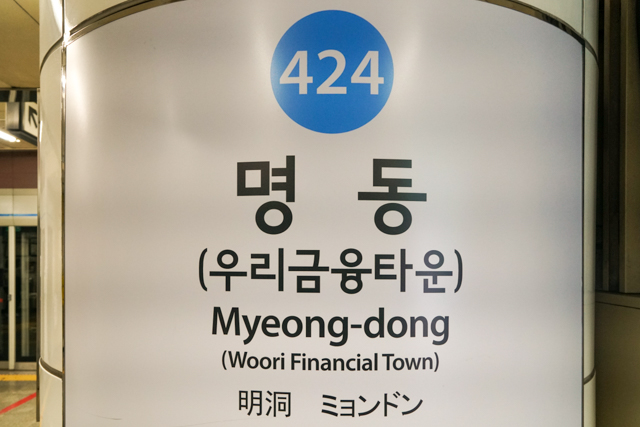
Exhausted, we caught the subway back from Anguk to Myeongdong after a brief stop at the Daiso.
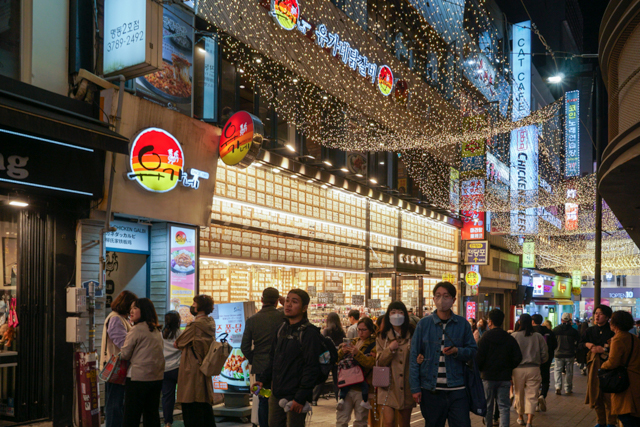
McDonald’s
맥도날드, 43 Myeongdong-gil, Jung-gu, Seoul, South Korea
Being a Saturday night meant that almost all the restaurants in the Myeondong area had long queues outside their doors. So, always eager to dry the regional menu items at McDonald’s overseas, we headed over to store near our hotel for dinner.
The upside of COVID-19, has meant a significant increase in the use of self-serve kiosks for ordering. These kiosks seemed to make English menus much easier to implement, and McDonald’s was no exception.
When weopted to dine-in, rather than order takeaway, in Korea, the shop provided our drinks in a reusable plastic cup (to be returned to the store), with a disposable sip lid. We appreciated that, unlike in Australia, we didn’t have to deal with paper straws that have trouble holding up to liquid.


This was D’s Shrimp and Beef Burger, which was a regular beef burger with an additional shrimp patty. He enjoyed the generous amount of shrimp in the patty.
This was by Bulgolgi Burger, which looked rather sad like the regular cheeseburgers in Australia. While I enjoyed the sweetness of the bulgogi sauce in the first few bites, by mid-burger it had overwhelmed the savoury aspect of the beef patty. It had a distinctly Asian flavour and was similar to the Teriyaki Burger in Japan, which had a touch more savouriness to balance.

Finally, the Jeju Hallabong Chiller was our favourite item of the evening. Hallabong is essentially Korea’s name for a Japanese dekopon of which we’re huge fans, so the result was, of course, a tasty citrus chiller with bright sweetness and restrained, balancing acidity. This would be an item we’d go out of the way to try again when visiting South Korea.
Seoul – Changdeok Palace, Bukchon Hanok Village, National Folk Museum of Korea, and Gyeongbok Palace was Day 4 of 6 in the South Korea 2023 trip. Day 5 saw us exploring more of Seoul – Insa-dong, including the Gongpyeong Historic Sites Museum, Haribo World and Museum Kimchikan.