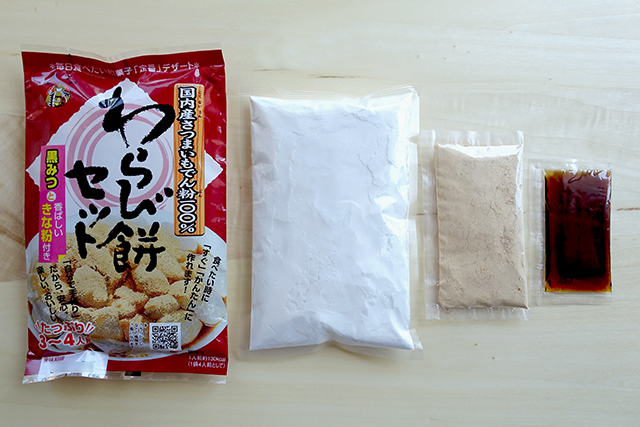
Warabi mochi is a jelly-like Japanese confection that’s often sold from food trucks and popular in the summertime in the Kansai region and Okinawa. Unlike true mochi, which is made from glutinous rice, warabi mochi is made from bracken starch (hon warabiko, but often substituted with the starch of sweet potato (warabi mochi ko) as the former is difficult to harvest and very expensive) and often served covered with toasted soybean flour (kinako) and brown molasses (kuromitsu).
Here, we have a Maehara Seifun Kuromitsu Kinako Warabi Mochi Set.
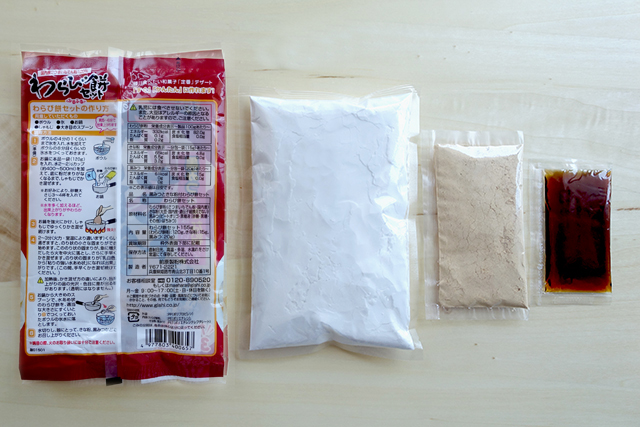
The set includes enough warabi mochiko, kinako and kuromitsu for 3-4 servings of warabi mochi. Of course, the ingredients can be also bought separately at Japanese grocery stores. While popular in Japan, warabi mochiko may be difficult to find in general Asian grocery stores and hon warabiko may be difficult to find in even Japanese grocery stores.
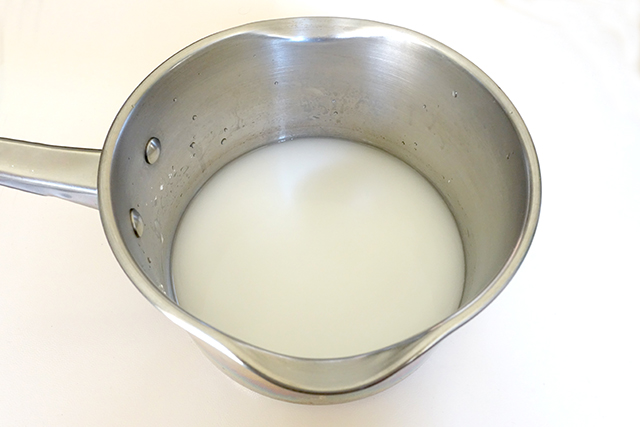
To make the warabi mochi, add the 120 gram bag of warabi mochiko with 3-4 tablespoons of sugar to a pan with 400-500 mL of water (depending on the desired firmness for the warabi mochi) and stir until the mixture is smooth with no lumps. I added 450 ml, so it’s neither too soft or firm.
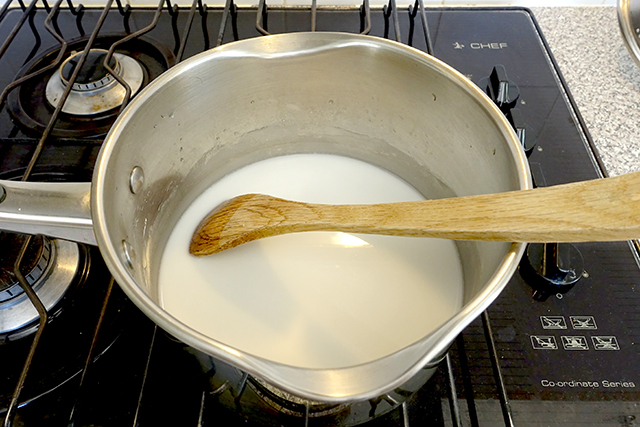
Place the pan with the mixture over high heat and stir slowly.
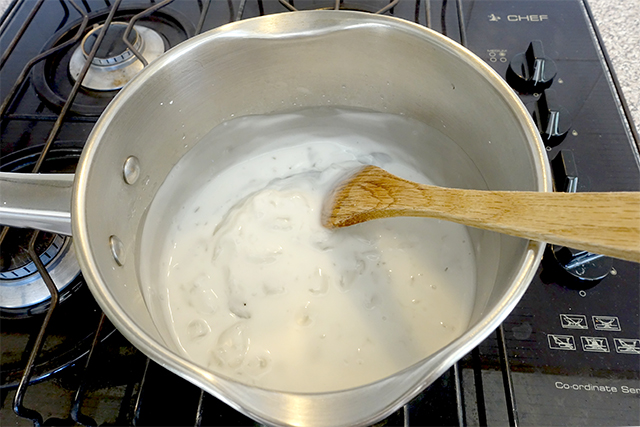
After 2-3 minutes of slow stirring, a small paste-like mass begins to form in the pan.
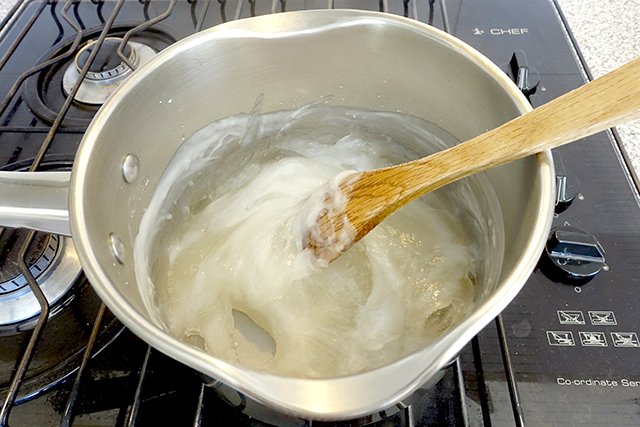
Reduce the heat to stop the mass from enlarging too quickly and stir quickly.
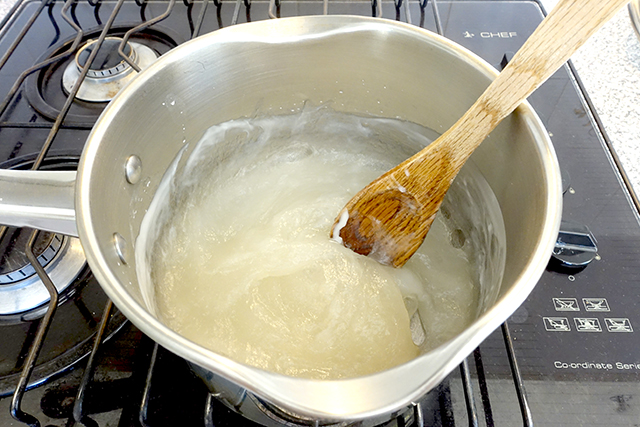
Continue stirring quickly until it reaches the consistency of a ckear and sticky paste. Then it’s ready!
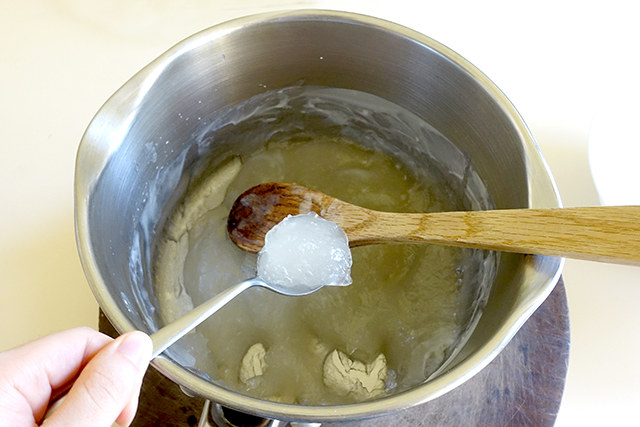
Off the heat, drop spoons of the sticky watery warabi mochi into a large bowl of ice water prepared earlier.
Alternatively, at this stage, you can transfer the warabi mochi onto a baking tray dusted with kinako, dust with more kinako, cool it in the fridge for 20 minutes, then cut it into 1-inch cubes. This method is suggested on the pamphlet inside the packaging and yields a neater final product, but I’m using the spoon method as I’m following the instructions on the back of the packaging.
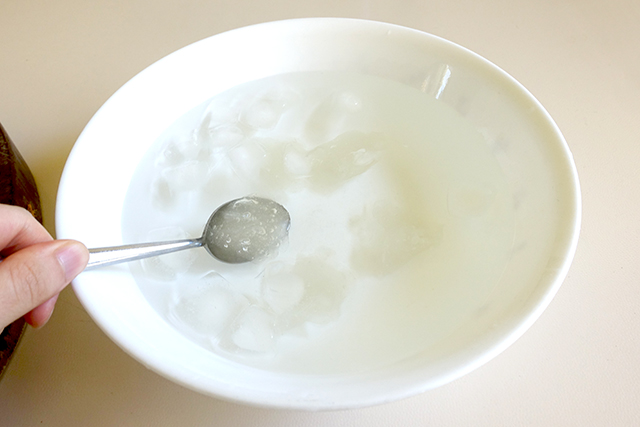
A teaspoon is perfect for creating bite-size pieces of warabi mochi.
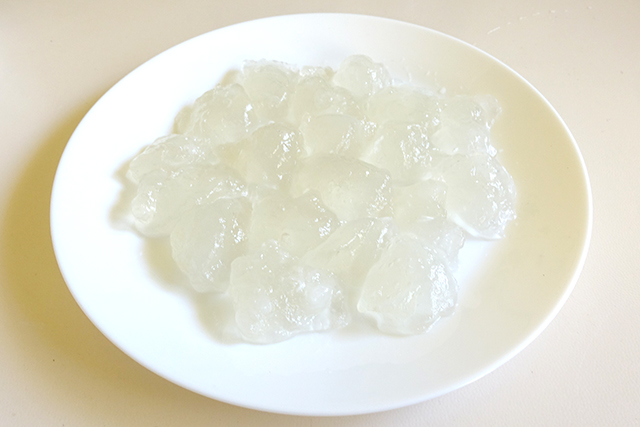
After transferring the warabi mochi into the ice water, drain warabi mochi and its ready for some condiments.
The colour of this warabi mochi is not crystal clear as you’d find in that made with true bracken starch. This warabi mochi uses sweet potato starch.
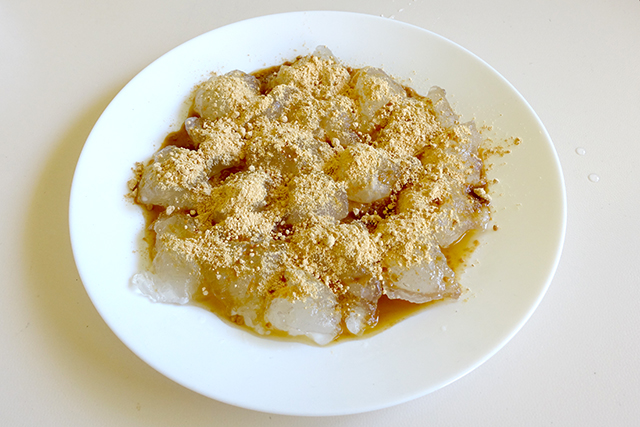
Dust the sachet of kinako over the warabi mochi, then drizzle the sachet of kuromitsu.
As with true mochi, the warabi mochi is a textural experience that has no flavour of its own, so condiments are quintessential to the eating experience. Kuromitsu and warabi mochi are a complementing match, with the former bringing the sweetness and the latter lending a delicious nutty flavour. The warabi mochi has a jelly-like, chewy texture that slightly slippery and dissolves quickly in your mouth. The coolness of the warabi mochi and its water-like translucency makes it a refreshing summertime snack.
The warabi mochi will keep at room temperature for 1-2 days, but it should not be kept in the refrigerator as it’ll harden and whiten.
This Maehara Seifun Kuromitsu Kinako Warabi Mochi Set contained 155 g including bracken starch (warabi mochi ko), soybean powder (kinako) and brown molasses (kuromitsu). It was produced in Japan and purchased in Sydney, Australia in 2016.